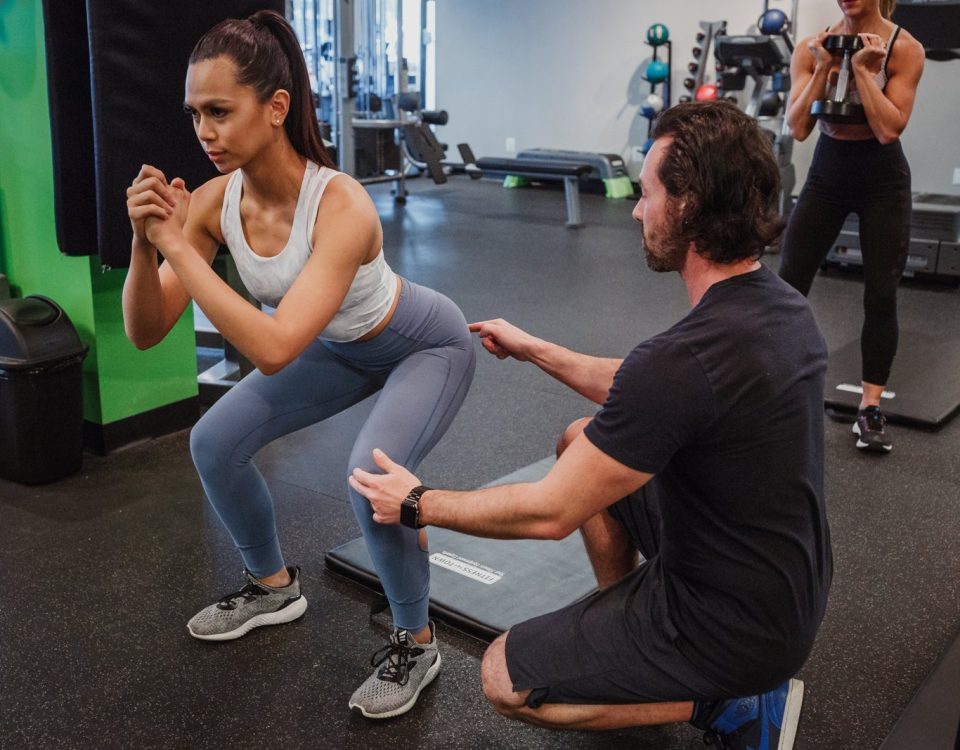
The seawall is not a strength program.
By David Turnbull, BCRPA Certified Personal Trainer & Founder, TurnFit Personal Trainers
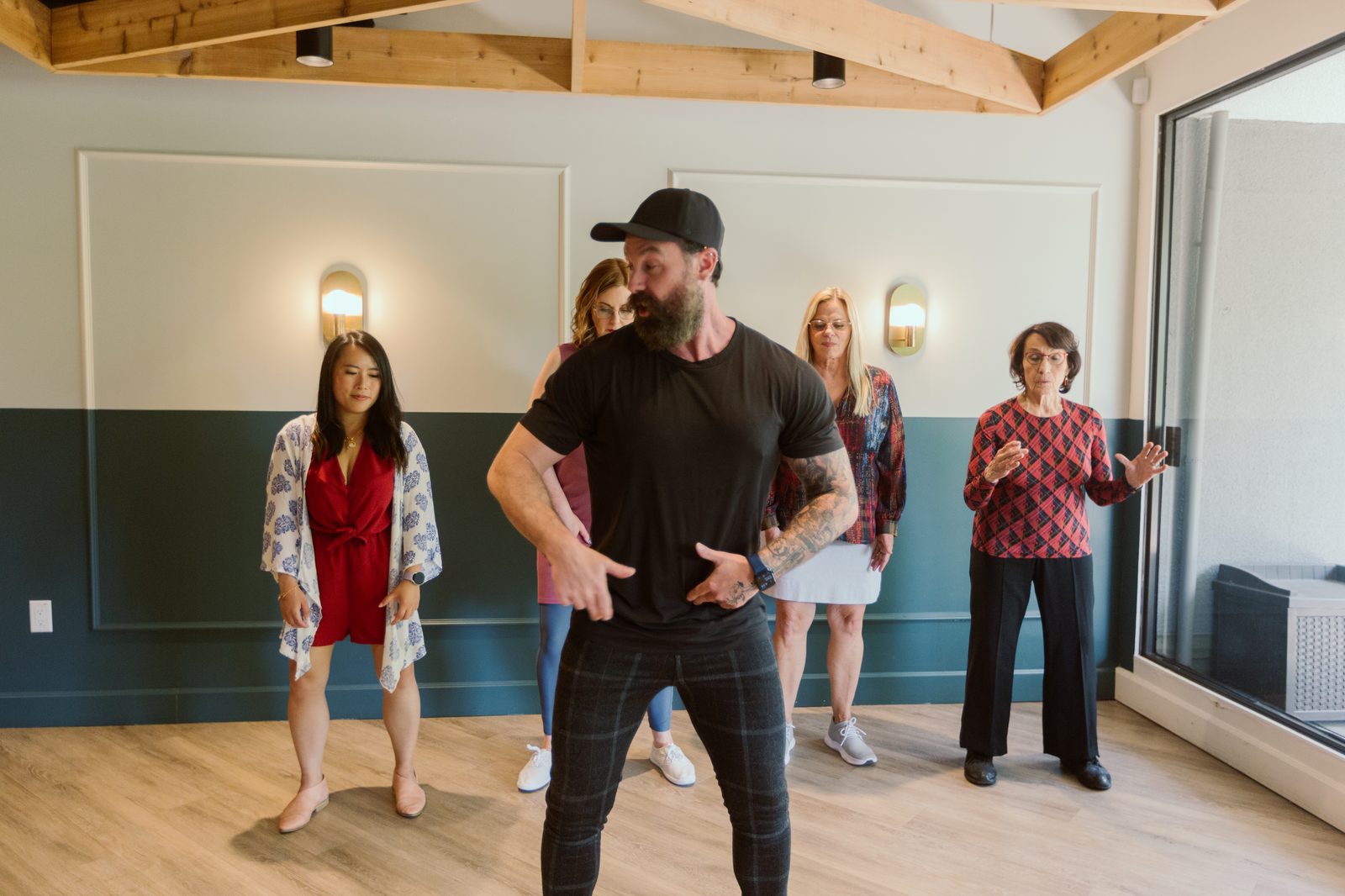
Movement that feels good is still movement — and after 40, it needs a progressive strength chapter too.
She does the Kitsilano seawall four mornings a week — Downtown walks on rainy days — watch buzzing at 8,000 steps before coffee. She also has a yoga mat that has outworked most Vancouver studio waitlists. She stretches. She breathes. She “works out.”
And somehow she is still tired by 3 p.m. Still softening in photos. Still hearing: But I work out.
If that is you in Kitsilano, Downtown Vancouver, or training online — this post is for you. Not because walking and yoga failed. Because walking and yoga aren’t enough after 40 for muscle, bone stimulus, posture under load, and independence. TurnFit coaches women over 40 across those lanes. Keep what you love. Add the missing stimulus.
TL;DR: Walking and yoga are excellent for heart health, mobility, stress, and consistency — and they are not a substitute for progressive strength after 40. Muscle loss (sarcopenia) runs roughly 3–8% per decade after 30; Osteoporosis Canada recommends resistance training 2–3× per week. A 2025 University of Exeter study found resistance training improved strength, balance, flexibility, and lean mass in women 40–60 across menopause status. Keep your seawall walks and your yoga class. Add coached lifting. Fuel with enough protein (TurnFit’s 40/30/30 rule). Ready for a plan? Book a free 5-minute assessment.
Why aren’t walking and yoga enough after 40?
Because after 40, muscle and bone need progressive load — and walking plus yoga rarely provide enough of it. You can be “active every day” and still lose the tissue that keeps you strong, upright, and independent. Activity ≠ stimulus. The seawall trains heart and habit. Yoga trains mobility, breath, and control. Neither systematically overloads major muscle groups the way progressive resistance does.
Like brushing without flossing, then wondering about gums: you are not lazy — you are missing a tool. That is the Vancouver “I already work out” trap: high effort, wrong stimulus. Longevity framing: strength training after 40 and feeling better in your 40s than your 30s.
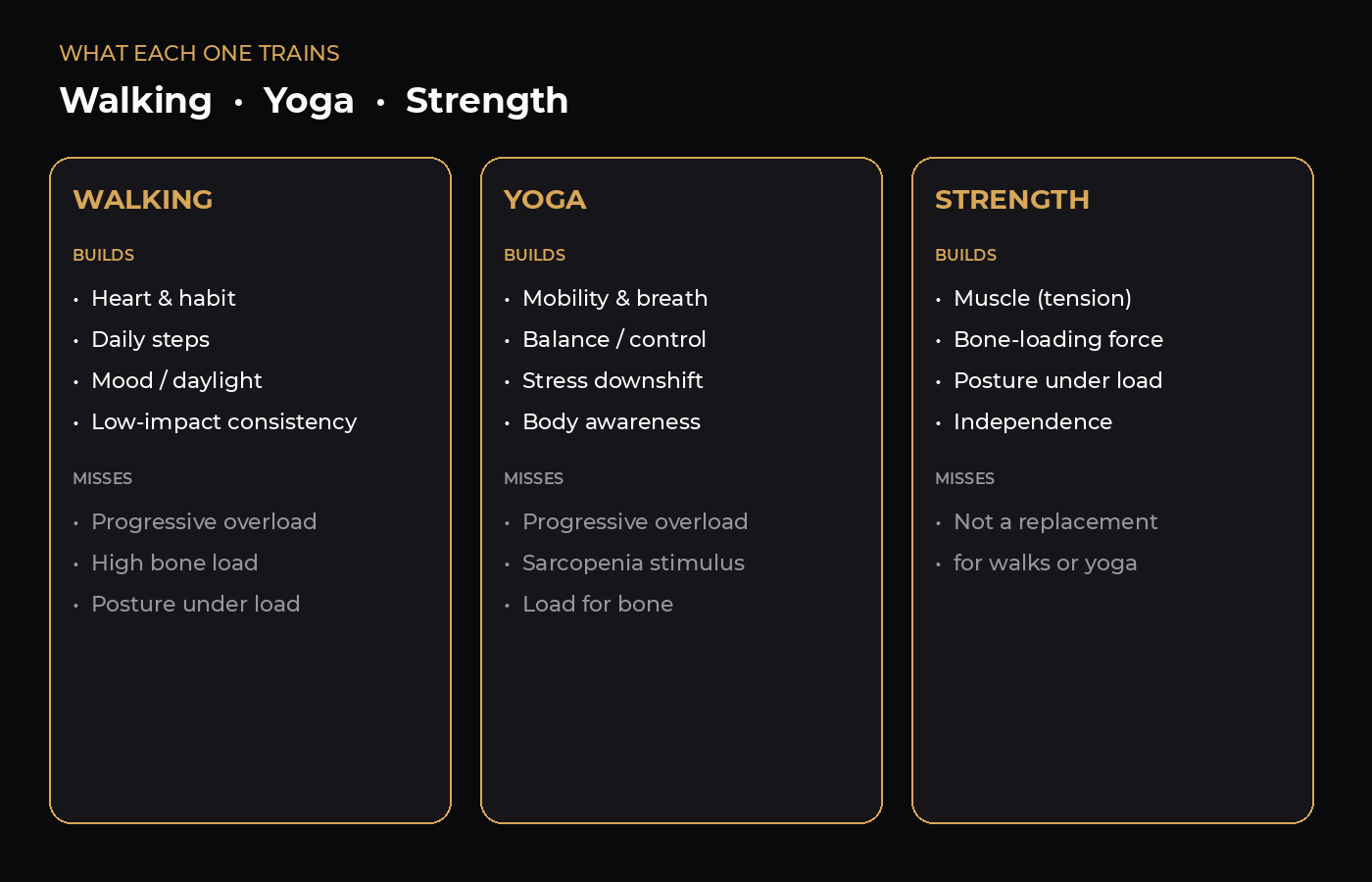
Walking and yoga are gifts. Strength is the chapter they cannot finish.
What does walking actually train (and what does it miss)?
Walking trains cardiovascular health, daily movement volume, mood, and low-impact consistency — and it largely misses progressive overload for muscle and bone. Heart, daylight, gentle rhythm: foundational, not “soft.”
What walking does not do well:
- Progressive muscle overload. Flat pavement is a fixed demand. Legs adapt, then plateau. More steps buy endurance, not strength.
- High bone-loading stimulus. Seawall walking is wonderful — and gentle. Midlife bone often needs more force.
- Posture under external load. Groceries, kids, YVR luggage ≠ a light stroll.
Ten thousand steps can make you healthier. They cannot replace a coached squat, a row for a desk-hunched back, or a hinge that wakes your glutes. Watch congratulations + jeans negotiations = stimulus mismatch, not moral failure.
What does yoga actually train (and what does it miss)?
Yoga trains mobility, balance, breath, body awareness, and stress regulation — and it usually misses progressive resistance for muscle mass and bone density. We love yoga at TurnFit — as a complement, not a punchline. Women who keep Saturday class and add strength feel better than those who make yoga their only workout identity.
Gifts: usable ranges, breath under challenge, quiet holds, a nervous system that can downshift.
Gaps after 40 for most studio formats:
- Limited progressive overload. Longer Warrior II ≠ months of loaded hinges and presses.
- Inconsistent sarcopenia stimulus. Few formats match Osteoporosis Canada’s progressive resistance 2–3× per week.
- “I stretch therefore I train.” Mobility ≠ muscle mass. Calm ≠ bone density.
Protect the practice. Stop asking it to finish strength’s job. See menopause exercise guide and perimenopause strength training in Vancouver.
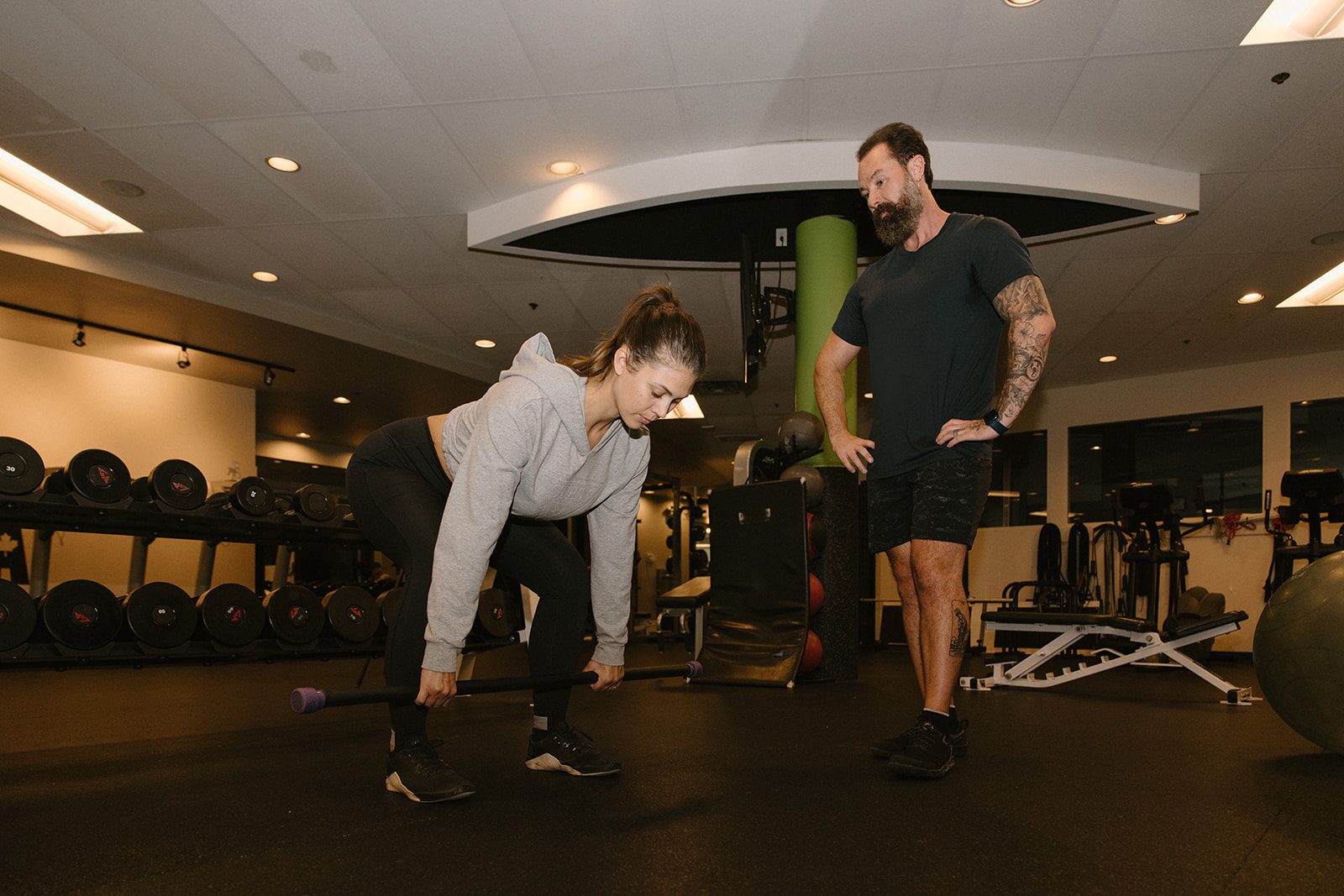
Progressive hinge work builds what walking and yoga rarely overload: posterior-chain strength under load.
What does strength training add that cardio and yoga cannot?
Strength training adds progressive mechanical tension — the primary signal for preserving and building muscle, supporting bone, and rebuilding posture under real-world loads. Cardio moves blood. Yoga moves joints and attention. Strength tells muscle and bone: you still matter; stay.
Coached progressive resistance delivers:
- 1. Muscle that stays. Osteoporosis Canada: sarcopenia ~3–8% muscle loss per decade after 30; menopause can accelerate. Progressive resistance is a primary tool.
- 2. Bone remodeling stimulus. Walks and many yoga flows are low impact. Multi-joint strength applies loading bones respond to. OC’s 2023 CPG: progressive resistance more than twice weekly, plus balance/functional work.
- 3. Posture under fatigue. Rows, controlled presses, braced hinges are posture correction in practice — not “stand up straight” reminders.
- 4. Independence insurance. Off the floor. Catching yourself when the sidewalk wins.
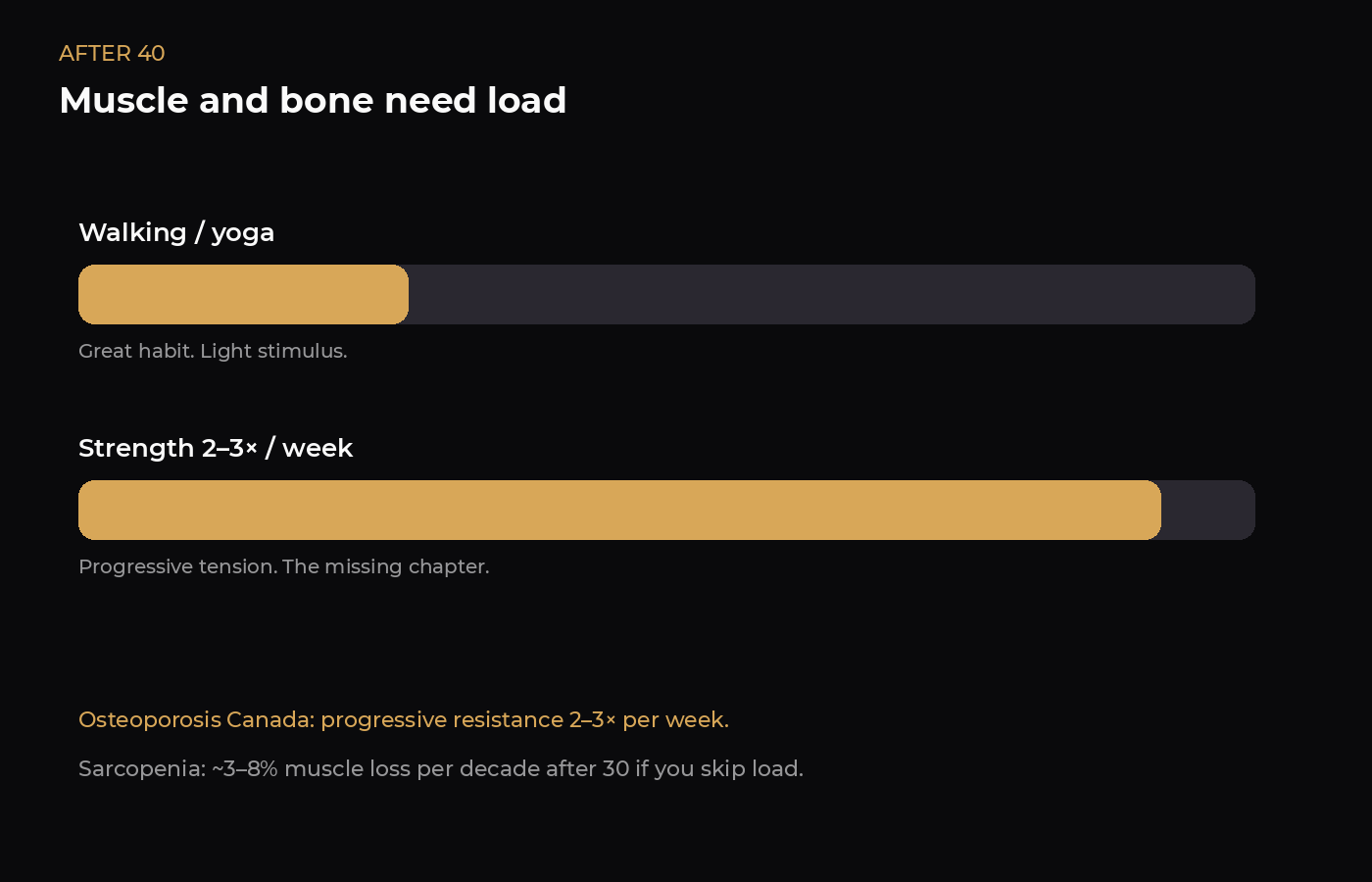
After 40, muscle and bone still listen — they need progressive load to stay.
University of Exeter (2025; Medicine & Science in Sports & Exercise): 12 weeks of resistance training improved hip/lower-body strength, flexibility, dynamic balance, and lean mass in women 40–60 across pre-, peri-, and post-menopause. Not too late. Hormones are not a veto.
Not male biohacking. Capacity, pain-free progression, clothes that fit — looking better is usually muscle + posture. Care-gap context: Canadian healthcare and muscle loss for women 40+.
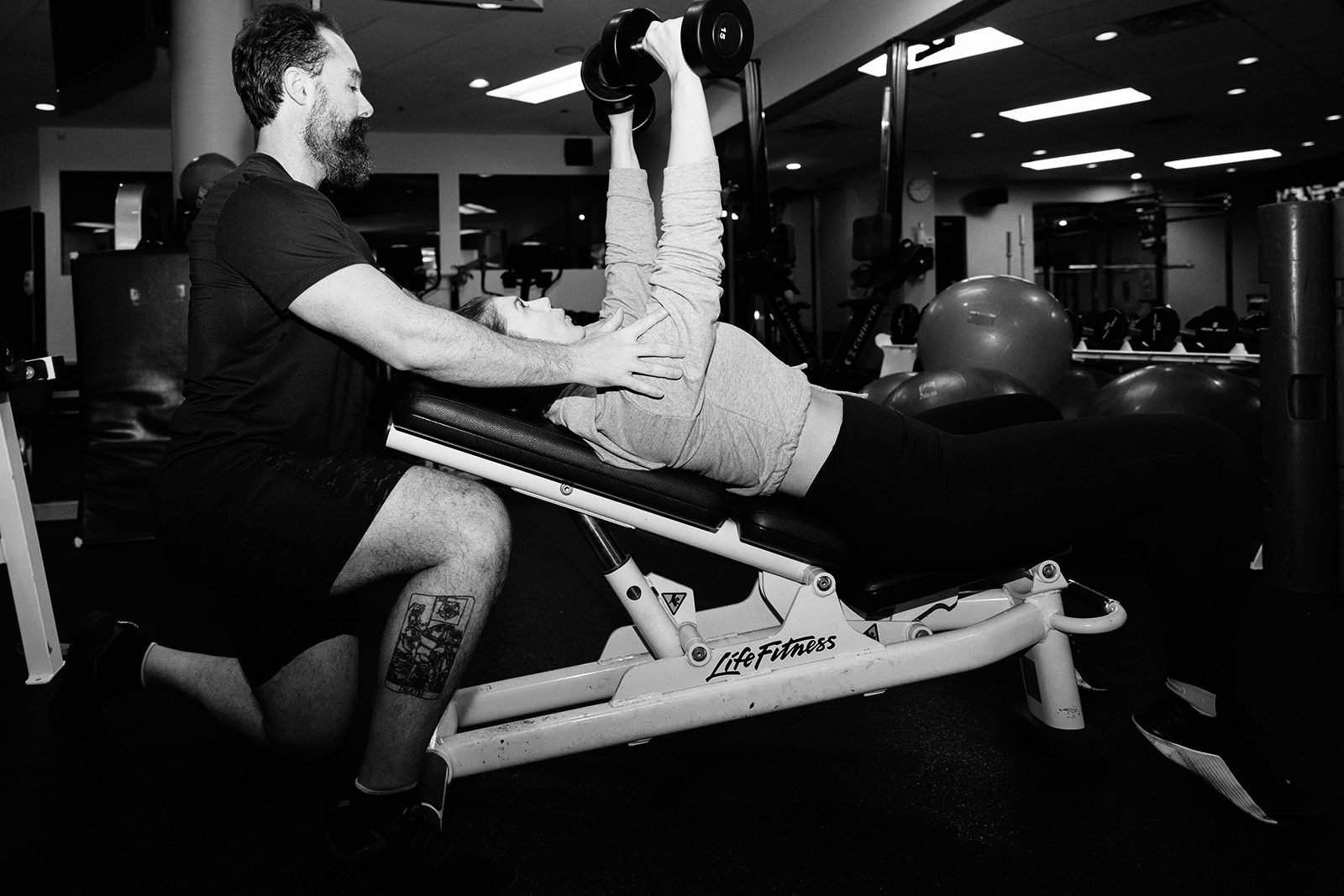
Coached pressing builds upper-body strength and posture — the stimulus a seawall walk cannot provide.
How often should women over 40 lift?
Most women over 40 should lift with progressive resistance about 2–3 times per week — enough to signal muscle and bone without making recovery a second job. Osteoporosis Canada: resistance 2–3×/week; 2023 CPG: progressive resistance more than twice weekly, plus balance/functional training.
A real Vancouver week: 2–3 coached sessions (hinge, squat pattern, push, pull, carry, transferable core); walks that stay walks; yoga that stays yoga; protein that supports the work (TurnFit’s 40/30/30 fuel rule — personalized in coaching, not a medical prescription). Consistency beats intensity.
Can I keep walking and yoga if I add strength?
Yes — keep walking and yoga; add strength 2–3× per week so they stop being asked to finish a job alone. Not a divorce from the seawall — an upgrade to the week. Thrive clients keep what they love; they stop treating “I walked” or “I did yoga” as a complete muscle-and-bone answer.
| Keep | Add | Why |
|---|---|---|
| Seawall / neighbourhood walks | Progressive lifting 2–3× | Heart + habit stay; muscle/bone get load |
| Yoga 1–3× (if you enjoy it) | Coached form and progression | Mobility + calm stay; overload arrives |
| Sleep & stress hygiene | Enough protein | Recovery + fuel make strength stick |
Knee or shoulder history? Reason for pain-free, posture-first coaching — not a reason to skip strength.
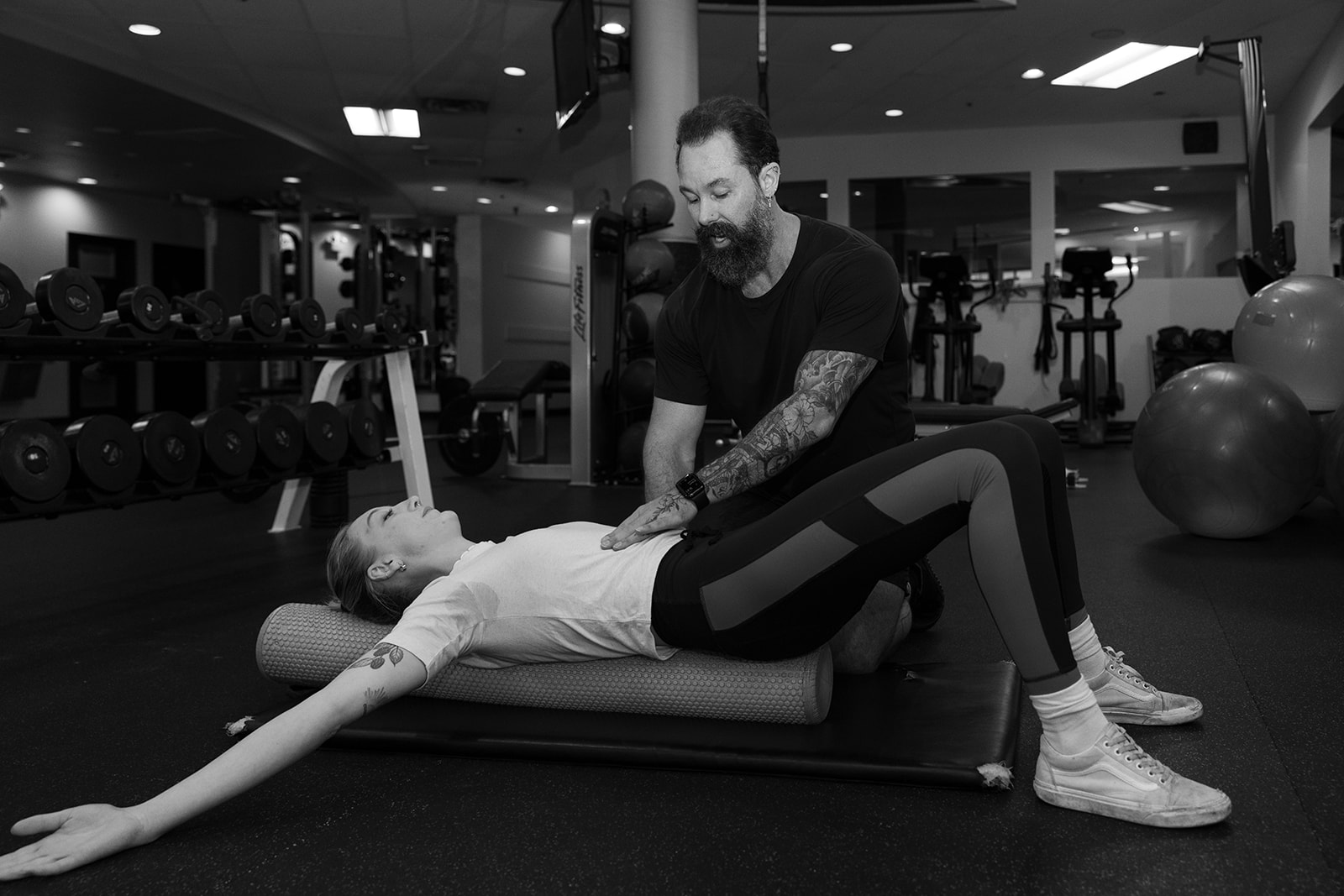
Posture and recovery tools support strength — they don’t replace progressive loading.
Key takeaways
- Walking and yoga aren’t enough after 40 for muscle, bone stimulus, and load-bearing posture — even when excellent for heart, mobility, and stress.
- The seawall is not a strength program. Your yoga mat is not a barbell. Both still deserve a place in your week.
- Sarcopenia: roughly 3–8% muscle loss per decade after 30; menopause can accelerate (Osteoporosis Canada).
- Progressive resistance 2–3× per week is the practical Canadian-aligned minimum for midlife muscle (plus balance/functional work per OC’s 2023 CPG).
- Exeter 2025: resistance training improved strength, balance, flexibility, and lean mass in women 40–60 across menopause status.
- Plan: keep walk + yoga → add coached strength → fuel with enough protein.
- TurnFit: Kitsilano, Downtown Vancouver, online — book a free assessment.
FAQ
Is yoga strength training?
Sometimes a little; usually not enough. Yoga builds control, mobility, and isometric endurance. Progressive strength systematically increases load so muscle and bone adapt. Enjoy yoga — then add lifting so “I do yoga” stops doubling as your only resistance plan.
Will lifting bulk me up after 40?
Unlikely the way most women fear. Large muscle is hard and usually needs aggressive programming plus surplus calories. Lifting does deliver denser muscle, better posture, stronger shape in clothes. “Toned” is mostly muscle you trained.
What if I have knee or shoulder issues?
You need coaching, not avoidance. Pain-free does not mean powerless. We start where your joints and history are, then progress. See pain-free personal training for women in Vancouver. A trainer is not a physician — get clinical clearance when appropriate, then train smart.
Is walking 10,000 steps enough after 40?
Enough for daily movement and heart health? Often a strong foundation. Enough alone for muscle preservation, bone loading, and midlife body composition? Usually no. Steps are currency. Progressive strength is the investment account.
What’s the first step in Kitsilano, Downtown, or online?
A free 5-minute assessment. Share goals, schedule, joints — then Kitsilano (3311 W Broadway), Downtown (180 W Georgia), or online Canada-wide. In-studio? See personal trainer for women over 40 in Vancouver.
Is personal training a substitute for medical care?
No. Training levers muscle, bone stimulus, posture, and energy. It does not diagnose, prescribe, interpret labs, or replace HRT conversations, imaging, or specialist care. A personal trainer is not a physician. Symptoms → clinician. Training questions → us.
Can I keep my yoga class if I start lifting?
Yes — please do, if you love it. Keep the class. Add 2–3 strength sessions. Protect recovery so you are not stacking intensity on intensity. Complete week, not a loyalty test between mat and barbell.
Why TurnFit
TurnFit is built for midlife women who already “work out” — and still need the missing strength chapter.
- 240+ reviews · 8× Top Choice Vancouver
- Women-over-40 fluency — perimenopause, menopause, posture, joints, real schedules
- Kitsilano (3311 W Broadway) · Downtown (180 W Georgia) · online Canada-wide
- 7-day risk-free start
- Posture-first, pain-free strength
- Respects walking and yoga while installing progressive resistance
Soft look only: pricing. Stimulus gap, not invoice.
Important: a personal trainer is not a physician or dietitian. We train — we do not diagnose, prescribe, or replace medical care.
Ready to start?
You do not need to quit the seawall or ghost your yoga teacher. You need to stop asking two excellent practices to cover progressive strength for muscle, bone, posture, and independence after 40.
TurnFit — Kitsilano · Downtown Vancouver · Online Canada-wide · 240+ · 8× Top Choice · 7-day risk-free
Book your free 5-minute TurnFit assessment →
The seawall is not a strength program. Keep walking. Keep yoga. Add the load your future self needs.
Sources
- 1. Osteoporosis Canada — Sarcopenia: progressive loss of muscle mass, strength, and performance; roughly 3–8% per decade after 30; progressive resistance training 2–3× per week as a cornerstone of prevention/treatment.
- 2. Osteoporosis Canada — Executive Summary, Clinical Practice Guideline for Management of Osteoporosis and Fracture Prevention in Canada: 2023 Update: progressive resistance training more than twice weekly, plus balance and functional training.
- 3. University of Exeter (Jan 28, 2025 news release on peer-reviewed research in Medicine & Science in Sports & Exercise): resistance training improved physical function — including strength, balance, flexibility, and lean mass — in women 40–60 across pre-, peri-, and post-menopause — Exeter news.
Related reading: Strength training after 40 — longevity blueprint · Feel better in your 40s than your 30s · Protein after 40 — midlife muscle gap · Canadian healthcare & muscle loss · Menopause exercise & bone density · Perimenopause strength training Vancouver · Pain-free training for women · Personal trainer women over 40 Vancouver · Online training · Posture correction · Pricing · Free assessment
Ready to Start Your Fitness Journey?
At TurnFit, we offer in-person personal training at our Kitsilano and Downtown Vancouver locations, online coaching programs with live Zoom calls, and online personal training across Canada. Check out our transparent pricing — no contracts, no hidden fees.
Book a Free 5-Minute Call →