TL;DR: Perimenopause (roughly ages 38–48) brings shifting estrogen, progesterone, and cortisol that accelerate muscle and bone loss and change how your body responds to exercise. Cardio-only routines often backfire during this window because they add stress without building the muscle and bone reserve you need. The evidence-backed answer is strength training 2–3x per week, 1.0–1.6 g/kg of protein daily, and prioritized sleep — started now, before symptoms become diagnoses like osteoporosis or sarcopenia.
By David Turnbull, TurnFit Founder & Head Coach
Canada’s healthcare system is built to treat problems after they show up on a scan or a lab report. Nobody gets a referral for “your muscle mass is quietly declining” or “your bone density will be a problem in twelve years.” By the time perimenopause-related changes get a diagnosis — osteopenia, sarcopenia, metabolic syndrome — you’ve usually been living with the early signals for years. This guide is about catching those signals now, while you still have every option on the table.
What Is Perimenopause, Exactly?
Perimenopause is the transitional stage before menopause, typically starting in your late 30s to mid-40s and lasting anywhere from a few years to over a decade. During this window, estrogen and progesterone don’t decline smoothly — they fluctuate unpredictably, sometimes spiking higher than your baseline before dropping. This is different from menopause itself, which is the single point marking 12 consecutive months without a period. If you’re looking for guidance on the post-menopause phase specifically, see our menopause exercise guide.
Why Do Women 38–48 Suddenly Feel Like Their Body Changed the Rules?
Many women in this age range describe the same thing: the workouts that used to work stop working. Weight creeps up despite eating the same way. Recovery takes longer. Sleep gets lighter. This isn’t in your head — it reflects real hormonal and metabolic shifts, and it’s exactly the population studied in a 2025 randomized pilot trial of a strength-focused intervention for pre- and perimenopausal women, which found that women aged 40–50 responded well to structured strength programming delivered even remotely via Zoom (Lewis et al., 2025, Women’s Health).
How Do Estrogen, Progesterone, and Cortisol Interact During Perimenopause?
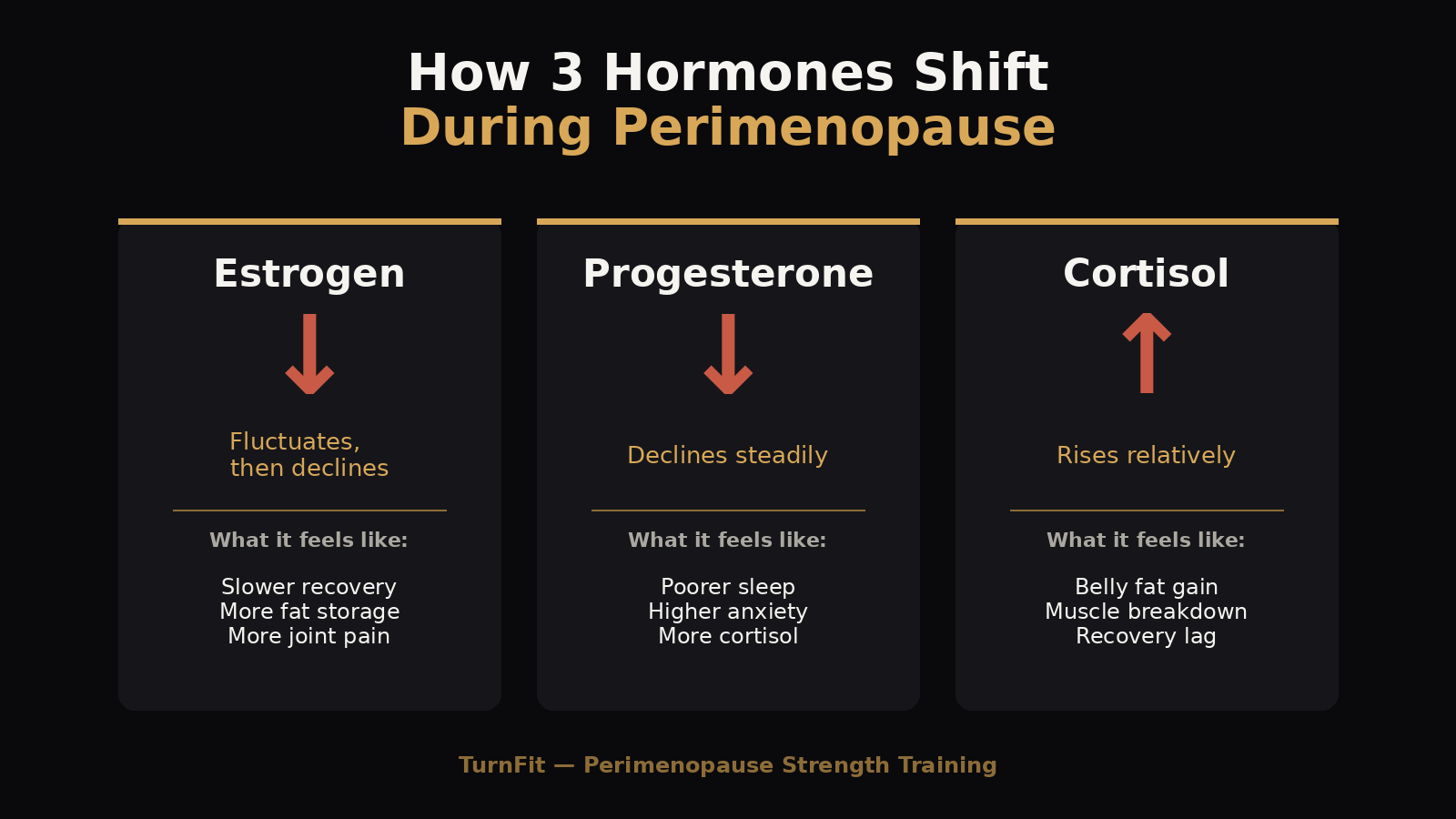
Estrogen supports muscle protein synthesis, bone remodeling, and insulin sensitivity — so as it fluctuates and trends downward, your body becomes less efficient at building and preserving muscle, and more prone to fat storage around the midsection. Progesterone drops earlier and more consistently than estrogen, which is part of why sleep and mood shifts often show up before hot flashes do. Cortisol, meanwhile, doesn’t change on its own — but a body under chronic stress, poor sleep, and excessive high-intensity cardio produces more of it, and elevated cortisol on top of declining estrogen is a specific recipe for muscle loss and stubborn abdominal fat.
| Hormone | What it does for you | What happens in perimenopause |
|---|---|---|
| Estrogen | Supports muscle repair, bone density, insulin sensitivity | Fluctuates unpredictably, trends down overall |
| Progesterone | Supports sleep quality, calms the nervous system | Declines earlier and more steadily than estrogen |
| Cortisol | Manages short-term stress response | Elevated by poor sleep, chronic stress, or excessive cardio — compounds muscle and fat changes |
Why Does Cardio-Heavy Training Often Backfire in Perimenopause?
Long, frequent steady-state cardio sessions are a common default for women trying to manage midlife weight gain, but this approach often adds to the cortisol load without addressing the actual issue: declining muscle and bone reserve. More running or spin classes doesn’t rebuild the muscle tissue that supports your metabolism — only progressive resistance training does that effectively. A 2025 systematic review and meta-analysis comparing aerobic and strength exercise in climacteric women found that while aerobic training helped with general symptoms, resistance exercise specifically strengthened muscle, increased bone density, and protected against osteoporosis (Trujillo-Muñoz et al., 2025, Healthcare).
What Does the Evidence Say Exercise Can Actually Do for Perimenopausal Symptoms?
A 2025 systematic review of randomized controlled trials on exercise and perimenopausal syndrome found a meaningful reduction in overall symptom severity — including hot flushes, insomnia, fatigue, irritability, and muscle and joint aches — measured by the Blatt-Kupperman Index (Philip et al., 2025, Cureus). The review found the largest improvements in paresthesia and irritability, with more modest but still notable gains in hot flushes and insomnia. This doesn’t mean exercise replaces medical care — it means structured movement is a legitimate, evidence-supported layer of your prevention plan, not an afterthought.
What Is the Minimum Effective Dose of Strength Training?
You do not need to spend hours in a gym to get protective benefits. The consistent pattern across the research is:
- Frequency: 2–3 resistance sessions per week, non-consecutive days
- Intensity: Moderate to challenging loads — working within roughly 6–15 reps per set, close to fatigue on the last 2–3 reps
- Coverage: Full-body compound movements (squats, hinges, presses, rows) that load the hips and spine, since these are the areas most affected by bone density loss
- Consistency: Sustained over months, not weeks — the pilot trial noted above ran for 12 weeks and still described its findings as preliminary
This is precisely why a generic drop-in class often underdelivers: perimenopausal bodies respond best to programming that adjusts load and volume as fatigue, sleep, and cycle patterns shift week to week.
How Much Protein Do You Actually Need in Your 40s?
Protein needs increase during perimenopause because your body becomes less efficient at using protein to build and repair muscle — a phenomenon researchers call anabolic resistance. A 2023 nutrition review focused specifically on menopause and perimenopause recommends 1.0–1.2 g of protein per kilogram of body weight per day to maintain muscle mass, rising toward 1.2 g/kg or higher for women who are actively exercising or trying to lose fat while preserving lean tissue (Erdélyi et al., 2023, Nutrients).
| Body weight | Daily protein target (1.0–1.2 g/kg) |
|---|---|
| 60 kg (132 lb) | 60–72 g |
| 70 kg (154 lb) | 70–84 g |
| 80 kg (176 lb) | 80–96 g |
Why Does Sleep Matter More Now Than It Did in Your 30s?
Sleep is when muscle repair, hormone regulation, and cortisol recovery actually happen — and perimenopause tends to fragment sleep right when you need it most. Poor sleep raises next-day cortisol and reduces training capacity, creating a cycle where hard workouts stop paying off. Prioritizing a consistent wind-down routine and treating 7–8 hours as non-negotiable is not indulgent during this phase — it’s part of the training program.
What About Training Through Vancouver’s Rainy Season?
Vancouver’s fall and winter stretch brings less daylight and more indoor time, which can compound the mood and energy shifts already happening in perimenopause. Indoor strength training gives you a controllable, weatherproof anchor in your week when outdoor routines like running or hiking become inconsistent. Clients who train indoors at our Kitsilano and Downtown studios often find the structure itself — a scheduled appointment, rain or shine — is what keeps consistency intact through the darker months.

What Mistakes Do Most Women Make During This Transition?
- Doubling down on cardio when energy and results decline, instead of adding resistance training
- Under-eating protein while trying to lose weight, which accelerates muscle loss
- Ignoring recovery — training hard without addressing sleep, stress, or rest days
- Waiting for a diagnosis — treating perimenopause as something to manage only once bone density or metabolic markers show a problem
- Generic programming that doesn’t account for fluctuating energy and joint sensitivity across the month
How Does This Fit TurnFit’s Prevention-First Approach?
Our method is built around four pillars — Mindset, Nutrition, Movement, and Recovery — because perimenopause touches all four simultaneously. A posture-first, pain-free approach to Movement matters more here because joint sensitivity often increases during hormonal fluctuation, and a program that pushes through pain rather than working around it creates setbacks. If your specific goal is body composition change during this transition, our guide on body recomposition and weight loss covers the nutrition side in more depth, and if you’re building your lower body specifically, see why your glutes aren’t growing for common training gaps.
Key Takeaways
- Perimenopause typically spans ages 38–48 and involves fluctuating (not just declining) estrogen and progesterone
- Cardio-only routines can add cortisol load without rebuilding the muscle and bone reserve you actually need
- Strength training 2–3x per week, with full-body compound lifts, is the evidence-supported minimum effective dose
- Protein targets should rise to roughly 1.0–1.2 g/kg of body weight per day
- Sleep and stress management directly affect how well your training works
- Prevention now — strength, protein, sleep — is simpler and more effective than reacting to a diagnosis later
Frequently Asked Questions
What age does perimenopause usually start?
Most women begin perimenopause in their late 30s to mid-40s, though it can start earlier or later. The transition can last anywhere from a few years to over a decade before reaching menopause itself.
Is strength training safe during perimenopause?
Yes — resistance training is one of the most well-supported interventions for this life stage, shown to strengthen muscle, support bone density, and reduce symptom severity when programmed appropriately (Trujillo-Muñoz et al., 2025).
Should I stop doing cardio entirely?
No — cardio still supports heart health and mood. The issue is relying on cardio alone while neglecting resistance training, which is what actually preserves muscle and bone during this phase.
How is perimenopause different from menopause?
Perimenopause is the transitional years leading up to menopause, marked by fluctuating hormones and irregular cycles. Menopause is a single point in time — 12 months without a period. If you’re past that point, see our menopause exercise guide instead.
How much protein should I eat during perimenopause?
Research suggests roughly 1.0–1.2 g of protein per kilogram of body weight daily to help preserve muscle mass, with higher intakes appropriate for women who are strength training regularly (Erdélyi et al., 2023).
Can exercise help with perimenopause mood and sleep symptoms?
A 2025 systematic review found meaningful improvements in irritability, insomnia, and fatigue among perimenopausal women following structured exercise programs, though effects on clinical depression were less clear (Philip et al., 2025).
Do I need a personal trainer for this, or can I do it myself?
You can self-direct if you’re confident programming progressive overload around fluctuating energy and joint sensitivity. Many women find a coach valuable specifically during this transition because the “right” program changes month to month — which is exactly what an initial fitness assessment is designed to identify.
Does TurnFit offer online coaching for perimenopause if I don’t live near Kitsilano or Downtown Vancouver?
Yes — our online training program follows the same Mindset, Nutrition, Movement, and Recovery framework as our in-person coaching, adapted for remote delivery.
Ready to Build Your Prevention Plan?
Why wait until strength or bone density becomes a diagnosis? Start with a 5-minute fit call, then a 30-minute Zoom game-plan session to map out a program built around where you are right now. Book your assessment today.
Ready to Start Your Fitness Journey?
At TurnFit, we offer in-person personal training at our Kitsilano and Downtown Vancouver locations, online coaching programs with live Zoom calls, and online personal training across Canada. Check out our transparent pricing — no contracts, no hidden fees.
Book a Free 5-Minute Call →