Muscle mass, not the number on the scale, is the strongest predictor of how well women age past 40. Muscle loss (sarcopenia) begins around age 30 and accelerates sharply after 40, especially through menopause, taking bone density down with it. The fix is a “longevity blueprint”: strength training 2–3x/week with progressive overload, 1.6–2.2 g of protein per kg of bodyweight daily, 7–9 hours of sleep, Zone 2 cardio, and planned deload weeks. This is prevention, not reaction — the goal is staying strong, independent, and fracture-resistant for the next 30 years, not chasing a smaller size. Book a free 5-minute fit call to build your plan.
By David Turnbull, TurnFit Founder & Head Coach
Most conversations about fitness after 40 are still framed around weight loss. That framing is outdated and, frankly, a little dangerous. The real story of aging well for women is written in muscle — how much you have, how fast you’re losing it, and what you do about it starting now. At TurnFit, we’ve coached more than 1,800 people in Vancouver using a prevention-over-reaction philosophy, and nowhere does that philosophy matter more than for women standing at the 40-year mark, looking at the next three decades of their lives.
Why Is Muscle Mass the Best Predictor of Healthy Aging for Women?
Muscle tissue is metabolically active — it burns calories at rest, stabilizes blood sugar, supports joints, and protects bone. Skeletal muscle also functions as an endocrine organ, releasing compounds called myokines during contraction that influence inflammation, metabolism, and even brain health. Women who maintain higher muscle mass and strength through midlife consistently show lower rates of falls, fractures, metabolic disease, and loss of independence in later decades. Put simply: strength is the biomarker that predicts whether you’ll be climbing stairs unassisted at 75 or not.
What Is Sarcopenia and When Does It Start?
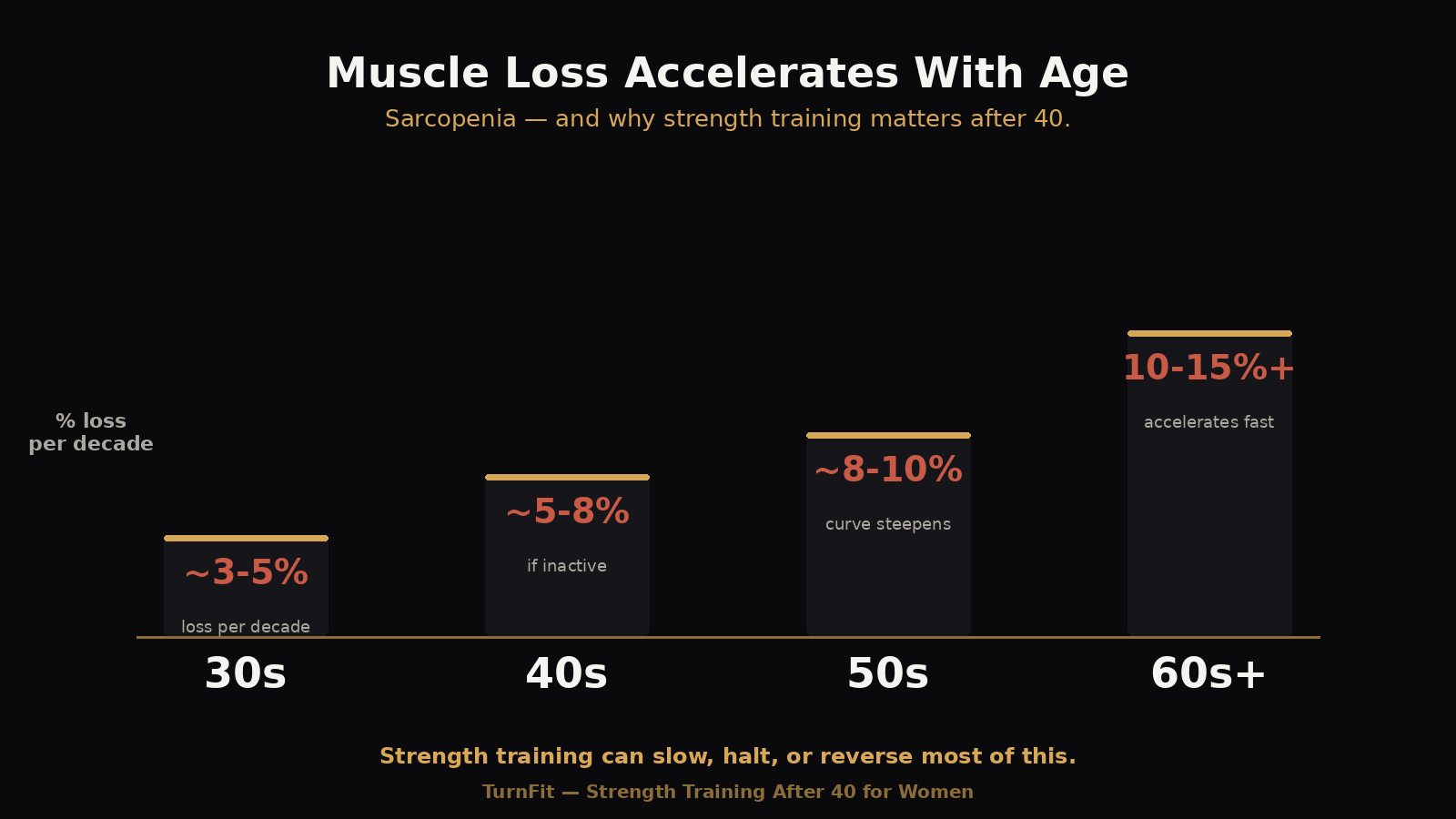
Sarcopenia is the progressive, age-related loss of skeletal muscle mass, strength, and function. It typically begins as early as the 30s, with muscle mass declining roughly 3–8% per decade after age 30, and the rate accelerates notably after 40 — then again more sharply after menopause, when the drop in estrogen removes a hormone that had been partially protecting muscle and bone. Left unaddressed, sarcopenia compounds year over year, which is exactly why prevention beats reaction: the earlier you build a strength reserve, the more buffer you have against decline.
| Age Range | What’s Happening | Why It Matters |
|---|---|---|
| 30–39 | Muscle loss begins quietly; strength training rarely prioritized | Peak window to build a “muscle reserve” before decline accelerates |
| 40–49 | Sarcopenia accelerates; perimenopause hormone shifts begin | Last stretch before menopause-related bone and muscle loss speeds up |
| 50–59 | Menopause transition; estrogen drop speeds bone and muscle loss | Bone density can drop up to 20% in the 5–7 years around menopause |
| 60+ | Fracture risk and fall risk rise sharply without a strength base | Grip strength and leg strength predict independence and longevity |
Why Does Bone Density Matter So Much After Menopause?
Bone is living tissue that responds to mechanical load the same way muscle does — use it or lose it. After menopause, declining estrogen accelerates bone resorption faster than bone formation, raising fracture risk, particularly at the hip, spine, and wrist. A hip fracture in a postmenopausal woman is one of the single biggest threats to long-term independence, which is precisely why bone-loading strength work belongs in every longevity plan, not just a cardio routine.
A systematic review and meta-analysis in Healthcare examined resistance training’s effect on bone mineral density in adults over 55 and found that while RT alone didn’t significantly increase BMD at the hip, spine, or femoral neck, it was associated with preventing the larger BMD losses typically seen with aging — supporting resistance training’s role in slowing decline rather than reversing it after the fact (Massini et al., 2022, Healthcare). A separate review in Endocrinology and Metabolism found more encouraging news specifically for postmenopausal women: resistance exercise performed 2–3 times weekly for a year was associated with maintained or increased bone density at the lumbar spine and hip, with particular benefit for cortical bone (Hong & Kim, 2018, Endocrinology and Metabolism). Together, these findings point to the same conclusion: consistent, progressive resistance training is one of the few tools that meaningfully slows bone loss in the menopause years.
What Does a Longevity-Focused Strength Blueprint Look Like?
A longevity blueprint isn’t a 6-week shred program — it’s a sustainable structure you can run for the next 30 years. At TurnFit, every client’s plan touches our four method pillars: Mindset, Nutrition, Movement, and Recovery. For women 40+, that structure translates into five concrete habits.
- Strength train 2–3x/week using compound, full-body movements (squat, hinge, push, pull, carry) rather than isolated machine work alone.
- Apply progressive overload — gradually increasing weight, reps, or difficulty every few weeks so muscle and bone keep adapting instead of plateauing.
- Eat 1.6–2.2 g of protein per kg of bodyweight daily, spread across meals, to support muscle protein synthesis and offset age-related anabolic resistance.
- Get 7–9 hours of sleep — the primary window for muscle repair and hormone regulation.
- Do 2–3 sessions of Zone 2 cardio weekly (a conversational pace) to build the aerobic base that supports recovery between strength sessions, plus scheduled deload weeks every 4–8 weeks to let joints and nervous system fully recover.
How Much Protein Do Women Over 40 Actually Need?
The commonly cited RDA of 0.8 g/kg/day was designed to prevent deficiency, not to optimize muscle and strength — and mounting evidence suggests it’s too low for anyone strength training past 40. A large cross-sectional study of 146,816 UK Biobank participants aged 40–69 found that higher dietary protein intake was positively associated with both fat-free mass and grip strength in women, with the strongest outcomes in those consuming 2.0 g/kg/day or more, independent of age, activity level, and other dietary factors (Celis-Morales et al., 2018, American Journal of Epidemiology). For a 65 kg (143 lb) woman, that translates to roughly 104–143 grams of protein per day — a meaningful shift from a typical diet, and one of the highest-leverage nutrition changes in a longevity plan.
Does Resistance Training Actually Reverse Sarcopenia?
Resistance training doesn’t stop the biological clock, but the evidence shows it meaningfully slows and can partially reverse the functional losses that come with sarcopenia. A 2025 scoping review of 36 studies on resistance training and sarcopenia risk in healthy older adults found that resistance-training programs may reduce sarcopenia risk and enhance muscle strength, though effects on muscle morphology and mobility were less pronounced and appeared to depend heavily on training dosage and intensity (Govindasamy et al., 2025, Life). The takeaway for women 40+: starting resistance training before a sarcopenia diagnosis, rather than after, is the more effective — and far less stressful — strategy.
Key Takeaways
- Muscle mass, not body weight, is the strongest single predictor of independent, healthy aging for women.
- Sarcopenia begins around age 30 and accelerates after 40, then again after menopause.
- Resistance training 2–3x/week helps prevent the steep bone density losses common in the menopause transition.
- Protein needs rise with age and training — aim for 1.6–2.2 g/kg/day, well above the standard RDA.
- A true longevity blueprint layers strength, protein, sleep, Zone 2 cardio, and deloads — not just one variable in isolation.
- Prevention beats reaction: building muscle reserve in your 40s pays off in your 60s, 70s, and beyond.
Frequently Asked Questions
Is it too late to start strength training at 40 or 50?
No. Muscle and bone remain responsive to resistance training at any age — multiple studies on postmenopausal women show measurable strength and bone benefits even when training starts well after 50. The biggest risk isn’t starting “too late,” it’s not starting at all.
How often should women over 40 strength train each week?
Two to three full-body sessions per week, with at least one rest or active recovery day between sessions targeting the same muscle groups, is a well-supported baseline for building strength without overtraining a recovering nervous system.
Will lifting weights make me bulky?
No. Significant muscle bulk requires a sustained calorie surplus and years of specific training most women never come close to in a general strength program. For most women 40+, resistance training builds lean, functional strength and improves body composition rather than adding bulk.
Can strength training really help prevent osteoporosis?
It’s one of the few modifiable tools that can. Research shows resistance training performed consistently over a year can help maintain or improve bone density at the spine and hip in postmenopausal women, particularly when combined with adequate protein and calcium intake.
How much protein is too much for a woman in her 40s or 50s?
Intakes up to roughly 2.0–2.2 g/kg/day are well tolerated by healthy adults and are the range associated with the greatest gains in fat-free mass and grip strength in large population studies. Anyone with kidney disease or another condition affecting protein metabolism should check with their physician first.
What’s the difference between strength training for longevity and strength training for aesthetics?
Aesthetic-focused training often chases visible change on a short timeline. Longevity-focused training prioritizes progressive overload, joint health, bone loading, and consistency over decades — the physique changes are a byproduct, not the goal.
Should I combine strength training with cardio, or just lift weights?
Both matter. Strength training builds and preserves muscle and bone; Zone 2 cardio builds the aerobic base and recovery capacity that let you train consistently for years. A longevity blueprint needs both, not one instead of the other.
Get Your Personalized Longevity Blueprint
Every woman’s starting point is different — training history, joint history, hormonal stage, and goals all shape the right plan. That’s exactly why TurnFit builds every program around a personal assessment rather than a generic template. If you’re navigating strength training alongside perimenopause or menopause symptoms, our menopause exercise guide goes deeper on hormone-specific programming. If your goal includes changing body composition alongside strength, see our guide to body recomposition. Whether you train with us in person in Kitsilano or Downtown Vancouver, or anywhere in the world through our online coaching, the process starts the same way.
Ready to build your plan? Start with our personal training programs or book your free 5-minute fit call — the first step in TurnFit’s funnel toward a customized, posture-first, pain-free strength program built for the next 30 years, not the next 30 days.
Ready to Start Your Fitness Journey?
At TurnFit, we offer in-person personal training at our Kitsilano and Downtown Vancouver locations, online coaching programs with live Zoom calls, and online personal training across Canada. Check out our transparent pricing — no contracts, no hidden fees.
Book a Free 5-Minute Call →