The Appointment That Never Comes
By David Turnbull, BCRPA Certified Personal Trainer & Founder, TurnFit Personal Trainers
TL;DR: Canadian healthcare is excellent at rescue — and almost silent on the slow muscle and bone loss that starts in your 40s. Bone density testing is often delayed until 70 if you have no listed risk factors. After a fracture, only about 15% of Canadians 40+ get a BMD test. One in three women will break a bone from osteoporosis in her lifetime. The appointment that would catch decline early? It was never on the schedule. Book the assessment the system never booked — TurnFit’s free 5-minute call (Kitsilano, Downtown Vancouver, or online Canada-wide).
The appointment that never comes
Somewhere between your last Pap and your next blood pressure check, there should have been another visit.
Not for a crisis. Not for a cast. For a quiet question: Are you still strong enough to get off the floor?
That appointment does not exist in most Canadian primary care. No one books “muscle and bone maintenance, age 42.” No reminder pings your phone. No form asks whether you can rise from a chair without using your hands.
So you keep walking. You keep doing yoga. You keep earning the sleep ring. And the decline that will one day become a fracture, a hip replacement, or a fear of falling keeps happening in the background — while the system waits for something loud enough to treat.
This is not a rant about nurses or doctors. They work inside a system built for rescue, not for catching silent decline. Fall and break something, and Canada can mobilize extraordinary care. Quietly lose muscle and bone between 40 and 55, and the calendar often stays empty until the damage is already expensive.
TurnFit lives in that gap — posture-first, pain-free strength for women who refuse to wait for the fall. For the bigger system picture, see why Canadians can’t rely on healthcare for fitness.
What is the silent decade (~40–55)?
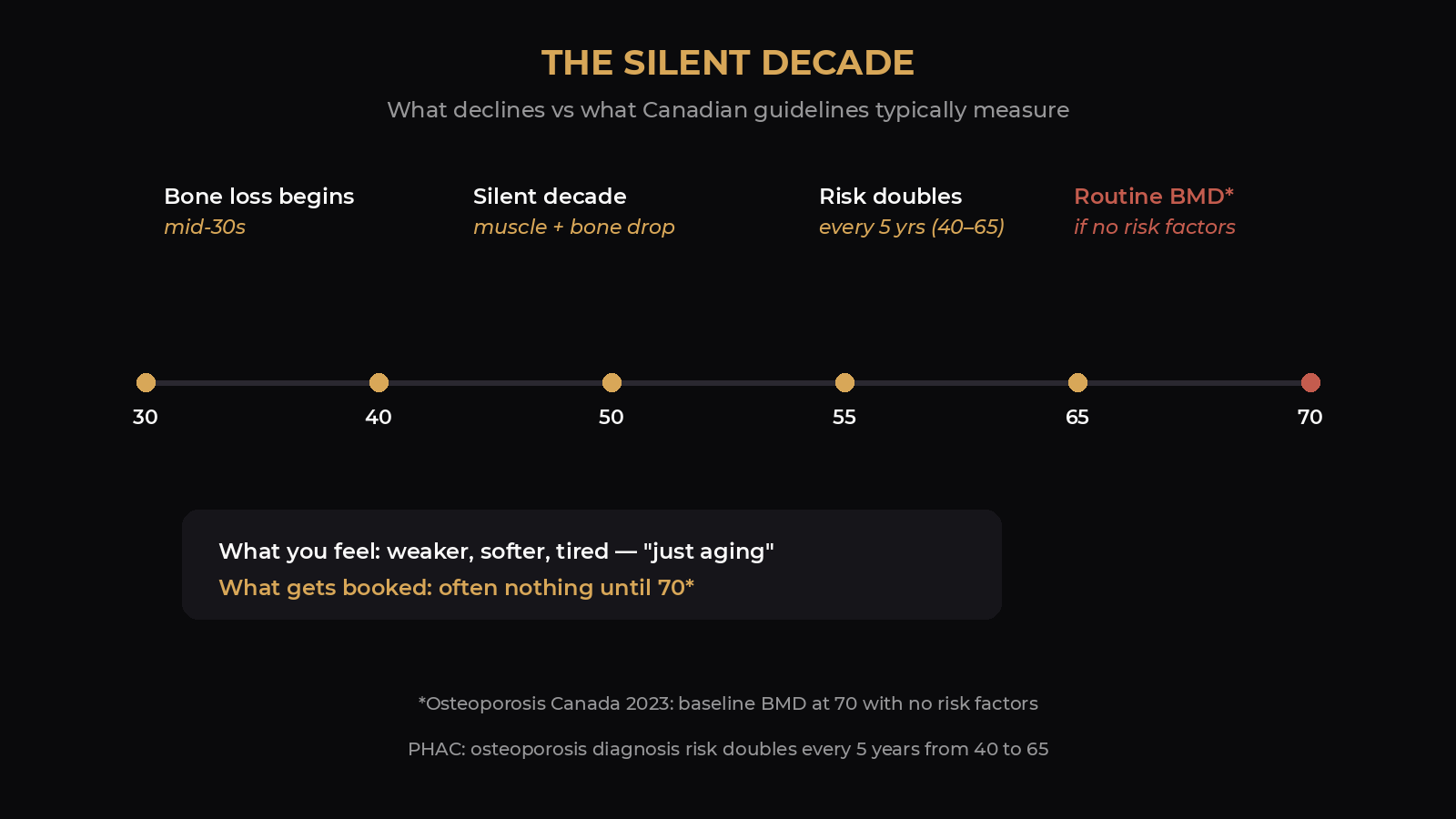
Call it the silent decade: roughly ages 40 to 55, when hormones shift, recovery slows, and muscle and bone start leaving without asking permission.
You may still look “fine.” You may still finish a 10K. Your annual physical can come back green. And yet strength that used to feel automatic now needs a pep talk. Stairs feel heavier. Balance feels slightly less trustworthy on uneven sidewalks.
Bone loss can begin in the mid-30s. Near menopause, it can accelerate to roughly 2–3% per year. Muscle loss (sarcopenia) runs roughly 3–8% per decade after 30 — and the menopause transition can throw gas on that fire. By the time something “shows up” on an X-ray or a fracture report, you have often been declining for years.
Want the fuller physiology? Read our menopause exercise guide and perimenopause strength training guide. Short version: waiting for the system to notice is not a plan.
The Canadian care gap
Here is the structural problem — Canadian numbers, not vibes.
BMD testing is often late. Osteoporosis Canada’s 2023 clinical practice guideline sets baseline BMD at age 70 if you have no risk factors; at 65 with one risk factor; and earlier (50–64) mainly if you already had a fracture or have two or more risk factors. A healthy-seeming woman in her 40s or early 50s can go years without anyone measuring the bone she is actively losing.
After a fracture, follow-through is still thin. The Public Health Agency of Canada (2023) reported that only 15% of Canadians 40+ who had a fracture also had a BMD test. Only 21% of people 65+ received anti-osteoporosis medication after fracture. Historically, Osteoporosis Canada has noted that fewer than 20% of fracture patients were adequately diagnosed and treated.
Diagnosis risk climbs fast in midlife. Among Canadians 40–65, the risk of an osteoporosis diagnosis roughly doubles every five years (PHAC). That is not a gentle curve.
The scale is already huge. About 2.5 million Canadians 40+ have diagnosed osteoporosis — roughly 81% women. Over 80% of fractures in people 50+ are osteoporosis-related. More than 1 in 5 people die of any cause within a year of a hip fracture (PHAC); Osteoporosis Canada cites roughly 22% of women and 33% of men dying within one year.
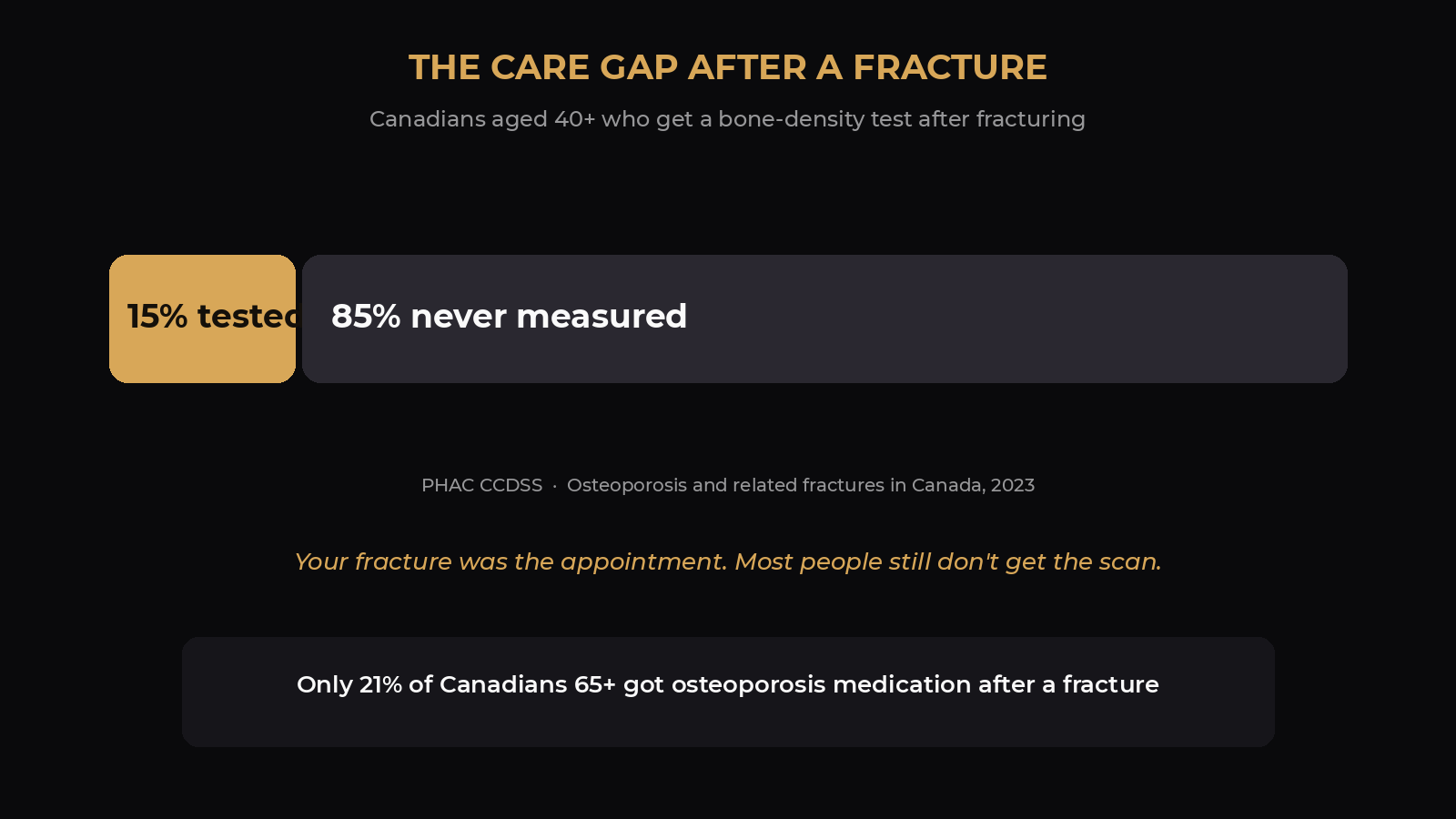
Again: this is not “doctors don’t care.” Primary care is drowning. Muscle mass almost never makes the 12-minute checklist. Bone density waits for age, risk factors, or a break. Your job is not to blame the clinic. Your job is to stop outsourcing prevention to a system that was never funded to deliver it.
Shock stats you should not ignore
If you only remember a handful of numbers, make them these (Osteoporosis Canada; PHAC 2023):
- At least 1 in 3 women (and 1 in 5 men) will suffer an osteoporotic fracture in their lifetime.
- Fractures from osteoporosis are more common than heart attack, stroke, and breast cancer combined.
- Bone loss can begin in the mid-30s; near menopause, 2–3% per year.
- Sarcopenia: roughly 3–8% muscle loss per decade after 30.
- Hip fracture: ~22% of women / 33% of men die within one year; PHAC: >1 in 5 die of any cause within a year; women have about twice the hip-fracture rate of men.
- After fracture, only ~15% of Canadians 40+ had a BMD test; only 21% of 65+ got anti-osteoporosis meds.
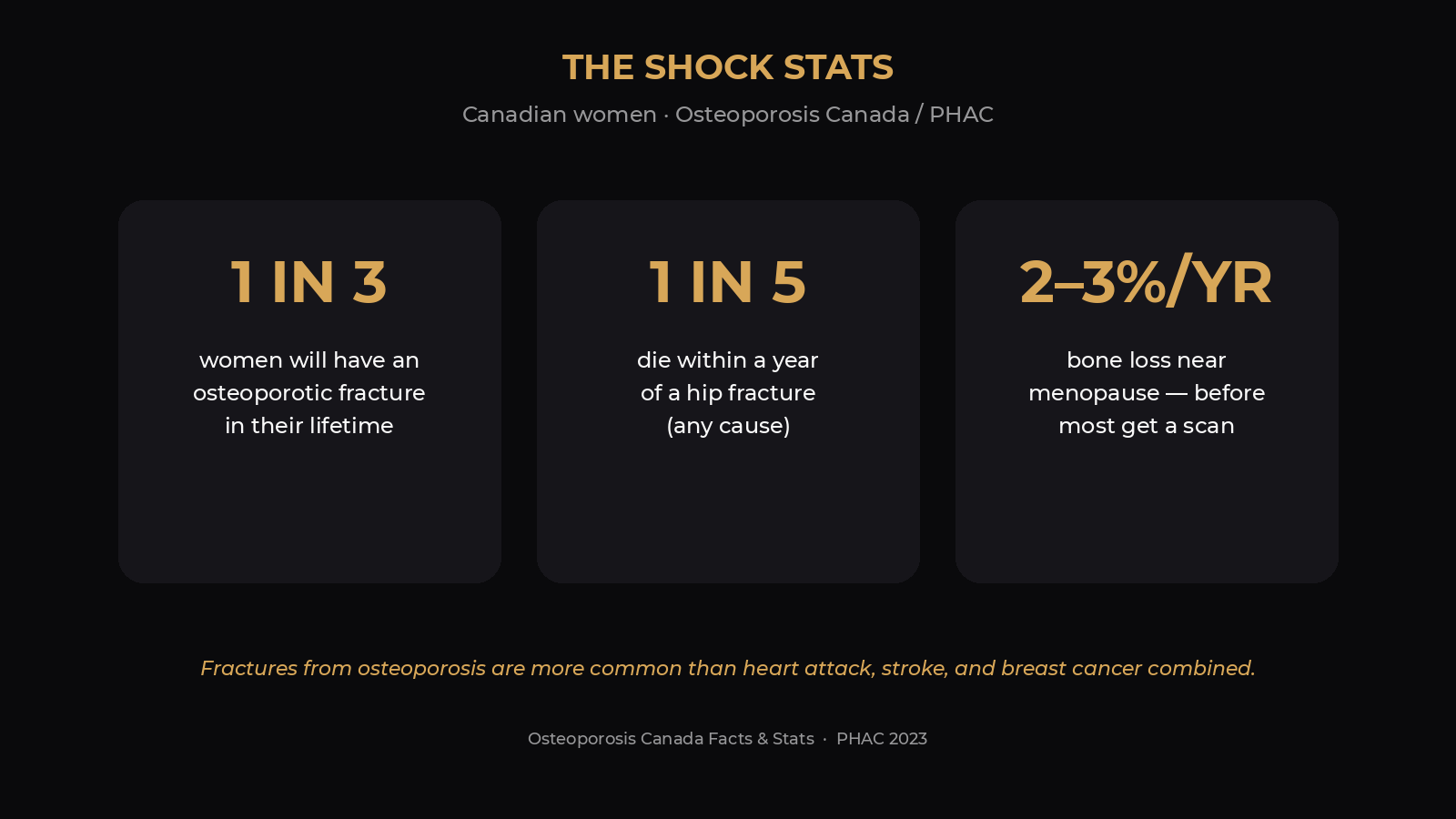
Scare is useless without a next step. The next step is measuring what you can measure now — then training what the waiting room never tests.
Laugh break: your wellness app is not a fall-risk clinic
Your watch will congratulate you for closing a sleep ring.
It will celebrate 10,000 steps like you cured gravity.
What it will not ask:
“If you sat on the kitchen floor to reach the Tupperware drawer… could you get back up without a negotiation?”
Somewhere a Canadian woman has pristine recovery scores and a grip strength that would lose an arm-wrestle to a jar of pickles. The app is not evil. It is just measuring the wrong movie. Steps and sleep matter. They are not a proxy for “Can I catch myself when the sidewalk wins?”
Why muscle almost never makes the primary-care checklist
Primary care is optimized for blood pressure, blood sugar, cancer screening, and the problem you walked in with today. Muscle and functional strength are rarely coded, rarely billed as prevention, and rarely given the minutes they deserve.
A few practical reasons:
- No universal “muscle appointment” at 40, 45, or 50.
- BMD timing is late for many — often age 70 without risk factors.
- Early sarcopenia whispers — harder stairs, slower recovery — it does not scream.
- “Just walk more” still dominates advice. Walking is wonderful. Walking alone is not bone-loading or muscle-preserving enough.
- The system rewards rescue. Fractures are visible. Silent decline is not.
You do not have to wait for that plot twist.
What you CAN measure now
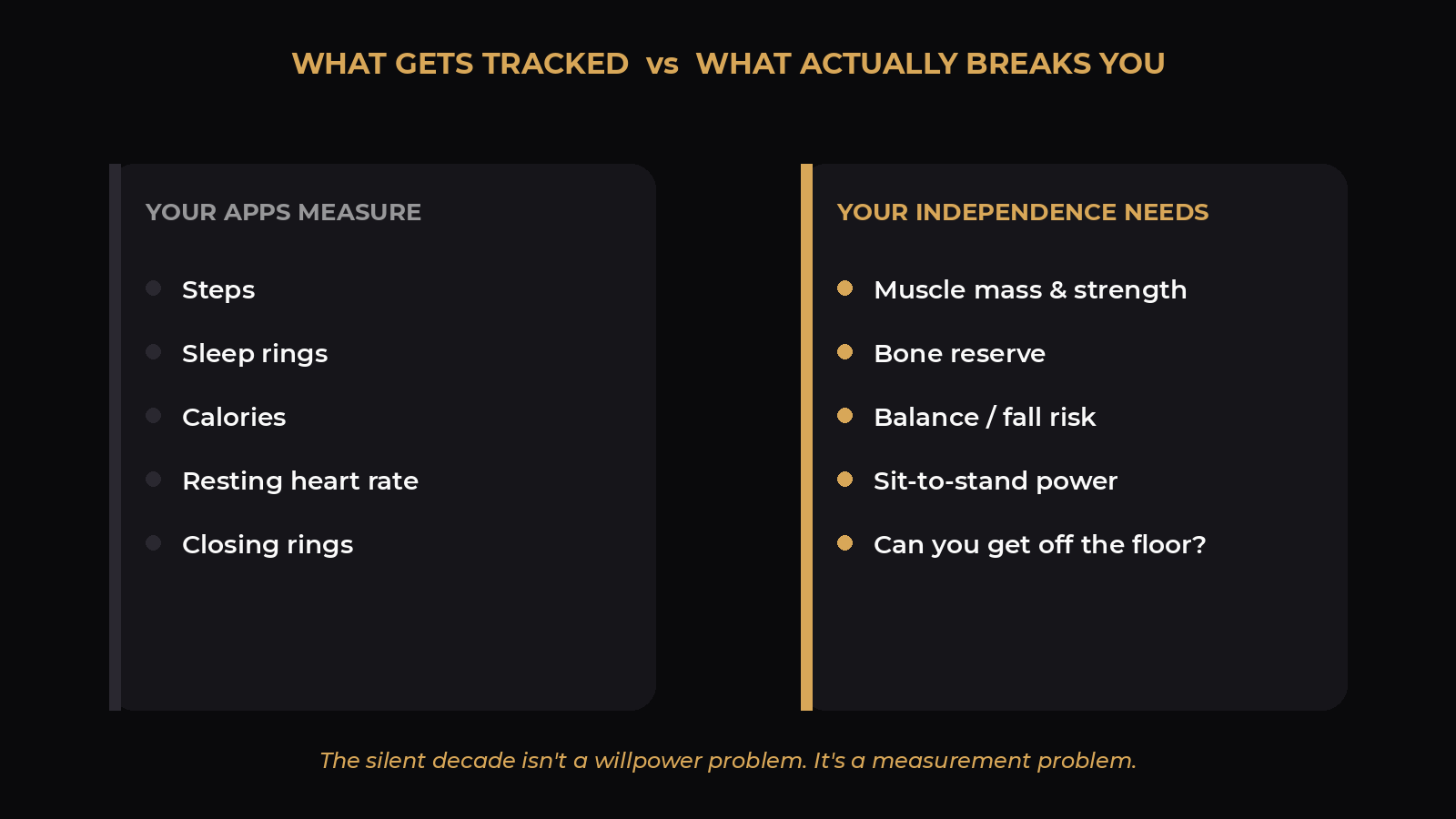
You cannot order your own hospital scan from the kitchen. You can track functional markers this week:
- Grip strength — a quick proxy linked to overall strength and healthspan.
- Sit-to-stand — how many chair stands in 30 seconds without using your hands.
- Balance — single-leg stance; confidence on uneven ground.
- Strength logs — progressive loads on squat, hinge, push, and pull over months.
These do not replace a BMD test or medical diagnosis. They do replace the fantasy that “feeling fine” equals “staying strong.”
A TurnFit assessment adds posture and movement quality, history (including menopause stage when relevant), baseline strength, and a plan aligned with Osteoporosis Canada’s emphasis on balance/functional training plus progressive resistance at least twice per week (Too Fit To Fracture direction in the 2023 CPG).
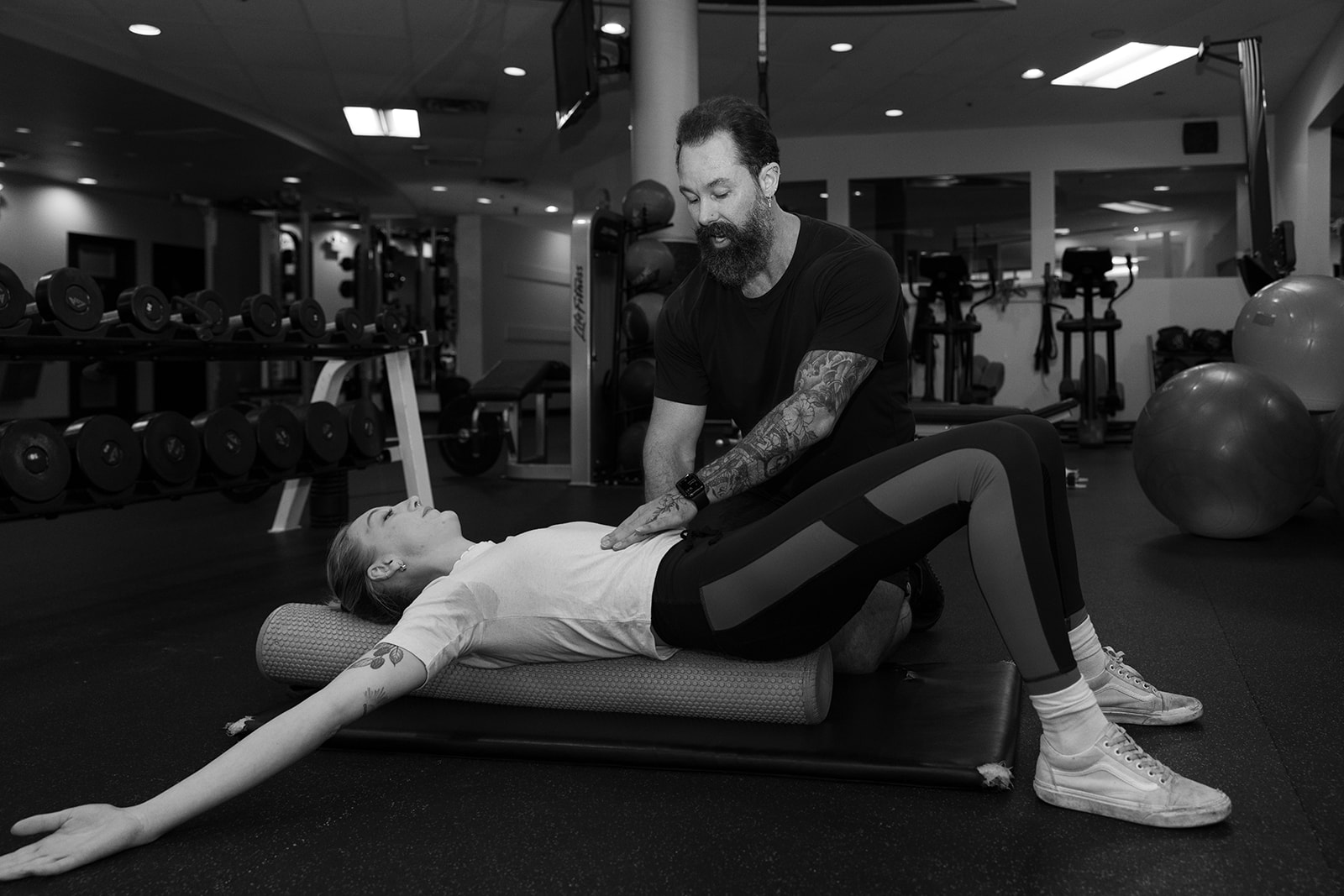
Train in Kitsilano or Downtown Vancouver or online across Canada. First useful output: clarity on where you are strong, where you are leaking capacity, and what to do twice a week so the silent decade does not become a loud one.
The prevention plan that replaces the missing appointment
1. Strength train 2–3× per week (Too Fit To Fracture–aligned)
Progressive resistance is primary for muscle and key for bone. Osteoporosis Canada’s sarcopenia guidance points to resistance training 2–3×/week; the 2023 CPG emphasizes balance/functional work plus progressive resistance ≥2×/week.
Prioritize squats/sit-to-stands, hinges, rows and presses, plus single-leg and balance work. Cardio-only is not enough. Your heart will thank you for the walk. Your skeleton wants load.
2. Protein that actually feeds muscle
Many Canadian women under-do muscle-strengthening relative to guidelines — and under-eat protein relative to midlife needs. Aim for consistent, meal-spaced intake your coach or dietitian can personalize.
3. Sleep like it is a training session
Poor sleep makes every other lever harder. Your wearable can help here — just don’t let it be the only dashboard.
4. Posture and pain-free progression
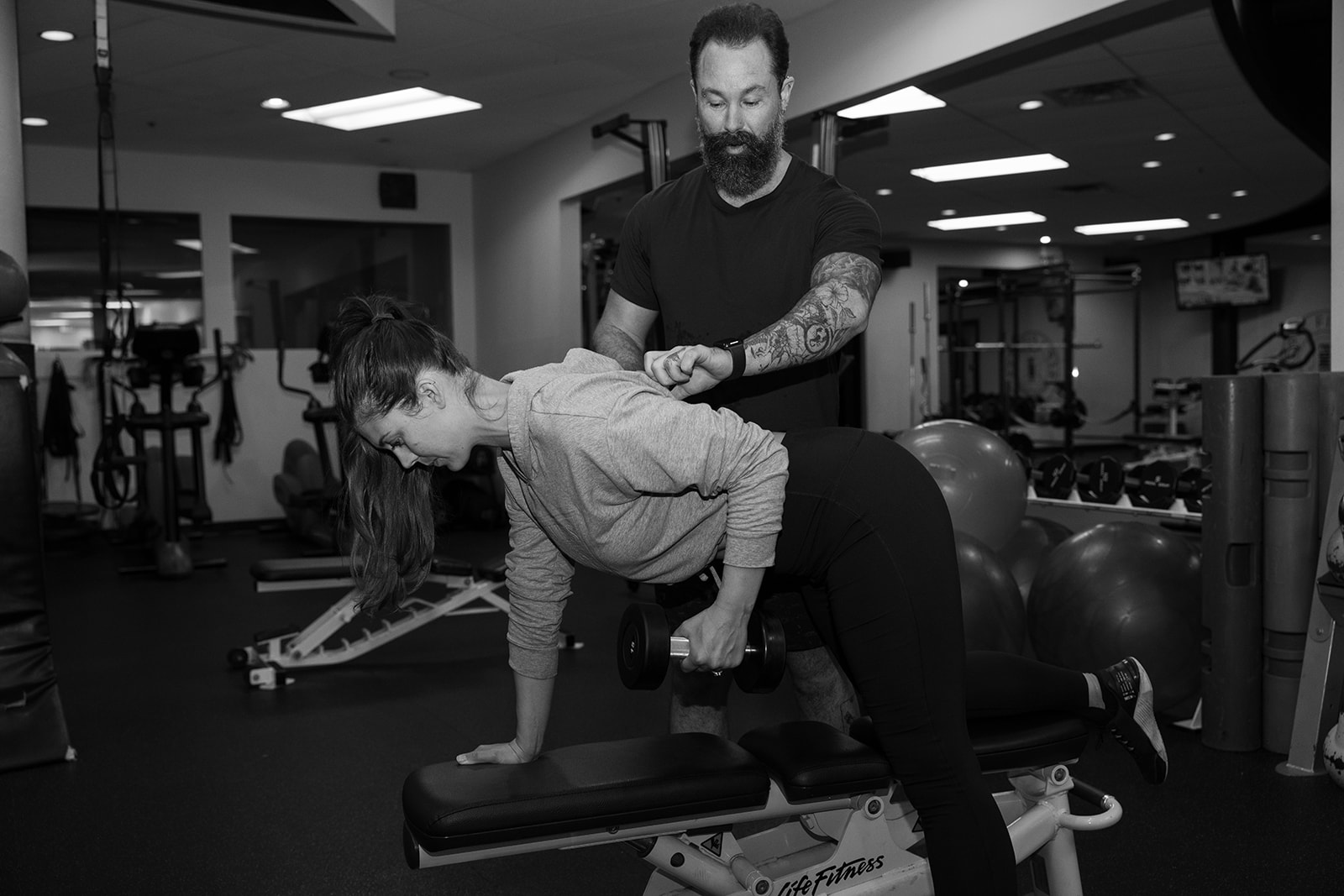
Bone loading only helps if you can train consistently. That is why TurnFit is posture-first and pain-free by design.
5. Never too late
A 2025 University of Exeter study found resistance-training benefits for strength, flexibility, and balance were similar across pre-, peri-, and postmenopausal women. It is not too late. See also strength training after 40 for women.
Medical care and BMD testing still matter on their timelines. This plan does not cancel them. It fills the years the system leaves blank.
Why TurnFit
If healthcare is built for rescue, TurnFit is built for the decade before rescue is needed.
- Pain-free, posture-first coaching for the body you actually have
- 240+ reviews and 8× Top Choice Award recognition in Vancouver
- 7-day risk-free start — clarity without a trapdoor contract
- Kitsilano (3311 W Broadway), Downtown Vancouver (180 W Georgia), and online Canada-wide
- Women-over-40 fluency — most clients are navigating perimenopause and beyond
We will never pretend a trainer replaces your physician. We will own the lane medicine rarely has time for: progressive strength, balance, posture, and independence.
Curious later? Pricing when you are ready. The urgent thing is the assessment, not a package pitch.
FAQ
When should women get a bone density test in Canada?
Under Osteoporosis Canada’s 2023 clinical practice guideline, a baseline BMD is recommended at age 70 if you have no risk factors; at age 65 if you have one risk factor; and between 50–64 if you have a previous fracture or two or more risk factors. Ask your clinician about your risk profile. Do not wait for a fracture to start strength and balance training.
Why doesn’t my doctor check muscle mass after 40?
Most primary-care visits are short and optimized for acute issues, medications, and established screening panels. Muscle mass and functional strength are rarely on the checklist, and there is no universal public “muscle appointment” at 40. That is a system design issue, not a character judgment on your GP. You can still measure grip, sit-to-stand, balance, and training logs — and work with a qualified coach while staying under medical care for diagnosis and imaging.
Is personal training a substitute for medical care or a BMD test?
No. Personal training is not a substitute for medical care, diagnosis, physiotherapy, or a bone mineral density test. TurnFit does not diagnose osteoporosis or prescribe medication. We build progressive, posture-first strength and balance programs that sit alongside medical care — and we encourage appropriate clinical follow-up when risk factors, fractures, or unexplained symptoms appear.
Can I reverse muscle and bone loss in my 40s?
You can often rebuild muscle and slow, stop, or in some cases improve bone outcomes with consistent progressive resistance training, adequate protein, and smart recovery — especially before a fracture. Exeter 2025: similar training benefits across pre-/peri-/postmenopause. Results vary; medical conditions and medications matter; your physician and (when indicated) BMD testing remain part of the full picture.
Kitsilano, Downtown, or online — what’s the first step?
Book a free 5-minute call. If we are a fit, we follow with a longer game-plan conversation and assessment. Choose Kitsilano or Downtown Vancouver for in-person coaching, or online elsewhere in Canada (or from home). Same prevention-first method; different delivery.
Book the appointment the system never scheduled
You now know the plot: the silent decade is real; Canadian BMD timing and post-fracture follow-up leave a prevention hole; wellness apps will not test whether you can get off the floor; strength 2–3× a week, protein, sleep, and posture-first coaching are the appointment you can still put on the calendar.
Do not wait for the cast, the walker, or the year-after-hip-fracture statistic to become personal.
Book a Free 5-Minute Call — Kitsilano, Downtown Vancouver, or online Canada-wide.
Sources
- Osteoporosis Canada — Facts and Stats (silent thief; ≥1 in 3 women / 1 in 5 men lifetime osteoporotic fracture; fractures more common than heart attack, stroke, and breast cancer combined; bone loss from mid-30s; 2–3%/year near menopause; hip-fracture one-year mortality ~22% women / 33% men; >80% of fractures in 50+ related to osteoporosis; historical undertreatment after fracture): https://osteoporosis.ca/facts-and-stats/
- Public Health Agency of Canada (2023) — Osteoporosis and related fractures in Canada, 2021 (~2.5M Canadians 40+ diagnosed; ~81% women; diagnosis risk doubles every 5 years ages 40–65; after fracture only 15% of Canadians 40+ had BMD; only 21% of 65+ received anti-osteoporosis medication; >1 in 5 die of any cause within a year of hip fracture; women ~2× hip fracture vs men): https://www.canada.ca/en/public-health/services/publications/diseases-conditions/osteoporosis-related-fractures-canada-2021.html
- Osteoporosis Canada (2023) Clinical Practice Guideline — Executive summary (baseline BMD at 70 with no risk factors; 65 with one risk factor; 50–64 with previous fracture or ≥2 risk factors; balance/functional + progressive resistance ≥2×/week): https://osteoporosis.ca/executive-summary-clinical-practice-guideline/
- Osteoporosis Canada — Sarcopenia (~3–8% muscle loss per decade after 30; resistance training 2–3×/week as primary prevention): https://osteoporosis.ca/sarcopenia/
- University of Exeter (2025) — Resistance training benefits similar across pre-/peri-/postmenopause: https://news.exeter.ac.uk/faculty-of-health-and-life-sciences/first-of-its-kind-study-shows-resistance-training-can-improve-physical-function-during-menopause/ · https://pubmed.ncbi.nlm.nih.gov/39480197/
By David Turnbull, BCRPA Certified Personal Trainer & Founder, TurnFit Personal Trainers
Ready to Start Your Fitness Journey?
At TurnFit, we offer in-person personal training at our Kitsilano and Downtown Vancouver locations, online coaching programs with live Zoom calls, and online personal training across Canada. Check out our transparent pricing — no contracts, no hidden fees.
Book a Free 5-Minute Call →