By David Turnbull, BCRPA Certified Personal Trainer & Founder, TurnFit Personal Trainers
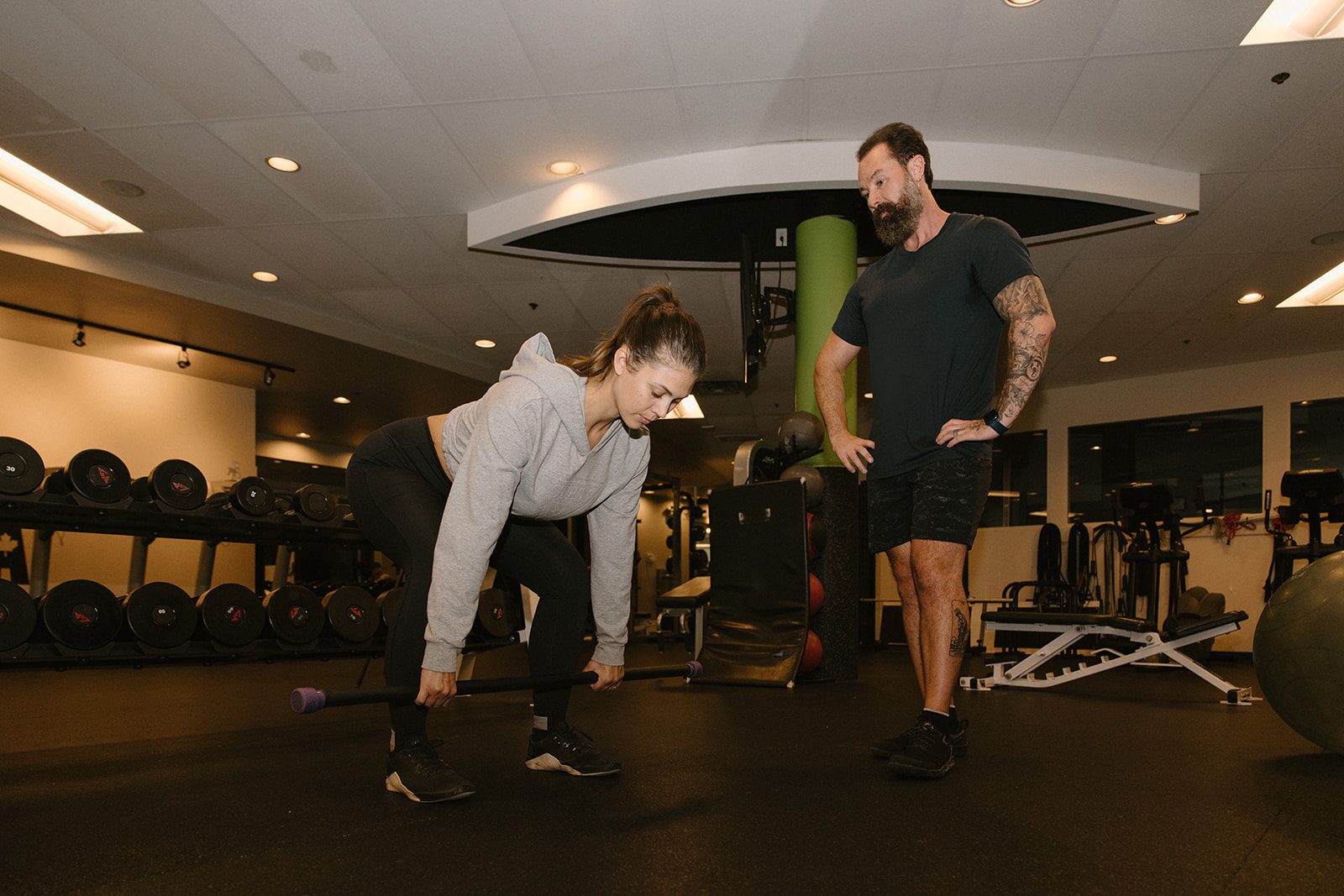
Strength needs fuel. Protein after 40 is how midlife muscle gets the materials to rebuild.
You eat the salad. You skip the late-night snack. You “behave” Monday through Thursday and call it balance. And somehow you still feel soft, tired, and slightly betrayed by a body that used to cooperate.
If that sounds familiar, you are not failing willpower. You may be failing fuel — specifically protein after 40 — right when midlife muscle needs it most.
How much protein do women over 40 need? More than most “healthy” plates deliver — and paired with strength training, not another round of low-cal restriction. At TurnFit (Kitsilano, Downtown Vancouver, and online Canada-wide), we close that gap with a memorable 40% protein / 30% carbs / 30% fat operating rule, progressive lifting, and coaching that fits real weeks.
This is education and coaching context — not medical advice, and not a substitute for a physician or registered dietitian.
TL;DR: After ~30, women can lose roughly 3–8% of muscle per decade, and menopause can accelerate that slide. Many “healthy” eaters under-fuel protein while chasing low calories. TurnFit’s operating rule for midlife muscle and energy is 40% of calories from protein, then 30% carbs / 30% fat — personalized in coaching, never a blanket prescription. Pair with strength training 2–3× per week and Why Women in Their 40s and 50s Can Feel Better Than Their 30s. Kitsilano, Downtown, or online? Book a free 5-minute assessment.
What is the midlife muscle gap?
The midlife muscle gap is the quiet space between how hard you try and how strong you feel — driven by sarcopenia plus chronic under-fueling of protein. Close it with progressive strength and enough protein; leave it open and “eating clean” keeps delivering soft, tired, and stuck.
On one side: sarcopenia. Osteoporosis Canada describes progressive loss of muscle mass, strength, and performance. Decline often begins after 30 (~3–8% per decade); menopause hormonal shifts can make it feel sudden. Less muscle means easier fat gain, harder recovery, softer strength on stairs, and higher long-term fall/fracture risk when muscle and bone decline together.
On the other side: under-fueling. Cut portions. Live on greens. Treat hunger like a character flaw. Your body hears: muscle is optional; energy is scarce. The woman who “eats cleanest” is often furthest from the protein her training needs — running a midlife engine on a salad-bowl budget.
The gap is closable when protein and strength stop being afterthoughts. See why healthcare often won’t catch decline until you fall, our menopause exercise guide, perimenopause strength training, and longevity training for midlife women.
How much protein do women over 40 need?
Women over 40 often need more protein than a “clean eating” plate provides — enough to support muscle repair, satiety, and training adaptation, not merely avoid deficiency. Research often uses grams per kilogram — ranges that rise when preserving or building midlife muscle. Those numbers matter. They are also easy to forget on a Seabus commute.
TurnFit’s memorable operating rule for midlife muscle and energy — David’s 40/30/30:
- 40% of calories from protein
- Then 30% carbohydrates / 30% fat
Example math (2,000 kcal day)
| Macro | % of calories | Calories | Approx. grams |
|---|---|---|---|
| Protein | 40% | 800 kcal | ~200 g (protein ≈ 4 kcal/g) |
| Carbs | 30% | 600 kcal | ~150 g (carbs ≈ 4 kcal/g) |
| Fat | 30% | 600 kcal | ~67 g (fat ≈ 9 kcal/g) |
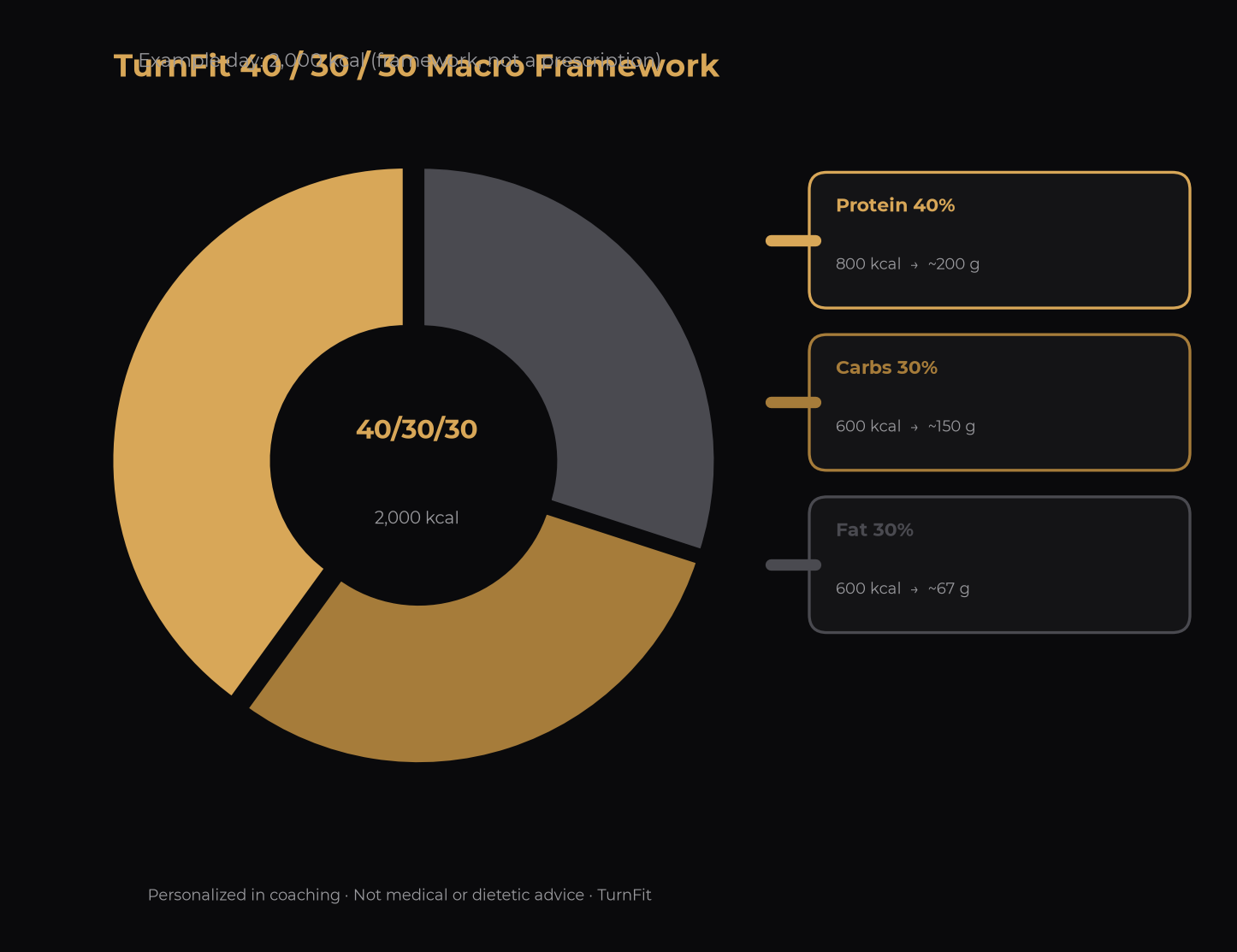
40/30/30 at a glance — ~200 g protein / ~150 g carbs / ~67 g fat on a 2,000 kcal example day.
That example is a framework, not a prescription. Calorie needs vary. Medical conditions, medications, kidney history, disordered-eating recovery, athletic volume, and menopause management all change the picture. A physician or registered dietitian guides clinical nutrition. TurnFit coaches training-nutrition habits inside a strength plan — we do not replace medical or dietetic care. A personal trainer is not a physician and not a dietitian.
In practice, many “stuck” women eat far below this protein share — a snack-sized afterthought — then wonder why strength and recovery feel flat.
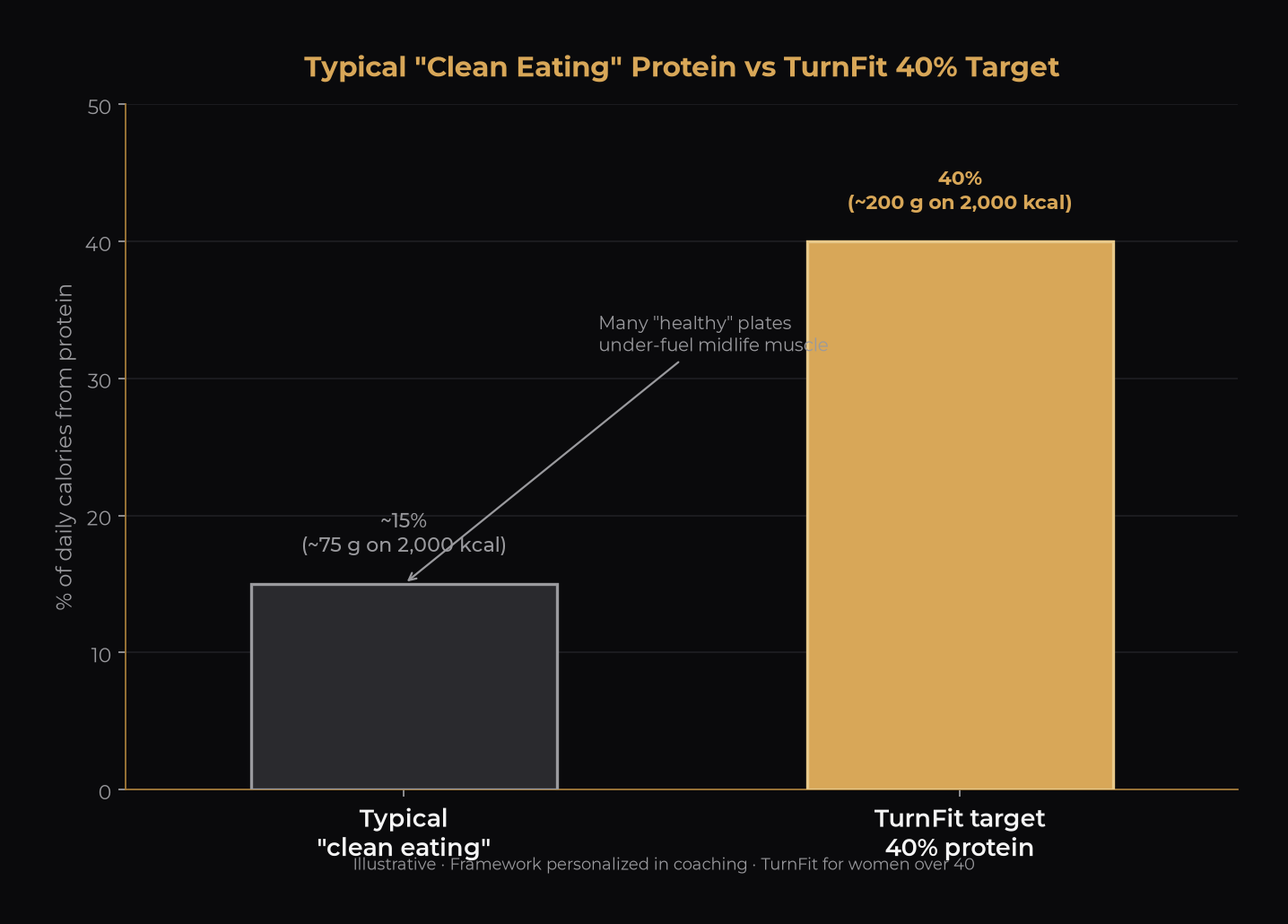
Many “healthy” plates land near ~15% protein — far from the midlife muscle target.
Personalization is the point. 40/30/30 is our preferred starting lens because it is memorable and actionable. We adjust with you — not a laminated religion.
Why does chicken-and-broccoli / low-cal dieting fail busy Vancouver women?
It fails because it is brittle, socially awkward, under-fuels training, and confuses thinness with capacity.
Brittle. Miss meal-prep Sunday and the plan collapses into toast and regret.
Socially awkward. Vancouver lunches, date nights, and travel happen; Tupperware-only diets fail in real life.
Under-fuels training. Low calories + cardio-heavy weeks + rising protein needs = softer and more exhausted.
Confuses thinness with capacity. After 40, the win is usable muscle: posture, forgiving joints, energy past 3 p.m.
Busy women need repeatable protein anchors plus strength work that tells those amino acids where to go.
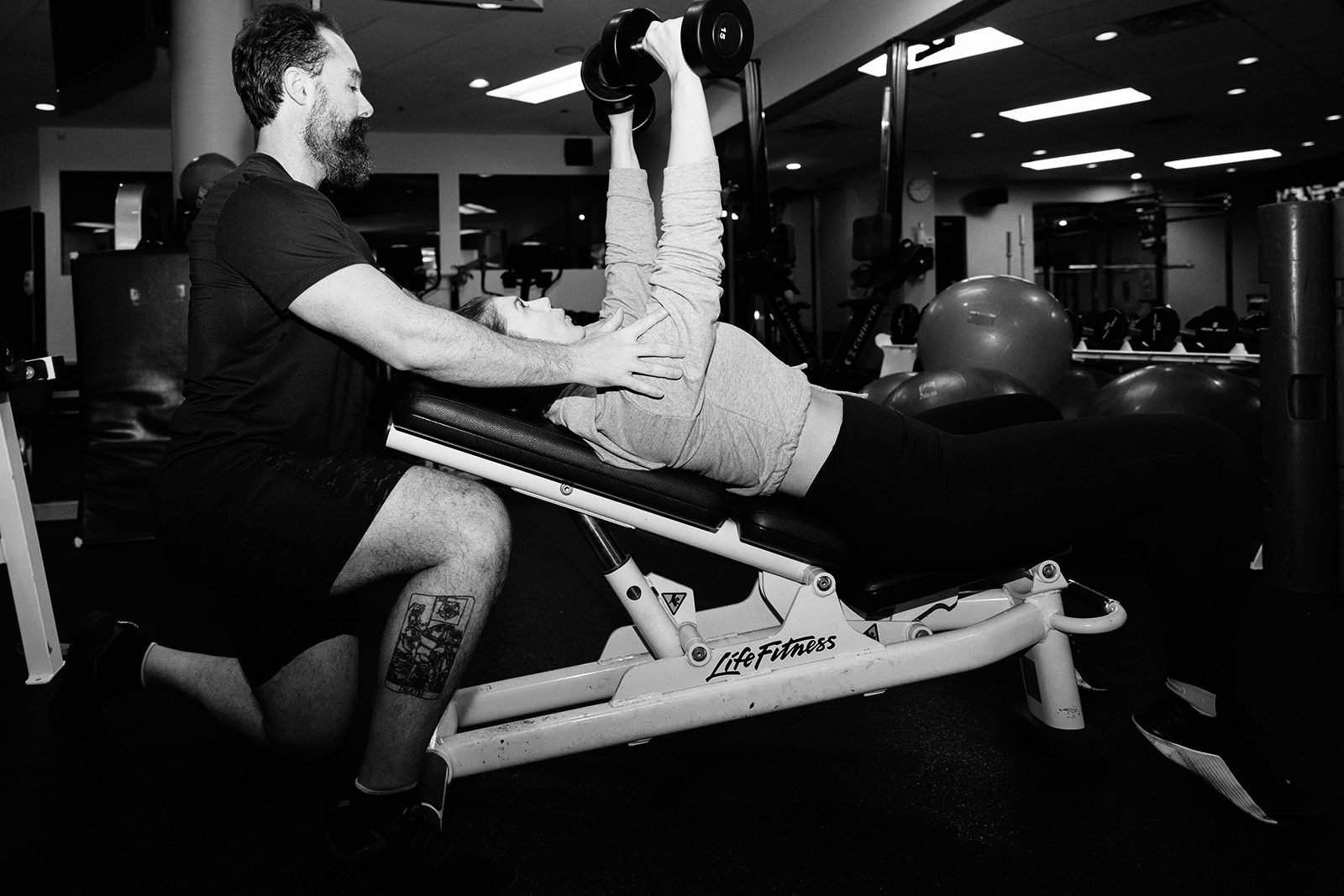
Protein without progressive strength is a half-conversation.
Soft next step: Suspect protein and strength are the missing pair? Book a free 5-minute assessment — Kitsilano (3311 W Broadway), Downtown (180 W Georgia), or online Canada-wide.
What are practical protein anchors for midlife women?
Practical protein anchors put a protein source at every eating occasion — consistency over perfection. Not a 7-day meal plan. A hit-list you can rotate.
Breakfast anchors
- Greek yogurt or skyr bowl with berries, nuts, optional protein scoop
- Eggs + leftover salmon or turkey sausage + fruit
- Cottage cheese toast with tomato and seasoning
- Smoothie built around protein (dairy, soy, or quality powder) — not juice with vibes
Lunch that travels
- Rotisserie chicken over greens with beans, cheese, or quinoa
- Salmon or tuna pack + crackers + vegetables + hummus
- Leftover steak or tofu stir-fry
- Chili or soup with lentils and meat or tempeh — not broth cosplay
Dinner without drama
- Sheet-pan protein (fish, chicken, tofu) + roasted vegetables + a carb you enjoy
- Burger night with a real patty and filling sides
- Tacos with double the filling you used to allow
- Pasta with shrimp or chickpeas — carbs are not the enemy; missing protein is
Snacks that close the gap
- Jerky, edamame, cheese sticks, hard-boiled eggs
- Protein pudding / skyr cups
- Nuts plus something higher-protein
- Leftover dinner as the afternoon snack — elite midlife move
Consistency tips
- Front-load protein at breakfast and lunch
- A protein source at every eating occasion
- Keep 2–3 “always in the fridge” options
- Shakes are a tool, not a personality
- Track a week if curious, then graduate to habits
Vegetarian and vegan clients can hit strong targets with soy, dairy if included, legumes, seitan, mycoprotein, and smart supplementation — planning, not martyrdom. See FAQ.
Why pair protein with strength training 2–3× per week?
Protein is the brick delivery; strength training is the construction crew. Without progressive resistance, extra protein mostly pays rent as food. With 2–3 posture-first, joint-friendly sessions per week, muscle has a reason to stick. That pairing drives midlife body composition and the “I feel like myself again” feedback we hear constantly.
Start here:
- Strength Training After 40 for Women: The Longevity Blueprint
- Companion: Feel better in your 40s than your 30s
- Canadian Healthcare & Muscle Loss for Women 40+
- Pain-free personal training for Vancouver women
You need consistency, coaching that respects your history, and fuel that matches the work — not a two-hour bro session.
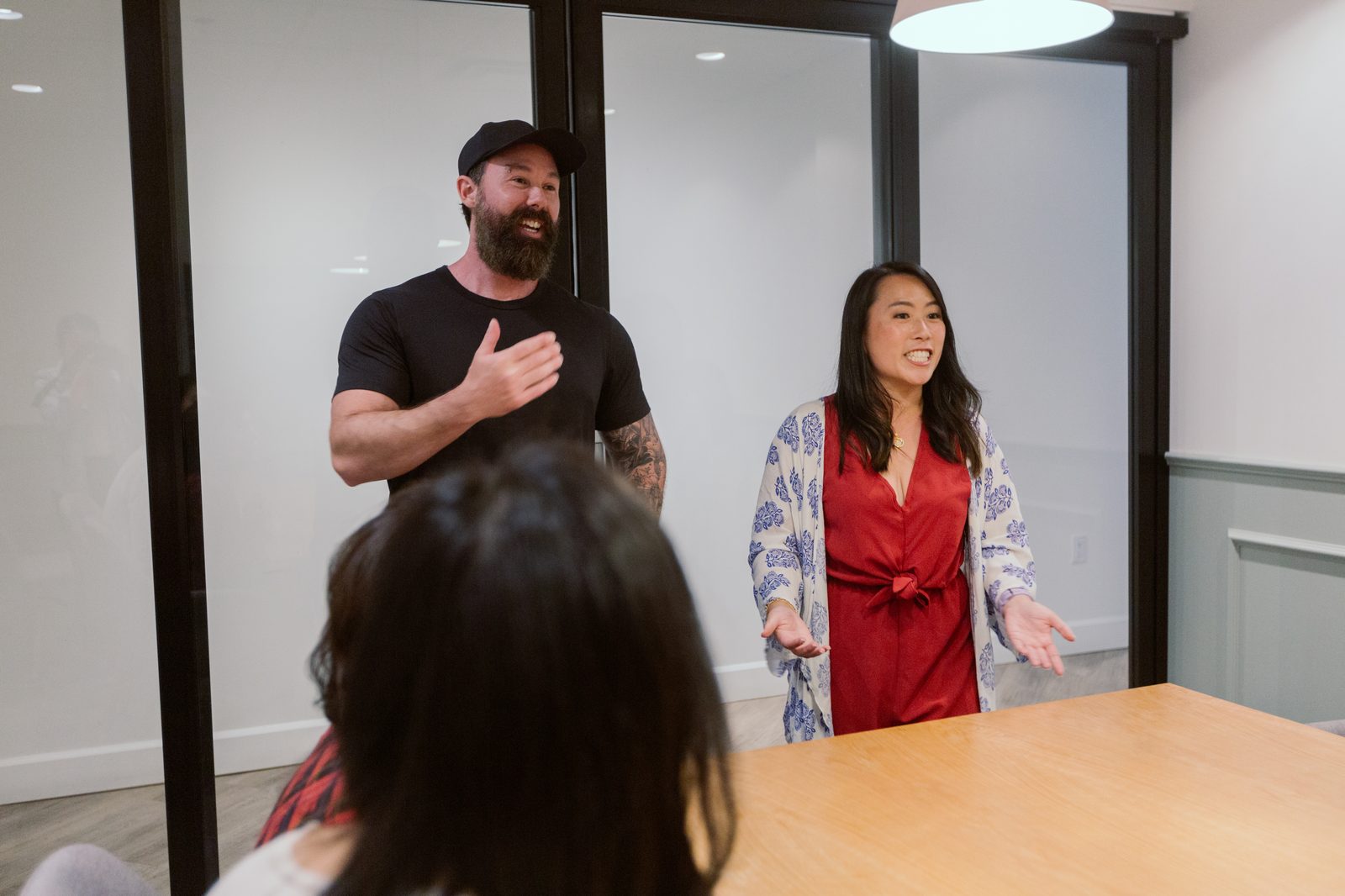
Coaching turns “I should eat more protein” into a week you can repeat.
Why TurnFit for protein, strength, and midlife women?
TurnFit exists for people who want results without guessing — midlife women especially, done with programs that ignore hormones, posture, and real schedules.
- 240+ reviews from clients who stayed because coaching worked
- 8× Top Choice recognition in Vancouver
- 7-day risk-free start so you feel the difference before a long commitment
- Training in Kitsilano (3311 W Broadway), Downtown Vancouver (180 W Georgia), and online across Canada
We coach training and help apply 40/30/30 inside your life. We do not sell shame or pretend a PDF meal plan replaces a human who adjusts when the week explodes.
Important: a personal trainer is not a physician and not a dietitian. We do not diagnose, prescribe clinical diets, or replace medical or dietetic care.
Curious about investment later? Pricing is here — this post is about muscle and energy, not sticker shock.
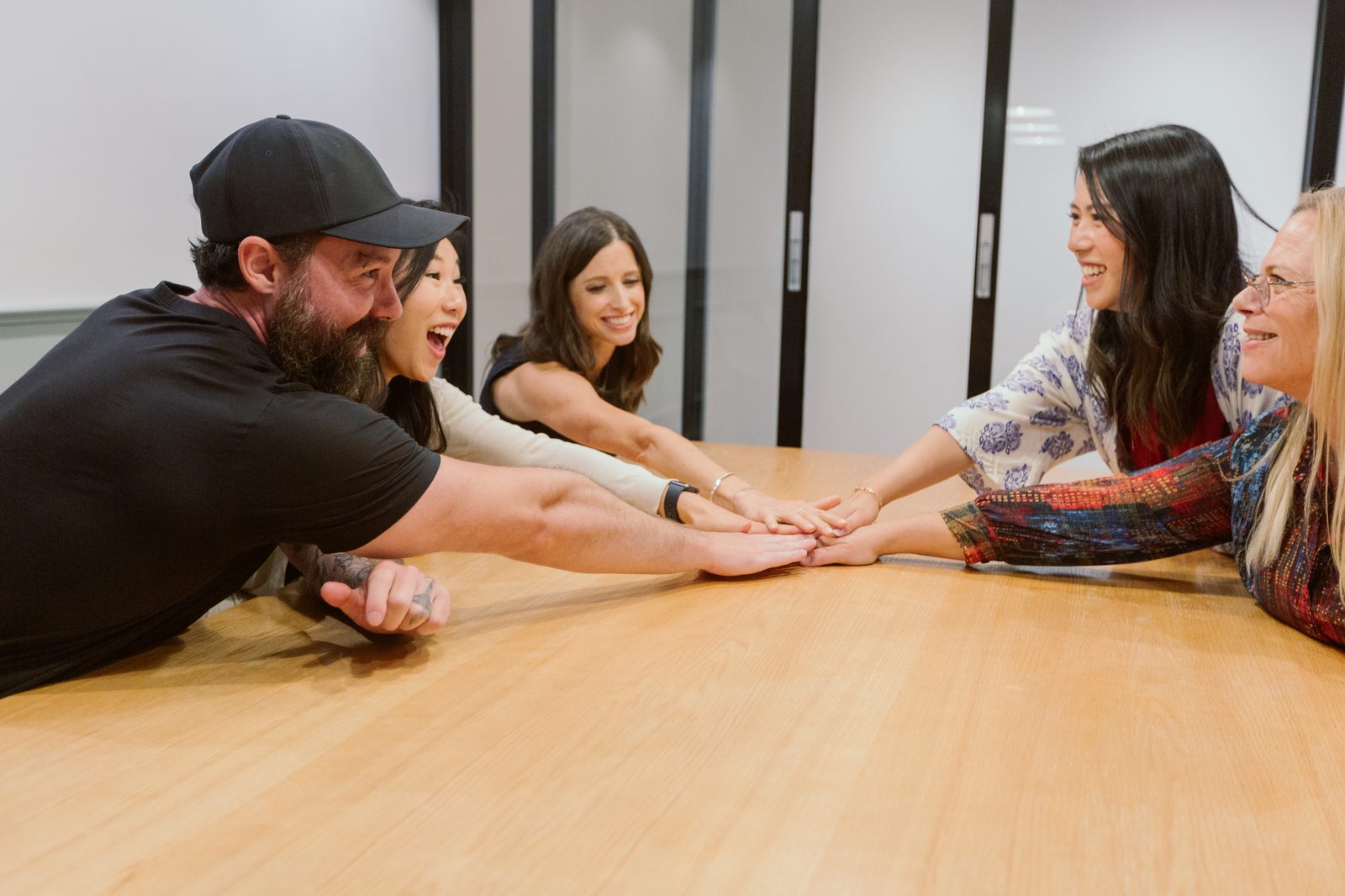
Posture-first strength + fuel that matches — that is the TurnFit lane.
Key takeaways
- Protein after 40 for women is often the missing lever when “healthy” eating still leaves you soft and tired.
- The midlife muscle gap = sarcopenia risk (~3–8% per decade after 30) + under-fueling — closable with protein + strength.
- TurnFit’s rule: 40% protein / 30% carbs / 30% fat (e.g. ~2000 kcal → ~200 g / ~150 g / ~67 g) — framework, not prescription.
- Low-cal chicken-and-broccoli plans fail busy women because they are brittle and under-fuel training.
- Use protein anchors at every meal; consistency beats perfection.
- Pair protein with progressive strength 2–3× per week.
- Personalize with coaching; clinical nutrition belongs with a physician or RD.
- Kitsilano, Downtown, or online: book a free 5-minute assessment.
FAQ
How much protein do women over 40 need day to day?
Enough to support muscle and training — often more than a salad-heavy “clean” plate. TurnFit’s rule is 40% of calories from protein, with carbs and fat at 30/30 (e.g. 2000 kcal → roughly ~200 g / ~150 g / ~67 g). Starting lens we personalize — not a medical prescription. Bigger frame: feel better in your 40s than your 30s.
Is 40% of calories from protein safe?
For many healthy adults pursuing muscle and satiety, higher protein is common in coaching — but “safe for you” depends on medical history, kidney function, and overall diet. 40/30/30 is a training-nutrition framework, not medical advice. Kidney disease, pregnancy, disordered-eating history, or relevant medications → talk to your physician or RD first.
Do I need protein shakes after 40?
No. Convenient, not mandatory. Whole-food first; powder when life gets loud. Use them without drama — or skip them and build the hit-list above.
Is TurnFit training a substitute for a doctor or dietitian?
No. We support movement, habits, and practical nutrition frameworks. A trainer is not a physician and not a dietitian. Clinical care stays with your care team.
Can vegetarian or vegan women hit these protein targets?
Yes — with intention. Soy, dairy if included, legumes + grains, seitan, mycoprotein, fortified options. More planning per gram; logistics, not destiny. We coach within your values.
I’m scared of “eating more” or lifting heavy — where do I start?
Assessment and coaching — not a stranger’s deadlift or a crash-diet rebound. We meet your joints, history, and schedule, then progress protein anchors and load together. See pain-free personal training for Vancouver women.
What’s the first step — Kitsilano, Downtown Vancouver, or online?
Book a free 5-minute assessment call. Tell us Kitsilano (3311 W Broadway), Downtown (180 W Georgia), or online Canada-wide — and what stronger muscle and better energy mean in your calendar.
Ready to start?
If you have been eating “healthy” and still feeling soft and tired, the midlife muscle gap is not a character verdict. It is a fuel-and-training problem with a practical fix.
TurnFit Personal Trainers — Kitsilano · Downtown Vancouver · Online Canada-wide
- 240+ reviews · 8× Top Choice · 7-day risk-free start
- Protein frameworks + posture-first strength for women over 40
Book your free 5-minute TurnFit assessment →
Bring questions about protein, strength, and a week you can repeat. We will meet you there.
Sources
- Osteoporosis Canada — Sarcopenia: progressive loss of muscle mass, strength, and performance; ~3–8% per decade after 30; menopause hormonal changes contribute; links to falls, fractures, and osteosarcopenia.
- Broader healthy-ageing protein guidance (including expert statements involving University of Exeter researchers / BASES summaries) commonly notes that optimal intakes for older adults preserving muscle often exceed basic RDAs, often discussed around ~1.0–1.2 g/kg/day and higher with resistance training — ranges, not one magic number. TurnFit’s 40/30/30 is our memorable client framework layered on that conversation, not a claim every journal mandates exactly 40% protein.
This article is for education and coaching context only. It is not medical advice and is not a substitute for care from a physician or registered dietitian.
Related reading: Feel better in your 40s than your 30s · Strength training after 40 — longevity blueprint · Menopause exercise & bone density · Perimenopause strength training in Vancouver · Canadian healthcare & muscle loss · Pain-free training for women · Online training · Pricing · Free assessment
Ready to Start Your Fitness Journey?
At TurnFit, we offer in-person personal training at our Kitsilano and Downtown Vancouver locations, online coaching programs with live Zoom calls, and online personal training across Canada. Check out our transparent pricing — no contracts, no hidden fees.
Book a Free 5-Minute Call →