Can you still build muscle after menopause? Yes. The process may deserve more patience and better planning, but menopause does not remove your ability to adapt to strength training. Current research continues to support resistance training for women before, during, and after menopause, including improvements in strength, muscle, balance, and body composition.
That is good news, but it is not a reason to copy a twenty-year-old’s workout or chase exhaustion. The most useful plan for a woman in her forties, fifties, or beyond is one that respects recovery, starts from her current ability, and progresses with enough consistency to create a signal her body can use.
In my work with women, I focus on what you can build: stronger legs, a more capable upper body, better balance, more confidence carrying and lifting, and a routine that supports your life instead of taking it over.
What changes after menopause, and what does not
The menopause transition can bring changes in sleep, body temperature, mood, recovery, and how easy it feels to maintain muscle. Those experiences vary widely. Some women notice hot flashes and disrupted sleep; others notice joint stiffness, reduced energy, or a change in body composition. You may experience several changes at once, or very few.
What does not change is the basic training principle: your body responds to a clear, repeated challenge. Muscles become stronger when they are asked to produce force and are given the time, food, and recovery required to adapt. You do not need to be symptom-free or perfectly motivated to start.
Hormone therapy, medication, nutrition, and medical conditions are individual health matters. Discuss those with your physician or another qualified healthcare professional. Training can complement medical care, but it does not replace it.
The 12-week framework
A twelve-week plan gives you enough time to practice movements, build tolerance, and notice meaningful changes without demanding that every week feel the same. I divide it into three four-week blocks.
- Weeks one to four: Establish. Train two days per week, using manageable loads and controlled repetitions. Learn the movement patterns, note how you recover, and finish sessions feeling that you could have done a little more.
- Weeks five to eight: Progress. Add a small amount of resistance, an extra set, or a few repetitions when your technique is stable. Do not change every variable at once. The goal is a measurable improvement that you can repeat.
- Weeks nine to twelve: Consolidate. Keep the movements familiar and work closer to your current capacity on selected exercises. Use the final week to review strength, balance, confidence, and recovery instead of judging the plan only by the scale.
Some women will thrive on two sessions. Others will eventually prefer three shorter sessions. More is not automatically better. The right frequency is the one that lets you train hard enough to progress and recover well enough to return.
Build each session around five movement patterns
Choose one exercise from each group. A coach can adjust the range, support, equipment, and load to match your starting point.
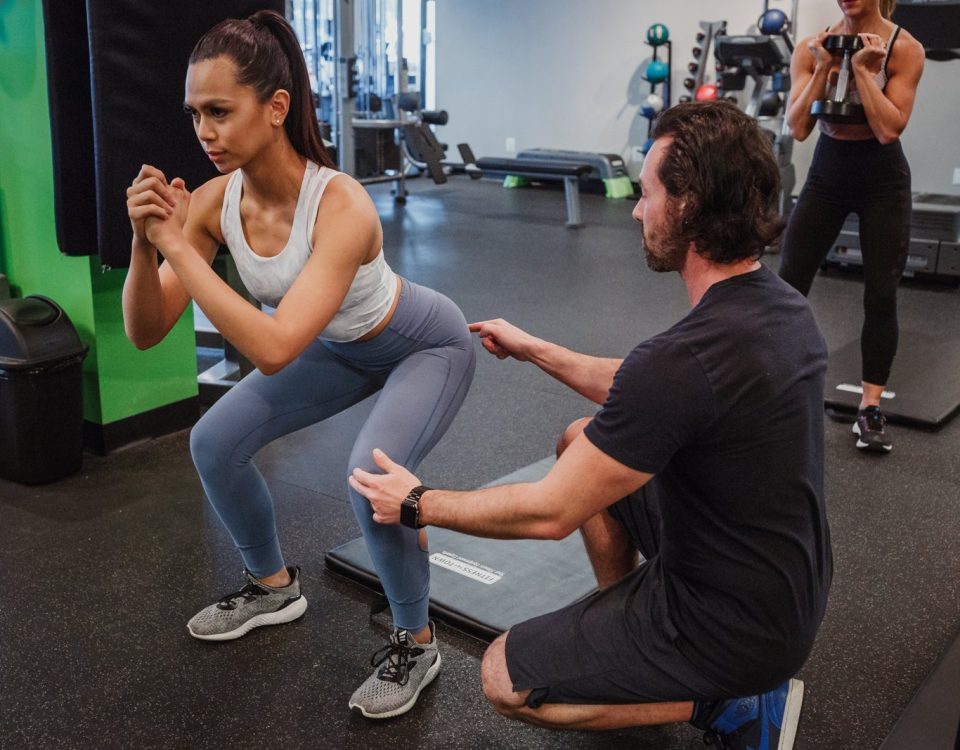
- Knee-dominant strength: Sit-to-stand, goblet squat, split squat with support, or a leg press. Use a range that feels controlled and lets your knee track comfortably.
- Hip-dominant strength: Romanian deadlift, hip thrust, or cable pull-through. These train the glutes and hamstrings while teaching you to create force through the hips.
- Upper-body push: Wall push-up, incline push-up, dumbbell press, or machine press. Keep your ribs and shoulders controlled rather than forcing a deep range.
- Upper-body pull: Band row, cable row, chest-supported dumbbell row, or pulldown. Strong pulling muscles support carrying, reaching, and upper-back endurance.
- Balance and trunk control: Supported single-leg stance, suitcase carry, dead bug, or side plank. Start with support and progress only when you can maintain control.
Two or three sets of six to twelve quality repetitions works well for many exercises, but those numbers are not a rule you must obey. A lighter load for more repetitions can be appropriate, as can a heavier load for fewer repetitions when technique and supervision are in place.
How hard should the workout feel?
Use effort, not pain, as your guide. A useful set may feel challenging near the end while still allowing you to maintain form. You might finish with two or three good repetitions left in reserve. Over time, you can work closer to your limit on selected exercises, but every set does not need to become a test.
Watch your recovery across the next twenty-four to forty-eight hours. Normal muscle fatigue is different from sharp joint pain, worsening symptoms, or exhaustion that affects your daily life. If recovery is poor, reduce the load, shorten the session, or take a rest day. Good training includes the ability to adjust.
Sleep disruption can also change your readiness. On a night when hot flashes or stress have kept you awake, keep the appointment but change the goal. A technique session, easy walk, or two conservative sets can maintain momentum without demanding a performance your body cannot give that day.
Support muscle with the basics
Strength training provides the signal; nutrition and recovery help you use it. Aim to include a source of protein at meals, eat enough to support your activity, and include carbohydrates around training if they help your energy. You do not need a perfect meal plan or a collection of supplements to begin.
Hydration, sleep, and stress management also affect how training feels. If your sleep is poor, your plan may need fewer hard sessions and more deliberate recovery. That is not weakness. It is intelligent programming.
Keep track of the evidence that matters to you. Write down weights, repetitions, and how the movement felt. Notice whether stairs feel easier, whether you can carry groceries with more confidence, or whether you recover from a hike more comfortably. These outcomes can appear before a scale changes.
When pain or stiffness needs a different strategy
Women often arrive at training believing that stiffness means they should only stretch or that pain means they should stop all strength work. Both conclusions can be too broad. A movement may need a smaller range, more support, less load, or a different variation. A healthcare professional should assess new or persistent symptoms, while a trainer can help you modify exercise within their scope.
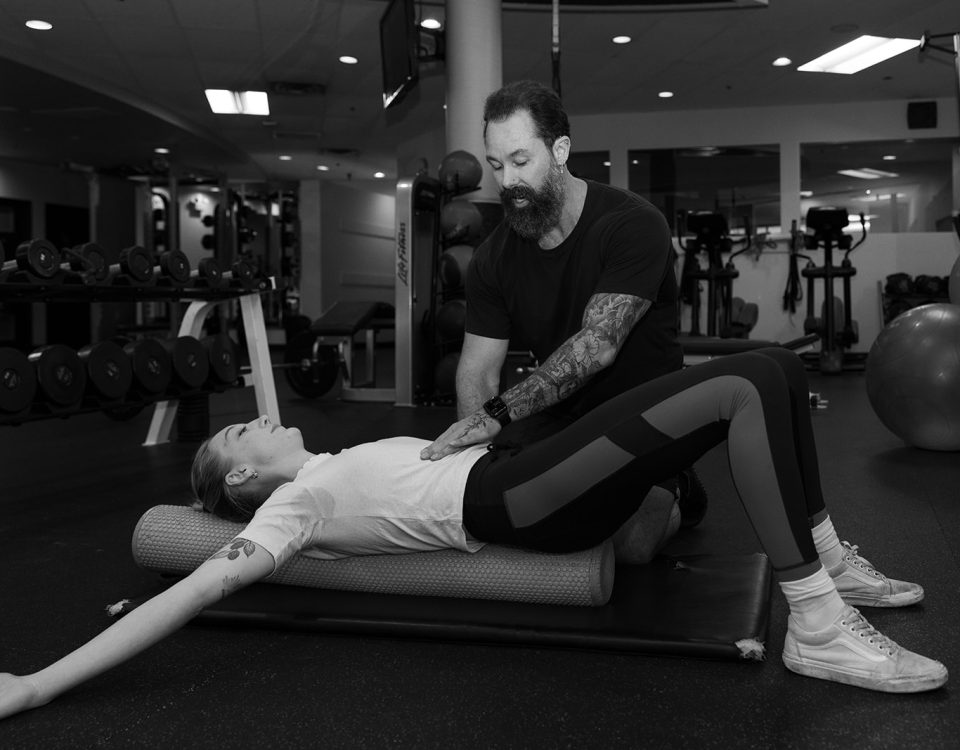
For desk-related neck, shoulder, hip, and upper-back stiffness, TurnFit’s posture and mobility approach combines movement preparation with strength and control. The objective is not to chase a dramatic stretch. It is to help you move confidently through the ranges you need.
Personalize the plan instead of guessing
A useful starting point is an assessment that considers your history, goals, symptoms, equipment, schedule, and current strength. I can then choose exercises that challenge you without treating age or menopause as a diagnosis.
Women in Kitsilano and Downtown Vancouver may prefer the feedback and accountability of in-person training. If you live elsewhere in Canada or need a plan that works around travel, online training can provide structured programming, video feedback, and adjustments without requiring a Vancouver commute.
Start where you are and build from there
Getting stronger after menopause is not about proving that your body has not changed. It is about giving your current body a clear opportunity to become more capable. Begin with two repeatable sessions, choose movements you can control, and progress one variable at a time.
If you want help building the first four weeks, book a TurnFit assessment. You are not too late, too old, or too far behind. Your next adaptation starts with the next well-planned session.
Ready to Start Your Fitness Journey?
At TurnFit, we offer in-person personal training at our Kitsilano and Downtown Vancouver locations, online coaching programs with live Zoom calls, and online personal training across Canada. Check out our transparent pricing — no contracts, no hidden fees.
Book a Free 5-Minute Call →