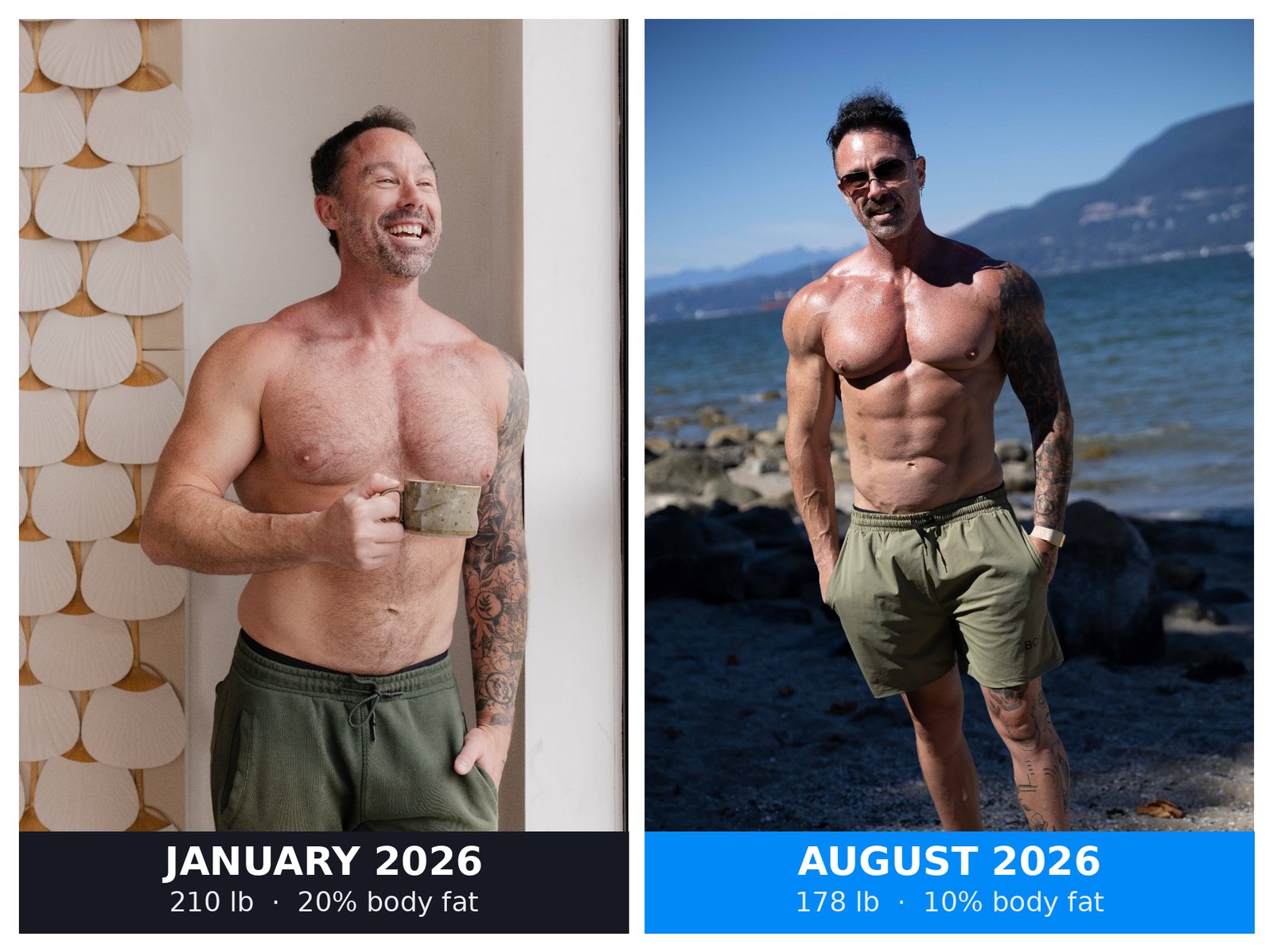
210 lb → 178 lb. 20% body fat → 10%. Eight months. Here’s the full system.
My 2026 Longevity Stack: What I Actually Did to Drop 32 Pounds and Cut My Body Fat in Half
TL;DR: In January 2026 I decided to stop giving advice I wasn’t following at 100% intensity myself. I built a longevity stack — seven pillars of evidence-based habits plus a physician-supervised prescription protocol — and ran it hard for eight months. The result: 210 lb at 20% body fat down to 178 lb at 10% body fat. Skin tighter, hair and nails growing faster, joints stronger, recovery through the roof. This post is the full system, the exact supplements I use, and where to actually buy them. Read to the end for the CTA — that’s where I tell you what I don’t put in writing.
This is my personal experience. I am a certified personal trainer, not a physician. Any prescription-based intervention referenced was prescribed and is monitored by a licensed Canadian medical doctor. If you’re considering anything medical as part of your own longevity plan, talk to your doctor — that’s non-negotiable.
Why I finally stopped talking and started running the experiment on myself
I’ve spent 20 years telling clients that consistency compounds, that prevention beats reaction, and that most health problems are simpler to solve than people think — they just require the right systems, knowledge, and consistency.
By January 2026 I realized I was giving that advice at maybe 70% intensity in my own life. Good, not great. So I made a decision: I was going to run the full playbook on myself for eight months, track everything, and see what the ceiling actually looks like when a coach applies his own advice without compromise.
The results changed how I think about aging entirely. And they made me want to publish this because most Canadians are being sold a version of “healthspan” that’s either watered down (30-minute walks) or unattainable (six figures a year for anti-aging clinics). The real answer is in the middle. Seven boring pillars. Consistency. And one honest conversation with the right physician.
Why longevity is the only word in fitness that matters now
For decades, fitness marketing sold two words: lose and gain. Lose 20 pounds. Gain 10 pounds of muscle. Fine short-term goals, but they miss the point.
The point is your healthspan — how many years you get to live feeling strong, sharp, and mobile. Not lifespan (how long you live), but healthspan (how long you live well).
In Canada, this matters more than most people realize. Statistics Canada’s most recent physical activity data shows the majority of Canadian adults still don’t meet the recommended 150 minutes of moderate-to-vigorous physical activity per week — and sedentary time keeps climbing. Sarcopenia — the age-related loss of muscle mass — starts as early as age 30 and accelerates after 50, and it’s one of the strongest predictors of frailty, falls, and loss of independence in your 70s and 80s.
The healthcare system won’t catch this. It only treats you once you’ve broken. Prevention is on you. And the right stack of habits, applied consistently, gives you an enormous head start.
My 2026 longevity stack: the seven pillars
Here’s the exact framework I’ve run since January, in the order of impact I’ve experienced.
Pillar 1 — Resistance training, 6 days a week on a push/pull/legs split
If I could only keep one thing in this stack, it would be this. Full stop.
A 2023 study in Nature’s Scientific Reports found that 16 weeks of resistance training in middle-aged women rejuvenated aging skin at the cellular level — improved dermal thickness, reduced inflammatory factors, boosted collagen expression. Same result you’d expect from expensive skin treatments, from lifting weights.
Add to that:
- Muscle mass is the #1 modifiable predictor of longevity after age 40
- Bone density gains reduce fracture risk (fractures are a top cause of death in seniors)
- Insulin sensitivity, resting metabolic rate, joint stability, connective tissue strength — all improved
My routine: A classic push/pull/legs split — Push, Pull, Legs, Rest, Push, Pull, Legs. Six training days, one full rest day. 45–60 minutes per session. Compound movements first (squat, hinge, bench, row, overhead press, pull-up), accessory work second, progressive overload tracked in a notebook.
Important context: I run 6 days a week because my recovery capacity right now — as part of the physician-guided peptide and hormone optimization protocol I’ll cover in Pillar 7 — is high enough to support that frequency. For most people I’d start with 3–4 sessions per week and only add frequency once recovery, sleep, and nutrition are locked in. More sessions do not equal better results — better recovery does.
Pillar 2 — 220 g of protein a day (120 g from whey isolate)
The standard Canadian Food Guide protein recommendation (0.8 g/kg) is set to prevent deficiency, not optimize muscle preservation. If you’re over 35 and want to hold onto muscle, you need more.
Research on protein and aging consistently supports 1.6–2.2 g/kg of bodyweight per day, distributed across 3–4 meals, with at least 30 g per meal to trigger muscle protein synthesis.
At 178 lb (81 kg), on a 6-day training week, I run my intake on the high end: ~220 g of protein daily, with 120 g coming from whey isolate across two shakes. The remaining ~100 g is whole food — meat, eggs, dairy.
I buy my whey and my vitamins from Canadian Protein because it’s Canadian-made, third-party tested, and roughly half the price of the brand-name stuff. Use code TRAIN15PERC for 15% off your order — it’s the same code my clients use.
My routine:
- Breakfast: 60 g protein shake (Canadian Protein whey isolate)
- Lunch: chicken, salmon, or steak with vegetables and complex carbs
- Post-workout: 60 g protein shake (Canadian Protein whey isolate)
- Dinner: chicken, salmon, or steak — again
- Before bed (on hard training days): cottage cheese, Greek yogurt, or hard-boiled eggs
- Snacks: Grenade Salted Caramel Protein Bars (the only flavour I actually love — buy on Amazon) and Quest Protein Chips (buy on Amazon)
That’s it. Nothing exotic. Just protein, hit consistently, spread across the day.
Pillar 3 — 7 to 9 hours of real sleep (the underrated multiplier)
Sleep is where your body actually adapts to everything else you do. Skimp on it and you undo the training, the nutrition, and the recovery.
A 2020 meta-analysis in BMC Public Health found a U-shaped relationship between sleep duration and all-cause mortality — with both short (<6 hours) and excessive (>9 hours) sleep associated with higher mortality risk. Sleep’s role in immune function is equally well-established: chronic sleep debt suppresses immunity and elevates inflammation.
Bonus: deep sleep is when your body naturally produces its largest pulse of growth hormone. Fix your sleep and you’re already optimizing your natural GH secretion for free.
My routine: In bed by 10:00 PM, out at 6:00 AM. Room is 20 °C and blackout dark. Magnesium and ZMA (see Pillar 6) 30 minutes before lights out. Sleep is where the physician-guided piece in Pillar 7 does most of its work — recovery signals only fire when you actually give your body the runway.
Pillar 4 — Walking, 2 to 3 hours a day (thanks to Juhee)
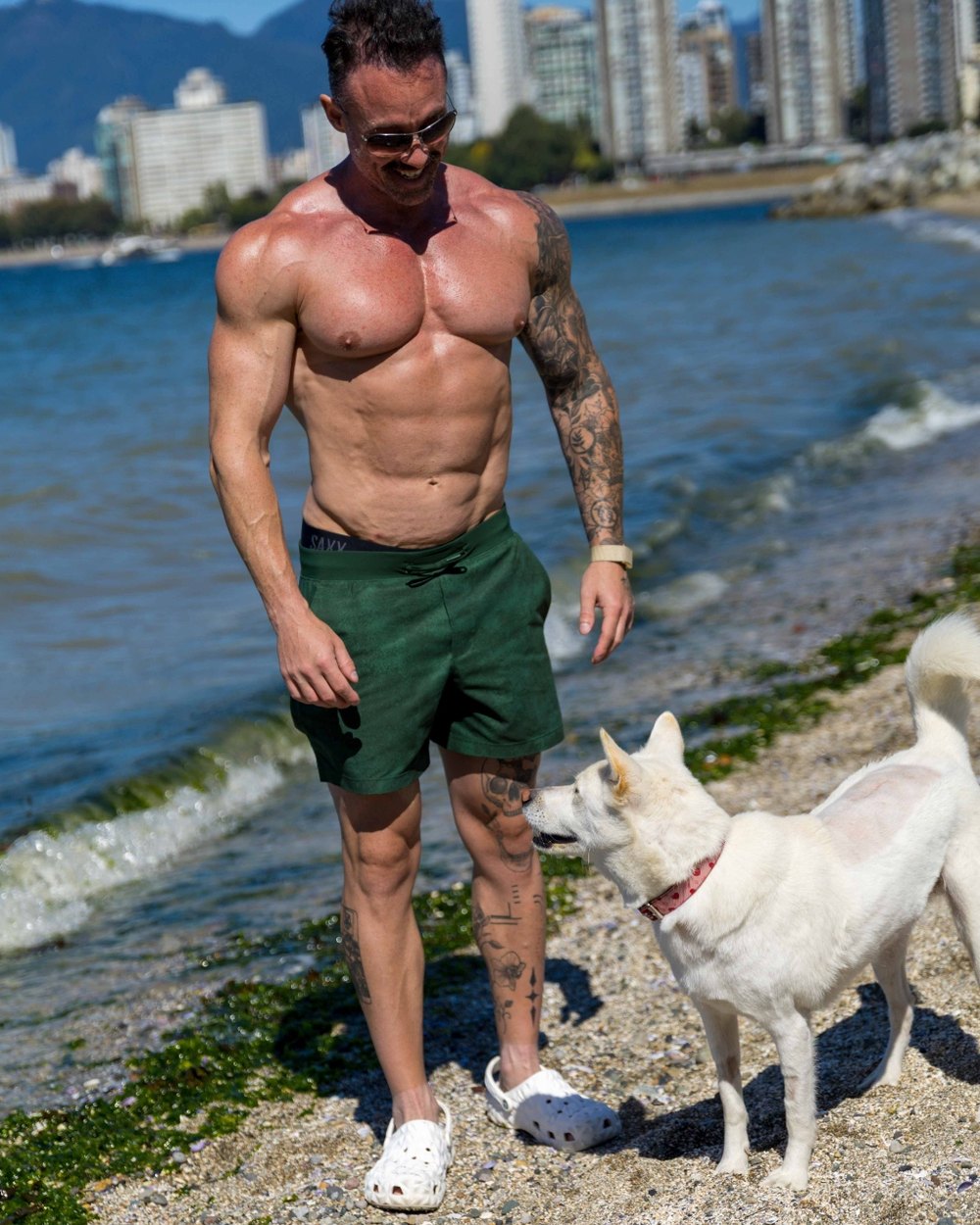
I don’t do formal Zone 2 cardio sessions. I don’t need to. My daily walk volume is already there because of Juhee, my Korean Jindo. She gets 2–3 walks a day at a mild-to-fast pace — which adds up to 2 to 3 hours of walking daily (minus the stops to sniff every scent and mark every tree we pass, which she takes very seriously).
Here’s why this matters more than most people realize: walking at a conversational pace is the definition of Zone 2 cardio — the training zone that builds mitochondrial density and metabolic flexibility, both massive drivers of long-term health. Peter Attia’s longevity framework prescribes 3–4 hours per week of Zone 2. I’m doing 14–21 hours a week just by owning a dog.
Dog-walking as cardio isn’t a workaround. It’s the highest-adherence cardio protocol I’ve ever seen — because you’re not doing it for yourself, you’re doing it for a dog who will absolutely hold you accountable at 6 AM regardless of the Vancouver weather.
Add one weekly high-intensity session for VO₂ max: VO₂ max is one of the strongest predictors of all-cause mortality. Once a week I add 6× 3-minute intervals at high intensity — on an Airdyne, on an incline treadmill, or hiking a steep grade. That’s the only “formal” cardio I do.
If you don’t have a dog: aim for 30 minutes of walking after each of your three main meals (breakfast, lunch, dinner). It hits the same Zone 2 target, improves post-meal blood sugar, and doesn’t require a gym.
Pillar 5 — Hot bath + cold shower contrast therapy (my sauna substitute)
The Finnish sauna cohort study — 2,315 middle-aged men followed for 20+ years — found that 4–7 sauna sessions per week was associated with a 50% reduction in cardiovascular mortality compared to 1 session per week. Bigger effect than most cardiovascular drugs.
Not everyone has access to a sauna. I don’t own one. Here’s what I do instead, 3–4 times a week:
- Hot bath — as hot as I can comfortably tolerate, with 2 cups of Epsom salts, for 20 minutes. This raises core body temperature and triggers a lot of the same heat-shock protein response the sauna literature is built on.
- Cold shower — immediately after, 2–3 minutes cold as it’ll go. Cold exposure triggers a norepinephrine spike, improves mitochondrial function, and (subjectively) does more for my post-training soreness than any recovery tool I own.
The formal science on hot-bath heat therapy is younger than the sauna literature, but the mechanisms (heat-shock proteins, endothelial function, HRV improvements) are shared. The cold-shower add-on stacks a second, complementary stressor on top. Combined, they cover most of what a sauna would do for me — for the cost of Epsom salts.
My routine: 3–4× per week, usually post-training. 20 minutes hot, 2–3 minutes cold. Two-tap system that any Vancouver apartment can run.
Pillar 6 — My exact supplement stack (and where I buy it)
Supplements are supplements — they don’t replace the pillars above. But a small, evidence-based stack punches above its weight after 40.
A 2025 systematic review of creatine and cognition in aging confirmed creatine’s benefits extend well beyond the gym — improved short-term memory and reasoning in older adults, especially when combined with resistance training. It’s cheap, safe, and one of the most-studied supplements in existence.
Here’s what I actually take, daily:
- Whey isolate — 120 g protein target/day (from Canadian Protein, code TRAIN15PERC for 15% off)
- Creatine monohydrate — 20 g/day (Canadian Protein)
- Omega-3 (EPA/DHA) — 2–3 g daily (Canadian Protein)
- Vitamin D3 — 4,000 IU daily, non-negotiable in a Vancouver winter (Canadian Protein)
- Vitamin B complex — daily (Canadian Protein)
- Magnesium glycinate — 300–400 mg before bed (Canadian Protein)
- ZMA — with magnesium before bed for sleep and recovery (Canadian Protein)
- Liver support — Liver HD: buy on Amazon
- Essential amino acids — sipped between meals for lean tissue support: buy on Amazon
- Psyllium husk — daily fibre for gut health and cholesterol: buy on Amazon
These Amazon links are affiliate links — if you buy through them I earn a small commission at no extra cost to you, which helps me keep this content free and produced.
Pillar 7 — Physician-guided peptide and hormone optimization
This is the pillar people ask me about most — and the one where I have to draw a careful line.
Since January 2026 I’ve been on a physician-guided peptide and hormone optimization protocol as part of my longevity approach. It was prescribed by a licensed Canadian physician after full bloodwork, is monitored on ongoing labs, and is re-evaluated regularly. Everything is legal, supervised, and appropriate for my age, health profile, and goals — as determined by a clinician, not a coach.
What I will say publicly:
- The recovery, sleep quality, and body-composition changes I’ve experienced this year are meaningfully greater than what I’ve been able to produce from training + nutrition alone in past years
- This kind of protocol is not a starting point — it’s a layer that goes on top of the six pillars above, only after those are locked in and only under a physician’s care
- Cost, supervision, and lab monitoring are non-trivial. It’s not a shortcut. It’s a serious commitment.
What I won’t say publicly: which specific compounds, dosages, frequencies, or sourcing pathways. Those aren’t blog details. They’re a conversation between you and a doctor — mine or your own.
If you’re curious whether something similar might be appropriate for you, the right first step is a full bloodwork panel with a physician who works in preventative or longevity medicine. I can point you at the panel I ran and refer you to the physician I personally used. That’s what the consult call at the bottom of this post is for.
What I’ve experienced in eight months
Here’s what actually changed:
- Body composition: 210 lb → 178 lb. 20% body fat → 10%. That’s the headline.
- Skin: tighter, brighter, fewer fine lines. My wife noticed before I did.
- Hair and nails: visibly faster growth, thicker, less breakage.
- Joints and ligaments: knees and shoulders that used to complain during heavy training don’t anymore. Recovery between sessions is dramatically shorter — which is exactly why I can run a 6-day split at my age.
- Energy and mood: steadier all day. No 3 PM crash. Better focus during coaching.
- Sleep: deeper, more consistent, waking rested without an alarm.
The caveat you need to hear: I can’t cleanly attribute any single change to any single pillar. Resistance training alone rebuilds collagen, tightens skin, and lowers body fat. Protein drives muscle protein synthesis. Sleep affects hair, nails, skin, mood, and recovery. Contrast therapy improves skin and cardiovascular function. Everything I did stacked together — and the physician-guided piece amplified the recovery capacity that made the training frequency possible.
What I can tell you is that the changes are real, they compound, and they came from consistency — not from any single silver bullet.
How to build your own longevity stack
You don’t need to add all seven pillars on day one. Please don’t. Here’s how I’d sequence it:
Weeks 1–4: Resistance training + protein. Three sessions a week (not six — build the base first), 1.6 g/kg of protein daily. These two alone will change your body composition, energy, and confidence more than anything else.
Weeks 5–8: Sleep + walking. Fix your sleep window (same in-bed and wake time, 7–9 hours), and get to 30 minutes of walking after each main meal — or get a dog. Whichever you can commit to.
Weeks 9–12: Contrast therapy + supplements. Add 3× weekly hot bath + cold shower, creatine, vitamin D, and omega-3.
Beyond week 12: If you’re crushing all of the above and want to explore more, that’s the conversation to have with a physician who works in longevity medicine — not a coach, not the internet.
Ninety percent of the results come from pillars 1 through 6. If you never touch a prescription of anything, you can still look, feel, and move like someone 10 years younger by doing the boring foundational stuff consistently.
Frequently asked questions
Do I need to train 6 days a week to see longevity results?
No — and please don’t start there. Three sessions per week hits the evidence-based minimum for muscle protein synthesis and delivers the majority of the benefit. I train 6 days a week because I’ve built the recovery capacity to support it under physician supervision. Most people would see life-changing results from 3–4 quality sessions a week — and would burn out or plateau by adding more.
Is 220 grams of protein a day too much?
For a healthy adult at 178 lb who trains 6× per week, it’s on the high end of the evidence-based range (1.6–2.2 g/kg) and matches my recovery demand. Multiple systematic reviews find no adverse effect of high-protein diets on renal function in healthy adults. If you have existing kidney disease, that’s a different conversation with your doctor. Most people don’t need to run this high — they just need to hit their target consistently.
Is 20 grams of creatine a day too much?
It’s on the higher end. Most research uses 3–5 g/day for maintenance, with an optional 20 g/day loading phase for the first 5–7 days. I personally run higher because I recover from heavy training better on it and creatine has an exceptionally safe long-term profile. Start with 5 g/day and see how you feel — that’s what I’d tell any client.
Does walking my dog really count as cardio?
Yes — and it might be the best cardio you can do. Walking at a mild-to-moderate pace sits squarely in Zone 2 cardio, which builds mitochondrial density and metabolic flexibility. Consistency matters more than intensity in this zone, and dog owners get consistency for free. Add one weekly high-intensity interval session and you’ve got a complete cardio program.
Can I really replace a sauna with a hot bath and cold shower?
The formal science on hot-bath heat therapy is younger than the Finnish sauna literature, but the mechanisms are shared — heat-shock protein activation, endothelial function, improved HRV. Add a cold shower for the norepinephrine and mitochondrial benefits and you cover most of the ground for a fraction of the cost. Not identical to a proper sauna, but a legitimate substitute.
How do I naturally boost growth hormone without prescriptions?
Three things drive natural GH secretion: high-intensity exercise, deep sleep, and periods of fasting or low insulin. Nailing pillars 1, 3, and (indirectly) 2 optimizes GH secretion naturally. This is why athletes in their 20s often have GH profiles similar to teenagers — training + sleep + nutrition does most of the work.
Can women follow this same stack?
Yes, with two adjustments: protein target usually lands at the lower end of the range (1.4–1.8 g/kg is often plenty for women), and cycle-tracking is helpful for adjusting training intensity across phases. If perimenopause is on the horizon, resistance training becomes more important, not less. We wrote a full guide on perimenopause strength training that covers this in depth.
What blood work should I be tracking?
At minimum: a full lipid panel, HbA1c, fasting insulin, hs-CRP, vitamin D, ferritin, and a comprehensive metabolic panel — annually. A physician who works in preventative medicine can add hormones, ApoB, Lp(a), and other markers based on your situation. Your family doctor can order most of these. If they push back, ask why. If you want the exact panel my doctor ran on me before we designed my protocol, that’s what a longevity consult is for.
Want the exact protocol, doctors, and dosages I use?
This blog is the public version of what I do. There’s a lot more that I don’t put in writing — the specific physicians I used, the full bloodwork panel we ran, the exact compounds and dosages in my Pillar 7 protocol, and how I structure the day-to-day. That’s not information that belongs in a blog post. It belongs in a real, private conversation between two adults.
If you’re serious about building your own longevity stack — and you want the version of this conversation where I can actually answer your specific questions — book a longevity consult with me. That’s the room where the real conversation happens.
Prevention beats reaction. Every time. Start now.
David Turnbull is the founder of TurnFit Personal Trainers in Vancouver, BC. Nothing in this article constitutes medical advice. Any prescription-based intervention referenced was prescribed by a licensed Canadian physician after clinical assessment and is monitored with ongoing lab work. If you’re considering any medical intervention as part of a longevity approach, speak to your family doctor first.
Ready to Start Your Fitness Journey?
At TurnFit, we offer in-person personal training at our Kitsilano and Downtown Vancouver locations, online coaching programs with live Zoom calls, and online personal training across Canada. Check out our transparent pricing — no contracts, no hidden fees.
Book a Free 5-Minute Call →