Guest post: This article was written for the TurnFit blog by Dr. Venous Salehi, DC, Partner and Chiropractor at HealthMax Physiotherapy Clinics.
TL;DR: A squat is not controlled by your hips and knees alone. Your ankles and hips have to supply enough movement to reach the depth you are training, and when they cannot, your body finds that range somewhere else — often through your pelvis and lower back. Research backs this up: lifters with limited ankle dorsiflexion squat with measurably more lumbar flexion, more pelvic movement, and more trunk lean (Zawadka et al., 2025, Journal of Manipulative & Physiological Therapeutics). That does not mean your back is being injured, and it does not mean there is one correct squat. It means the goal is enough mobility for the squat you actually want to train, plus the strength and control to use it.
Squats are one of the most effective exercises for building strength throughout the lower body. They train the quadriceps, glutes, hamstrings, and core, while also teaching the body how to coordinate multiple joints through a loaded movement.
However, as you add weight to the bar, technique becomes increasingly important. Your ankles and hips need enough mobility to allow you to reach your desired depth while maintaining control. When one or both of these areas are restricted, your body may find another way to complete the movement, sometimes placing additional demands on your lower back.
Limited ankle or hip mobility does not automatically cause back pain, nor is there one “perfect” squat technique for everyone. Understanding how mobility can influence movement mechanics can help you train more effectively and identify areas that may benefit from targeted mobility work.
Why does mobility matter during a squat?
A squat requires coordinated movement at the ankles, knees, hips, and spine. As you lower into the movement, your knees and hips bend while your ankles move into dorsiflexion, meaning your shin moves relative to your foot. At the same time, your trunk needs to maintain an appropriate position to keep the weight balanced over your base of support.
Everyone’s squat will look slightly different. Limb length, hip structure, training experience, footwear, joint mobility, and individual anatomy can all influence squat mechanics. There is not a single body position that every person needs to reproduce. However, you do need sufficient movement at the relevant joints to perform the version of the squat you are attempting. If one joint cannot provide the movement required, other parts of the body may have to compensate.
This is measurable, not theoretical. In a study of 101 healthy adults, ankle dorsiflexion range and hip flexion range were the variables most strongly associated with how deep someone could squat (Kim et al., 2015, Journal of Human Kinetics). Depth is not purely a matter of effort or willingness. It is partly a matter of available range.
How does limited ankle dorsiflexion change your squat?
Ankle dorsiflexion allows your knees to travel forward as you descend into a squat. If your ankle does not move comfortably through dorsiflexion, you may find it difficult to reach depth while keeping your feet stable and your balance centred. Your body may respond by changing the way you move elsewhere.
For example, you might:
- Shift your weight toward your heels or the outside of your feet
- Allow your feet to turn outward to find additional room
- Limit your squat depth
- Shift your hips backward more than intended
- Alter your trunk position to maintain balance
None of these changes are automatically “bad.” Some are normal strategies that allow you to adapt to your available range of motion. Concern arises when a movement strategy consistently places more demand on an area that is not well-prepared to handle it, particularly when you are lifting substantial loads or performing high volumes of repetitions.
When researchers artificially restricted ankle dorsiflexion using a forefoot wedge, squatters showed reduced peak knee flexion, increased knee valgus and medial knee displacement, less quadriceps activation, and more calf activation (Macrum et al., 2012, Journal of Sport Rehabilitation). A restriction at the ankle does not stay at the ankle.
A clinician, physiotherapist, or personal trainer can assess whether restricted ankle mobility is actually affecting your squat and determine whether mobility work is appropriate.
What do your hips have to do with it?
The hips also play a major role in determining how comfortably and efficiently you can squat. Hip mobility involves several different movements, including flexion, extension, rotation, and abduction. The amount and combination of motion you need will depend on your individual anatomy and the type of squat you are performing.
If your hips have limited mobility in a direction required by your squat, your body may alter the position of your pelvis or spine to continue moving. For some lifters, this may show up as excessive posterior pelvic rotation near the bottom of the squat. A small amount of pelvic movement can be completely normal, and the presence of this movement alone does not mean that someone is destined for injury.
Instead of trying to eliminate every deviation from an idealized squat, it is more useful to ask whether the movement is comfortable, controlled, appropriate for the task, and consistent with the individual’s goals. When mobility limitations are contributing to a loss of control or unwanted strain, addressing them can create more options for movement.
Hip position is also strongly influenced by how you spend the rest of your day. Prolonged sitting is one of the most common contributors to restricted hip mobility and reduced glute activation, which is covered in more detail in TurnFit’s guide to desk-job back, neck, and hip pain.
Why shouldn’t your lower back do the hips’ job?
Your lower back is designed to move, but during a loaded squat, its role is primarily to provide stability while the hips, knees, and ankles contribute to the movement. When mobility is limited elsewhere, the lumbar spine may contribute more movement than intended. This can occur when someone repeatedly tries to reach a depth that their current hip or ankle mobility does not comfortably support.
This is exactly what the recent kinematic evidence shows. Comparing lifters with limited ankle dorsiflexion (under 30 degrees on the weight-bearing lunge test) against lifters with more than 35 degrees, the restricted group squatted with significantly greater pelvic range of motion, greater hip and lumbar flexion range, and noticeably more trunk forward lean (Zawadka et al., 2025, Journal of Manipulative & Physiological Therapeutics).
Notably, a moving lower back is not necessarily an injured lower back. A systematic review with meta-analysis found low-quality evidence that greater lumbar flexion during lifting was not a risk factor for low back pain onset or persistence, and did not distinguish people with back pain from people without it (Saraceni et al., 2020, Journal of Orthopaedic & Sports Physical Therapy). Spinal movement is a normal part of human movement, and research does not support the idea that one specific spinal position guarantees injury prevention. The goal is to avoid unnecessary or poorly controlled movement under load, not to eliminate movement.
If your technique changes significantly as you descend, fatigue, or increase the weight, that may be a sign that your current mobility, strength, or motor control needs attention. If you are experiencing persistent lower-back discomfort alongside changes in your movement, a clinician can assess the contributing factors and determine whether chiropractic care or physiotherapy may be appropriate.
Mobility vs. flexibility: what’s the difference?
Mobility and flexibility are related, but they are not identical.
| Flexibility | Mobility | |
|---|---|---|
| What it describes | Available range of a muscle or tissue | Ability to actively control movement through a range |
| How it’s tested | Usually passive, often non-weight-bearing | Active, ideally in a position that resembles the task |
| What it predicts about your squat | Less than you would expect | Considerably more |
| How you train it | Stretching | Loaded, controlled movement through the range |
This distinction is not academic. When researchers compared testing methods, non-weight-bearing passive ankle dorsiflexion showed no relationship to squat mechanics, while dorsiflexion measured during a weight-bearing lunge did predict altered knee and ankle movement during squatting (Dill et al., 2014, Journal of Athletic Training). Being able to passively move your ankle or hip through a large range does not necessarily mean you can control that range while squatting with a barbell.
A mobility program should therefore do more than simply stretch a muscle. Ideally, it should help you develop usable movement that translates into the activity you are trying to perform.
Clinician-led strategies for improving ankle mobility
If limited ankle dorsiflexion is affecting your squat, a physiotherapist can help determine why. Restrictions have different causes, including limitations in joint movement, muscle or soft-tissue flexibility, previous injury, or unfamiliarity with the required range.
Depending on the individual, a mobility program may include a combination of the following strategies:
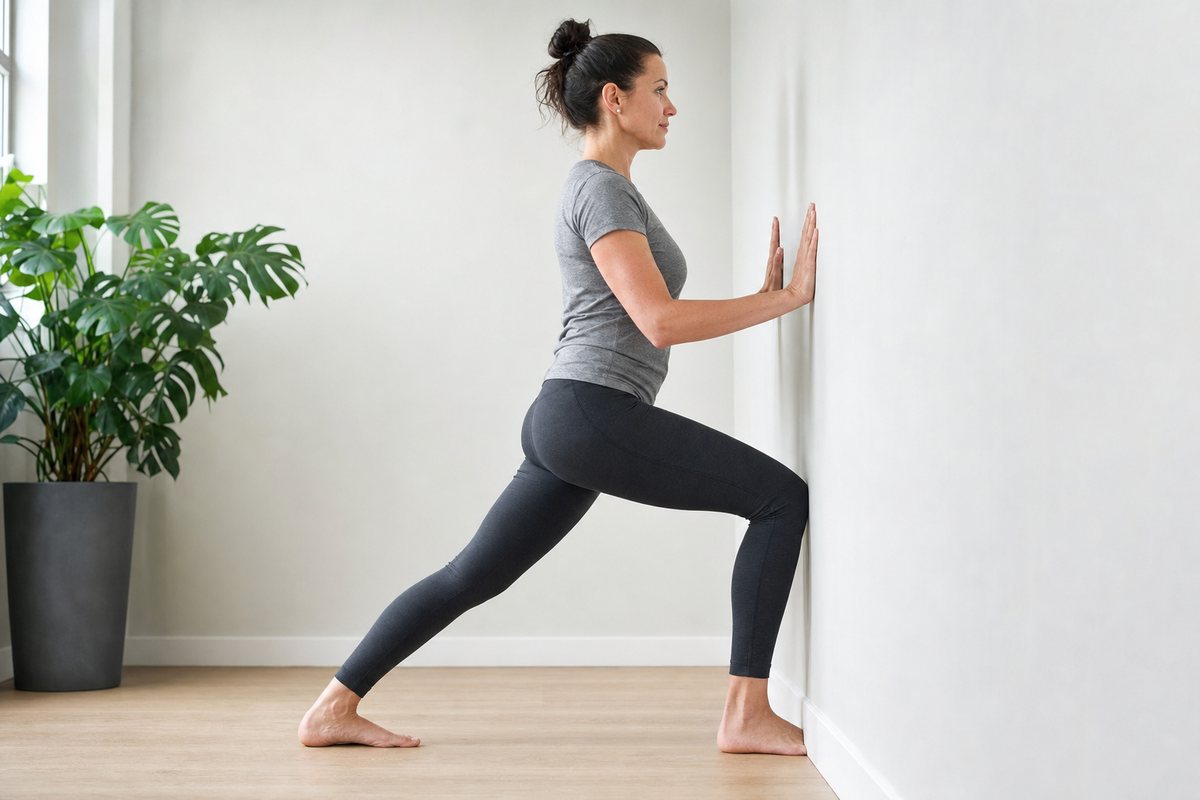
- Knee-to-wall mobilizations. Stand facing a wall with one foot in front and gradually drive the knee forward while keeping the heel grounded. This provides a simple way to practise ankle dorsiflexion in a controlled position.
- Calf mobility work. The gastrocnemius and soleus muscles both influence ankle movement. Targeted mobility exercises may help address limitations in these tissues when appropriate.
- Loaded ankle mobility. Once basic mobility is established, controlled movements that gradually introduce resistance can help build strength and control through the available range.
Through these various strategies, the goal is to develop comfortable, controlled movement that you can use during your squat.
Clinician-led strategies for improving hip mobility
Hip mobility exercises should similarly be selected based on what is actually limiting the individual’s movement. The hips are capable of moving in several directions, and a restriction in one area may not respond to the same approach as a limitation in another.
Potential strategies may include:
- Controlled hip rotations. Gentle active rotation exercises can help develop awareness and control of the hip’s available range.
- Hip flexion mobility. Controlled movements that bring the hip into flexion can help you explore the range required for your particular squat pattern.
- Dynamic mobility before training. Rather than relying exclusively on long static stretches before lifting, dynamic movements can help prepare the hips for the ranges and positions they will encounter during the workout. TurnFit’s five-minute pre-training mobility sequence is a practical example of this approach.
The key here is specificity. If your squat is limited by strength, motor control, or anatomy, rather than mobility, repeatedly stretching the hips may not solve the problem. A physiotherapist can always help you determine the best targeted strategy.
Don’t forget to train the mobility you gain
One of the most common mistakes with mobility work is treating it as something separate from strength training. If you spend several minutes improving your ankle or hip range of motion and then immediately return to the exact movement strategy that created the limitation, you may not develop much control over that new range.
Instead, follow mobility work with movements that reinforce the position. For example, an athlete working on ankle dorsiflexion might follow mobility exercises with controlled bodyweight squats, split squats, or other movements that require the newly available range. Someone working on hip mobility might practise controlled squatting variations that allow them to explore their range without immediately adding a heavy load.
This is where mobility becomes more than just stretching. By training and testing the new mobility you have gained, you are teaching your body to use the range you have just developed.
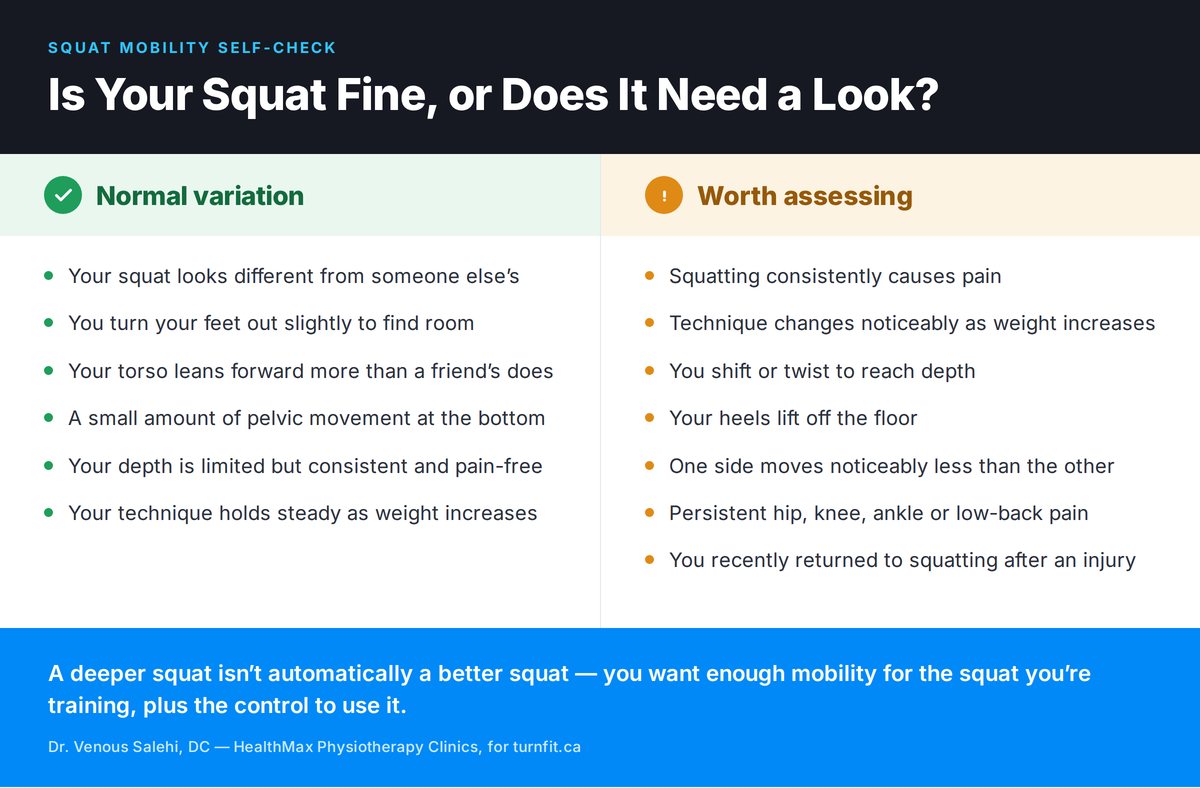
How do you know when your squat needs a closer look?
Not every imperfect-looking squat requires intervention. Your anatomy, experience, training goals, and chosen variation all matter.
However, consider having your movement assessed if:
- Your squat consistently causes pain
- Your technique changes significantly as you increase the weight
- You repeatedly shift or twist to reach your desired depth
- You struggle to keep your heels grounded
- Your range of motion is noticeably different from one side to the other
- You have persistent hip, knee, ankle, or lower-back discomfort
- You have recently returned to squatting after an injury
That side-to-side item deserves particular attention. When researchers restricted dorsiflexion on one side only, lifters shifted measurably more force onto the unrestricted leg through every phase of a bodyweight squat (Crowe et al., 2020, Journal of Strength and Conditioning Research). An asymmetrical squat is worth screening for an asymmetrical ankle before assuming it is a strength issue. A related pattern shows up at the knee, where hip and glute control often turns out to be the driver rather than the joint that hurts, as covered in TurnFit’s article on knee pain and weak glutes.
A qualified clinician can assess your movement rather than simply looking at one joint in isolation, and determine whether mobility, strength, motor control, or another factor is contributing to the way you squat.
Squat smarter, not just deeper
A deeper squat is not automatically a better squat, and more mobility is not always the answer. The goal is to have enough mobility to perform the squat variation you want to train, combined with the strength and control to use that range effectively. If your ankles or hips are not providing enough movement, your body may find another strategy. Under light loads, that may simply be an adaptation, but under heavier loads, improving your movement options may help you train more comfortably and efficiently. Mobility work is therefore most effective when it is targeted to the individual and integrated into strength training rather than treated as a generic stretching routine.
If you are struggling with your squat mechanics, experiencing pain during training, or want to understand whether mobility is limiting your performance, a physiotherapist can help identify the underlying factors and develop an individualized plan. At HealthMax Physiotherapy Clinics, physiotherapists can assess your movement and help you build the mobility, strength, and control you need to keep training with confidence.
A note from TurnFit: HealthMax’s clinics are located across the Greater Toronto Area. If you are training in Vancouver and your squat is the thing that keeps flaring up, that is exactly the kind of problem we screen for on day one. Every program starts with a movement assessment — squat, hinge, push, pull, single-leg balance — before we load anything. Book a free 5-minute fit call and we will tell you honestly whether this is a coaching problem, a mobility problem, or something you should see a clinician about first. We train clients in person at our Kitsilano and Downtown Vancouver studios and online across Canada.
Frequently asked questions
Does limited ankle mobility cause lower back pain?
Not directly, and not inevitably. What the evidence shows is that lifters with limited ankle dorsiflexion squat with more pelvic movement, more lumbar flexion, and more trunk lean than lifters without that restriction (Zawadka et al., 2025). That is a change in strategy, not an injury. It becomes a concern when the strategy is repeated under heavy load or high volume in someone whose back is not prepared for it.
How much ankle dorsiflexion do I need to squat?
There is no single number that applies to everyone, because required range depends on your limb proportions, stance width, foot position, footwear, and which squat variation you are training. The practical test is whether you can reach your intended depth with your heels down, your balance centred, and your technique holding steady as the weight increases. Research using the weight-bearing lunge test has compared groups under 30 degrees against groups over 35 degrees, which gives a rough sense of scale rather than a target to chase.
Is it bad if my lower back rounds at the bottom of a squat?
A moving lower back is not the same thing as an injured lower back. A systematic review with meta-analysis found no good evidence that greater lumbar flexion during lifting is a risk factor for low back pain onset or persistence (Saraceni et al., 2020). What matters more is whether the movement is controlled, whether it changes sharply as load increases, and whether it is accompanied by pain.
Should I stretch or strengthen to fix my squat?
It depends on what is actually limiting you, which is why an assessment is worth more than a generic routine. If the limit is joint or tissue range, mobility work is appropriate. If the limit is control or strength through a range you already have, stretching will not solve it. In most cases the answer is mobility work followed immediately by loaded movement that uses the new range.
What’s the difference between mobility and flexibility?
Flexibility is the passive range available to a muscle or tissue. Mobility is your ability to actively control movement through a range. The distinction matters: passive, non-weight-bearing ankle measurements showed no relationship to squat mechanics in one study, while dorsiflexion measured during a weight-bearing lunge did (Dill et al., 2014).
Why is one side of my squat different from the other?
Side-to-side differences are worth screening rather than ignoring. When dorsiflexion was restricted on one side only, lifters shifted significantly more force onto the unrestricted leg through every phase of a bodyweight squat (Crowe et al., 2020). Before assuming an asymmetrical squat is a strength imbalance, check whether one ankle or hip simply has less available range.
Do I need a physiotherapist, a chiropractor, or a personal trainer?
If you have pain, a recent injury, numbness, or symptoms that are getting worse, start with a clinician — a physiotherapist or chiropractor can assess the contributing factors and treat them. If you are pain-free and your squat is simply not progressing, a personal trainer can screen your movement, adjust your programming, and build the strength and control side. The two roles are complementary, and good practitioners in each will refer you to the other when it is the right call.
About the author
Dr. Venous Salehi is a Doctor of Chiropractic and Partner at HealthMax Physiotherapy Clinics, with over 15 years of specialized experience in motor vehicle accident (MVA) rehabilitation. A graduate of the Canadian Memorial Chiropractic College and the University of Waterloo, she is an expert in navigating the Statutory Accident Benefits Schedule (SABS) and Independent Medical Evaluations (IME). Dr. Salehi is dedicated to evidence-based care, combining manual therapy and exercise prescription to help patients recover from complex musculoskeletal injuries.
References
- Zawadka M, Smolka J, Skublewska-Paszkowska M, Lukasik E, Gawda P. Effect of limited ankle dorsiflexion on lower limbs and trunk kinematics during squat. Journal of Manipulative & Physiological Therapeutics, 2025. PubMed
- Macrum E, Bell DR, Boling M, Lewek M, Padua D. Effect of limiting ankle-dorsiflexion range of motion on lower extremity kinematics and muscle-activation patterns during a squat. Journal of Sport Rehabilitation, 2012. PubMed
- Kim SH, Kwon OY, Park KN, Jeon IC, Weon JH. Lower extremity strength and the range of motion in relation to squat depth. Journal of Human Kinetics, 2015. PMC
- Dill KE, Begalle RL, Frank BS, Zinder SM, Padua DA. Altered knee and ankle kinematics during squatting in those with limited weight-bearing lunge ankle-dorsiflexion range of motion. Journal of Athletic Training, 2014. PMC
- Saraceni N, Kent P, Ng L, Campbell A, Straker L, O’Sullivan P. To flex or not to flex? Is there a relationship between lumbar spine flexion during lifting and low back pain? A systematic review with meta-analysis. Journal of Orthopaedic & Sports Physical Therapy, 2020. PubMed
- Crowe MA, Bampouras TM, Small K, Howe LP. Restricted unilateral ankle dorsiflexion movement increases interlimb vertical force asymmetries in bilateral bodyweight squatting. Journal of Strength and Conditioning Research, 2020. PubMed
Ready to Start Your Fitness Journey?
At TurnFit, we offer in-person personal training at our Kitsilano and Downtown Vancouver locations, online coaching programs with live Zoom calls, and online personal training across Canada. Check out our transparent pricing — no contracts, no hidden fees.
Book a Free 5-Minute Call →