Every year, I watch the same thing happen. Women wait until January to “get back on track,” as if the calendar is what determines readiness. It isn’t. Late summer — right now, in fact — is one of the best times of year to rebuild strength. Not in January. Not “when things slow down,” because things rarely do.
Here’s the good news if you’ve had a few weeks (or a few months) off: your body re-adapts to a strength stimulus faster than most women expect. This isn’t wishful thinking — it’s muscle memory, and it’s real. The strength you built before is not gone. It’s dormant, and it comes back quicker than it took to build the first time.
Why August Is the Ideal Time to Restart (Not September)
September feels like the natural reset point. Everyone says it. But by the time September arrives, school schedules lock in, work ramps back up, and your calendar fills before you’ve made a single decision about your own training.
Starting in August means you get ahead of all of that.
- You beat the fall rush. Once school and work schedules lock in, your time is no longer fully your own. Starting now means your training routine is already built before the fall chaos begins.
- Your social calendar is lighter. Fewer weekend commitments in August than in September or October means more consistent training weeks, with fewer interruptions.
- You arrive at fall already in rhythm. Three to four weeks of consistent training before Labour Day means that when fall routines do take over, you’re not starting from zero — you’re already moving.
Consistency compounds. The women who start in August are the ones who are still training confidently in November. They’re not scrambling to “start fresh” every time the calendar flips — they’ve already built the habit while everyone else is still deciding.
I see this pattern every single year with my Vancouver clients. The ones who come in during August, even for just a handful of sessions, walk into September with momentum already on their side. The ones who wait until after Labour Day spend the first month just trying to catch up to where they could have already been.
What “Starting Again” Actually Looks Like Physiologically
I want to walk you through what’s actually happening in your body when you restart, because understanding it changes how you approach the first few weeks.
Muscle memory is real, and it works in your favor. The neural adaptations that let your muscles fire efficiently under load return within one to two weeks of consistent training — much faster than the months it took to build them originally. Your nervous system remembers the patterns even when your body feels rusty.
That said, don’t restart at 100% of where you left off. I know the instinct is to jump back in at your old weights, but that’s how women end up sidelined by soreness or injury in week one. Start at 60–70% of your previous loads and progress weekly from there. You will catch up faster than you think.
This is the part most women get wrong on their own. Ego says go heavy right away to “prove” you haven’t lost anything. Your body says otherwise. Respecting that 60–70% starting point is exactly what lets you progress quickly and safely, instead of stalling out with a strain or a flare-up in week two.
Also — expect more muscle soreness than you remember. DOMS (delayed onset muscle soreness) tends to hit harder after a break, even at reduced loads. Plan for it. Don’t panic when it shows up. It’s a normal part of re-adaptation, not a sign that something’s wrong.
The 4-Week Rebuild Plan Structure
This is the structure I use with clients coming back after a break. It respects where your body actually is, while still moving you forward with purpose.
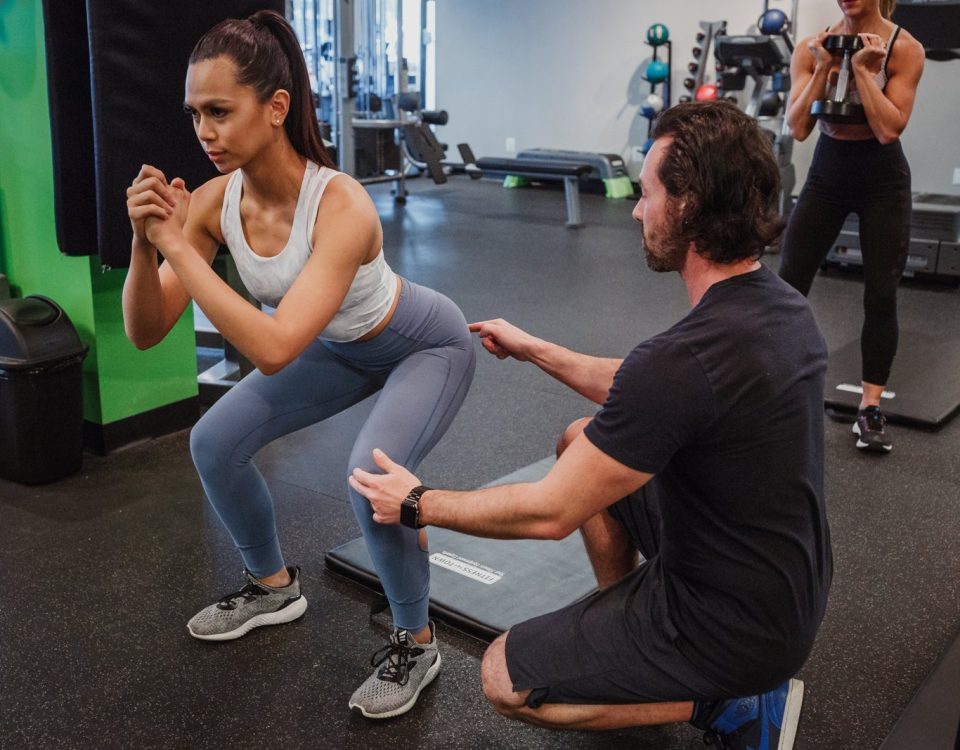
- Week 1 — Reintroduction: Two full-body sessions. The focus here is form and range of motion, not load. You’re re-teaching your body the movement patterns before you ask it to work hard.
- Week 2 — Load: Add weight to your lifts and introduce a third session. Your body has re-familiarized itself with the patterns; now it’s ready to work harder.
- Week 3 — Volume: Increase your sets and introduce supersets. This is where strength gains start to accelerate.
- Week 4 — Test: Push to near-failure on your key lifts and assess your progress. This tells us — and you — exactly where you stand, and where week 5 should start.
Four weeks is enough time to feel like yourself again, without rushing the process and risking a setback. Most of my clients tell me that by the end of week three, training already feels like a normal part of their week again — not a chore they’re forcing themselves through.
What matters most in this stretch is not any single session. It’s the pattern. Missing one workout in a four-week block won’t derail you. Skipping the whole block will. So build the schedule around your actual life — the mornings you have energy, the evenings that are realistically free — rather than an idealized version of your week that won’t hold up past day three.
The 5 Exercises to Prioritize When Rebuilding
If you only have time for a handful of movements while you rebuild, prioritize these five. They cover the patterns that matter most for strength, posture, and everyday function.
- Romanian Deadlift — builds the posterior chain, supports posture, and strengthens the glutes and hamstrings that tend to weaken with inactivity.
- Goblet Squat — rebuilds quad strength and doubles as a mobility check for your hips and ankles.
- Dumbbell Row — strengthens the upper back and directly supports posture correction, especially important if you’ve spent the break sitting at a desk.
- Hip Thrust — reactivates the glutes and rebuilds pelvic stability, which supports nearly every lower-body movement you do.
- Push-up or DB Press — restores your upper body push pattern and rebuilds shoulder and chest strength safely.
If posture has taken a hit over the summer — a common complaint I hear, especially from women who’ve spent the season traveling, sitting on planes, or hunched over a laptop between vacations — the row pattern above is a good place to start paying closer attention. I go deeper on this in my piece on posture and mobility, which pairs well with a rebuild plan like this one.
You don’t need to master all five of these movements perfectly on day one. You need to show up, do them with attention to form, and let the reps accumulate. Strength is built in the boring, consistent repetition — not in any single heroic session.
What to Do If You’re Starting From Scratch (Not Just Restarting)
Maybe this isn’t a restart for you — maybe it’s a true beginning. That changes the plan, but it doesn’t change the opportunity. August is still the right time to start, for all the same reasons.
The fastest way to get a plan matched to your body, your goals, and your current fitness level is a free assessment. We’ll talk through where you are, what you’re working toward, and what a realistic path looks like. No guesswork, no generic program. Book your free assessment and we’ll build the plan together.
If you’re outside Vancouver — or simply prefer training from home or your own gym — I also offer online training for women across Canada. Same coaching approach, same accountability, delivered wherever you are.
The Mindset Shift That Makes the Difference
Here’s what I want you to take away from all of this: starting again is not failure. It’s a skill.
The women who get results long-term are not the ones who never stop. Life happens — summer happens, travel happens, busy seasons happen. The women who succeed are the ones who restart without drama. They don’t spiral into guilt or wait for a “perfect” moment. They just begin again, at 60–70%, and trust the process.
Consistency beats perfection every time. You don’t need a flawless streak. You need to keep coming back.
I’ve coached enough women through enough seasons of life to know that the ones who succeed long-term are not the ones with the most willpower. They’re the ones who’ve made peace with imperfect consistency — who train hard for three weeks, take a week off for a trip or a busy stretch at work, and then simply pick the plan back up without treating the break as some kind of failure. That’s the whole skill. It’s learnable, and it’s exactly what we’ll build together.
If you’re ready to rebuild your strength before fall takes over your schedule, let’s talk. Book your free assessment today, and if you’re anywhere else in Canada, join us through online training. Let’s get you back to your best — on your terms, starting now.
Ready to Start Your Fitness Journey?
At TurnFit, we offer in-person personal training at our Kitsilano and Downtown Vancouver locations, online coaching programs with live Zoom calls, and online personal training across Canada. Check out our transparent pricing — no contracts, no hidden fees.
Book a Free 5-Minute Call →