You don’t need equipment or an hour to counter desk-job posture — you need 15 focused minutes before your laptop opens. This routine has 5 phases: breathing reset (2 min), thoracic mobility (3 min), hip flexor and glute activation (4 min), neck deep flexor and scap engagement (3 min), and integration (3 min). Each phase targets a specific consequence of sitting: shallow breathing, a stiff mid-back, dormant glutes, a forward head, and poor movement patterns. Do it daily, before sitting down, not after the damage is done — that’s the prevention-over-reaction principle behind everything at TurnFit. Book a free assessment if pain persists beyond what a routine like this can fix.
By David Turnbull, TurnFit Founder & Head Coach
Desk-job posture doesn’t happen because you’re lazy or weak-willed — it happens because your body adapts to whatever position it holds most often, and for most people, that’s a seated slump for 8+ hours a day. We covered the full mechanics of this in how the Vancouver desk job reshapes your body. This post is the practical follow-up: a specific, 15-minute, no-equipment sequence you do before your workday starts, so you’re undoing the damage proactively instead of chasing pain reactively later.
Why Do 15 Minutes in the Morning Instead of Stretching at Night?
Morning mobility work primes the exact tissues and movement patterns you’re about to load for the next 8 hours, before poor posture sets in for the day. Doing this work at night, after the damage from a full day of sitting is already done, is reactive — you’re recovering from posture stress instead of preventing it. Fifteen minutes before your first email is a small, repeatable habit that compounds daily, which is the same prevention-first thinking behind TurnFit’s entire coaching method.
What’s in the 15-Minute Routine?
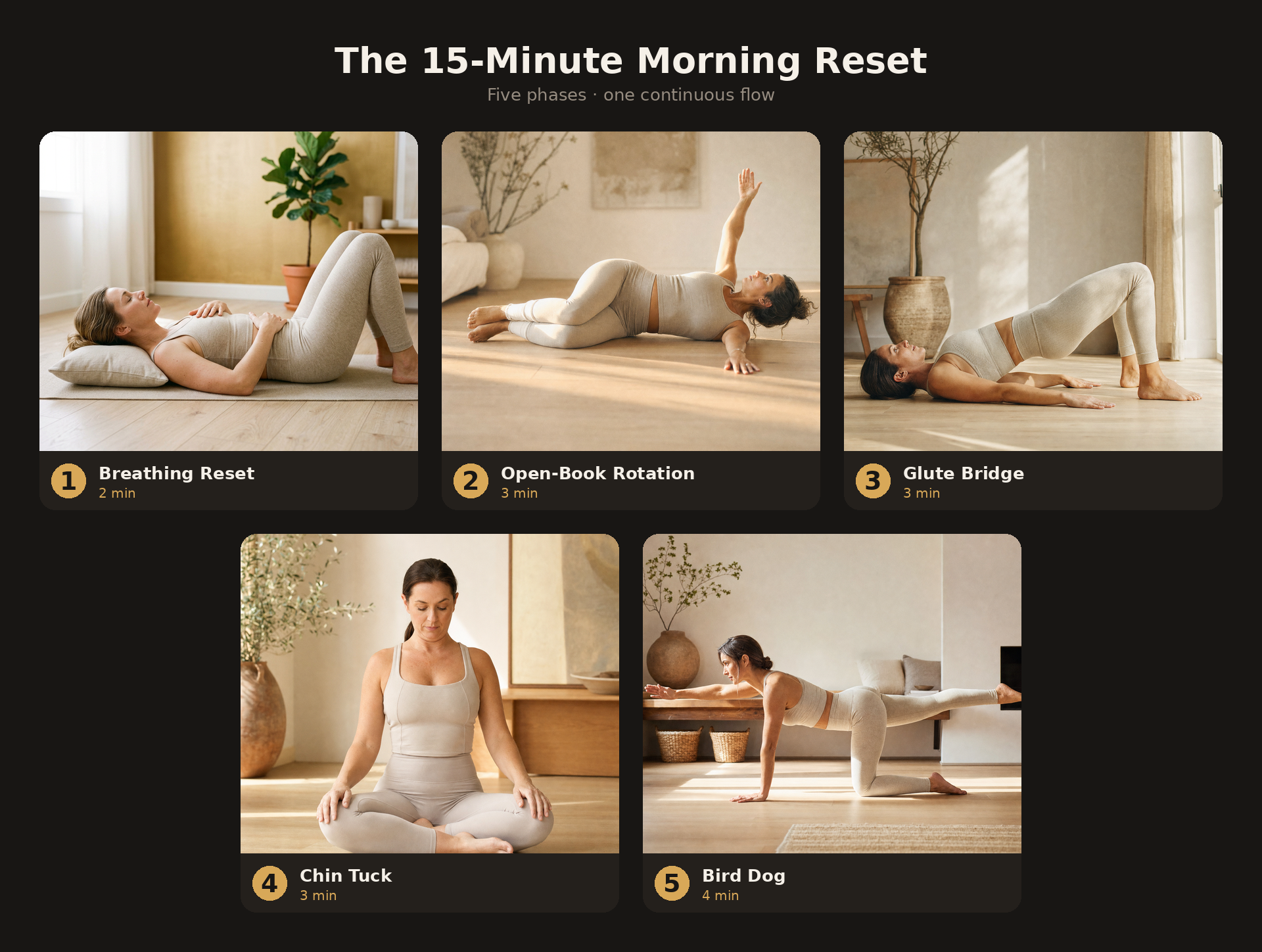
The sequence has five phases, done in order, using nothing but floor space and your own bodyweight. Total time: 15 minutes.
| Phase | Duration | Exercise | Reps / Time | Form Cue |
|---|---|---|---|---|
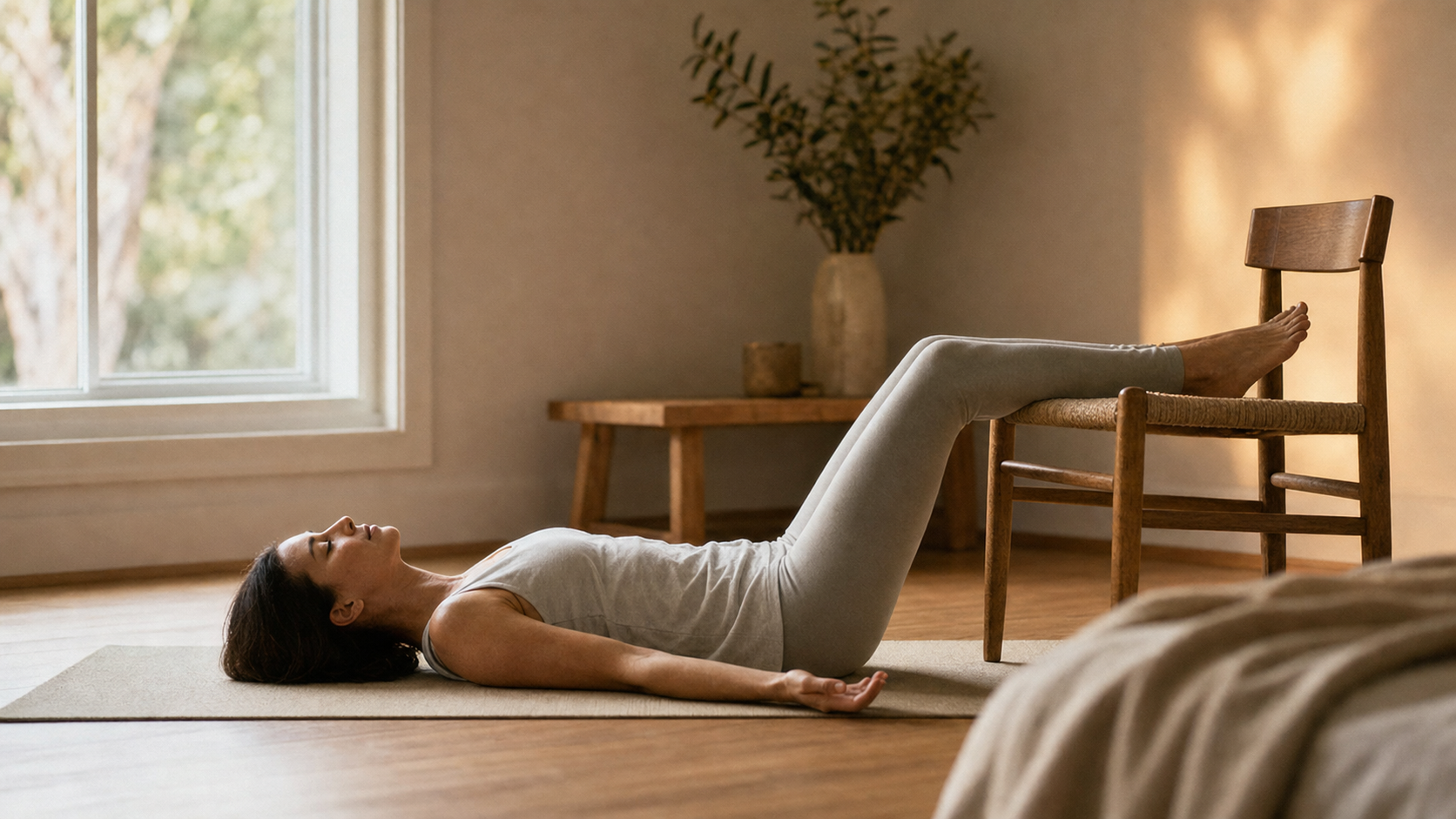
| 1. Breathing Reset | 2 min | 90/90 diaphragmatic breathing (lying on back, knees on a chair or elevated) | 8–10 slow breaths | Exhale fully, feel ribs drop and belly rise before chest; 4 sec in, 6 sec out |
| 2. Thoracic Mobility | 3 min | Open-book rotation (side-lying) | 8 reps per side | Keep knees stacked and stationary; rotate only through the upper back, follow top hand with eyes |
| 3 min | Cat–camel | 10 slow reps | Move segment by segment through the spine, not just hips and shoulders | |
| 3. Hip Flexor + Glute Activation | 4 min | Half-kneeling hip flexor stretch | 30 sec per side | Tuck pelvis under (posterior tilt) before leaning forward; squeeze the back glute |
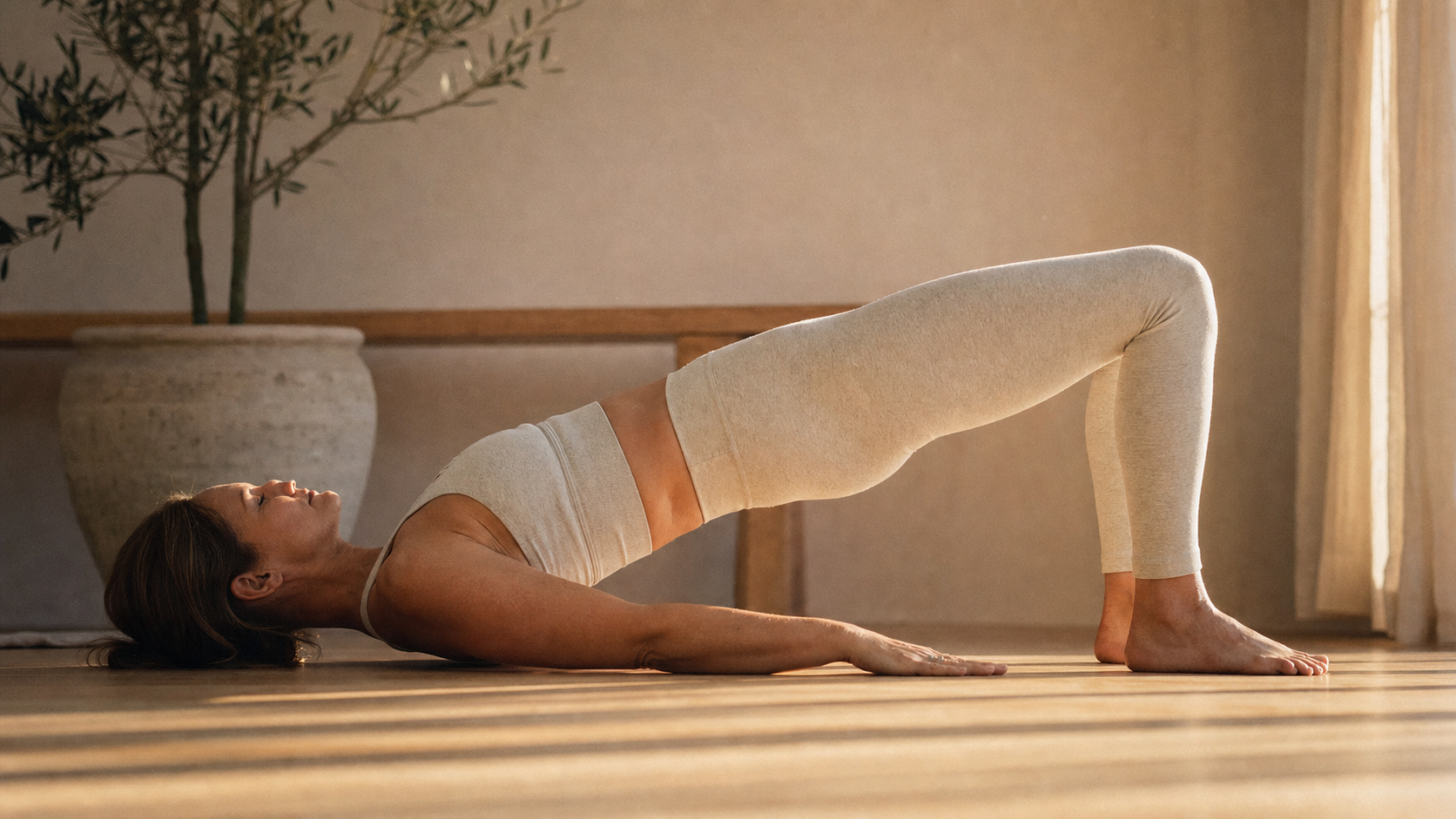
| 4 min | Glute bridge | 12–15 reps, 2 sec hold at top | Push through heels, squeeze glutes hard at the top, avoid arching the lower back | |
| 4. Neck Deep Flexor + Scap Engagement | 3 min | Chin tuck (deep neck flexor activation) | 10 reps, 3 sec hold | Glide chin straight back, “make a double chin,” don’t tilt down |
| 3 min | Wall slides / scapular retraction | 10 reps | Back flat on wall, slide arms up keeping wrists and elbows touching wall | |
| 5. Integration | 3 min | Bird dog + standing march w/ posture reset | 8 reps per side each | Move slowly, brace core, keep hips level; finish standing tall before sitting down |
Why Does the Breathing Reset Come First?
Desk posture and shallow, chest-dominant breathing feed each other — a slumped, seated position compresses the ribcage and makes diaphragmatic breathing harder, while shallow breathing keeps neck and shoulder muscles chronically overactive as backup breathing muscles. Starting the sequence with 2 minutes of diaphragmatic breathing downregulates that overactivity before you ask those same muscles to do postural work. A narrative review of diaphragmatic breathing research found that it may reduce physiological and psychological stress, citing a randomized controlled trial in which diaphragmatic breathing lowered respiratory rate and salivary cortisol levels compared with a control group (Hamasaki, 2020, Medicines).
Why Focus on Thoracic Mobility Specifically?
The thoracic spine (mid-back) is the segment that stiffens most from prolonged sitting, and when it can’t rotate or extend properly, the neck and lower back compensate — which is how desk posture turns into neck pain. A randomized clinical trial comparing thoracic spine mobilization and mobility exercise against cervical spine mobilization in people with forward head posture found the thoracic-focused intervention produced better outcomes in craniovertebral angle, pain, and neck disability at six-week follow-up (Cho, Lee & Lee, 2017, BMC Musculoskeletal Disorders). In other words, fixing the mid-back does more for forward head posture than working the neck directly.
Why Do Hip Flexor and Glute Work Matter for Posture?
Sitting keeps hip flexors chronically shortened and glutes chronically underused — a pattern sometimes called “gluteal amnesia” — which tilts the pelvis forward and increases strain on the lower back. A 2025 randomized clinical trial in females with gluteal amnesia found that both clamshell and glute bridge exercises significantly reduced low back pain and disability after six weeks, with the glute bridge producing greater functional improvement (Jameel et al., 2025, Journal of Health and Wellness Care Research). That’s exactly why the glute bridge, not just a hip flexor stretch, earns a spot in this routine — stretching the tight side without activating the weak side only solves half the problem.
Why Train the Deep Neck Flexors Instead of Just Stretching the Neck?
Forward head posture isn’t caused by tight neck muscles alone — it’s often caused by weak deep neck flexors that fail to hold the head stacked over the shoulders, forcing superficial neck muscles to overwork. Chin tucks specifically target these deep stabilizers, and pairing them with scapular retraction (wall slides) reinforces the shoulder position that supports a neutral head position. Combined thoracic and cervical interventions in the research above consistently improved craniovertebral angle — the clinical marker of forward head posture — reinforcing why this routine treats the neck and mid-back together rather than in isolation.

Why End with an Integration Phase?
Mobility and activation work only transfers to real posture if you practice it in a functional pattern immediately after. Bird dogs and a standing march with a posture reset rehearse core bracing and hip stability in positions closer to standing and walking — the postures you’ll actually hold all day — so the previous four phases translate into how you sit, stand, and move once you’re at your desk.
Modifications for Different Levels
- Beginner / limited mobility: Reduce cat-camel and open-book rotation range of motion; hold chin tucks without adding wall slides at first; do glute bridges without the 2-second hold.
- Time-crunched (7-minute version): Keep the breathing reset (1 min), cat-camel (2 min), glute bridge (2 min), and chin tuck (2 min); skip hip flexor stretch and integration phase.
- Advanced / already active: Add a 30-second wall sit or single-leg glute bridge to phase 3, and extend bird dogs to include a 2-second hold at full extension.
- Chronic pain or recent injury: Skip this self-guided routine and get a movement assessment first — persistent pain needs individualized programming, not a generic sequence.
Key Takeaways
- Do this 15-minute sequence in the morning, before sitting down, to prevent posture strain rather than treat it after hours of damage.
- The five phases target breathing, thoracic mobility, hip/glute activation, deep neck flexors, and functional integration — in that order, for a reason.
- Thoracic mobility work often improves forward head posture more effectively than working the neck alone.
- Glute activation (not just hip flexor stretching) is essential — stretching the tight muscle without strengthening the weak one leaves the underlying pattern unresolved.
- No equipment is required — just 15 minutes and floor space.
- If pain persists despite consistent practice, that’s a signal for individualized assessment, not more stretching.
Frequently Asked Questions
How long until I notice a difference in my posture?
Many people notice looser shoulders and an easier time sitting tall within 1–2 weeks of daily practice, but meaningful postural change — like a measurably improved craniovertebral angle — typically takes 4–6 weeks of consistency, based on the timelines used in the clinical trials referenced above.
Can I do this routine at night instead of in the morning?
You can, and it will still help, but doing it in the morning is more prevention-focused because it primes your posture and breathing before the workday’s sitting load begins, rather than only recovering from it afterward.
Do I need a yoga mat or any equipment?
No. Every exercise in this routine uses only bodyweight and floor space. A mat or towel is comfortable but entirely optional.
I have a herniated disc — is this routine safe?
Cat-camel and gentle bridges are generally well tolerated for many disc issues, but “generally” isn’t personalized. Anyone with a diagnosed disc injury should get individual clearance and, ideally, a customized plan — book an assessment before self-prescribing.
Why does the routine start with breathing instead of stretching?
Because shallow breathing keeps neck and shoulder muscles overactive as backup breathing muscles; calming the breath first makes the mobility and activation work that follows more effective, not just more relaxing.
My knees hurt when I do the glute bridge — what should I do?
Check that your feet aren’t too far from your hips (shins should be roughly vertical at the top of the movement) and that you’re pushing through your heels, not your toes. If knee pain persists, weak glutes may be forcing the knees to compensate — our guide on knee pain and weak glutes covers this connection in depth.
Can this routine replace strength training or a full workout?
No — it’s a maintenance and prevention routine for posture, not a substitute for progressive strength training. Think of it as brushing your teeth for your spine: necessary daily upkeep, not the whole dental plan.
When a Routine Isn’t Enough
A 15-minute daily routine solves a lot of desk-job posture problems, but not all of them — especially if pain is already chronic, radiating, or tied to a specific injury. If that’s where you are, or if you want a plan built around your specific posture, job, and goals rather than a generic sequence, TurnFit’s in-person personal training in Kitsilano and Downtown Vancouver, or our online coaching for anywhere else, starts with a real assessment of how you move. Book your free 5-minute fit call to find out what’s actually driving your desk-job posture — and fix the cause, not just the symptoms.
Ready to Start Your Fitness Journey?
At TurnFit, we offer in-person personal training at our Kitsilano and Downtown Vancouver locations, online coaching programs with live Zoom calls, and online personal training across Canada. Check out our transparent pricing — no contracts, no hidden fees.
Book a Free 5-Minute Call →