Book a free consultation.” />
By David Turnbull, BCRPA Certified Personal Trainer | TurnFit Personal Trainers LTD | Updated 2026
Picture this: you are an HR manager at a 35-person tech company in Yaletown. You have just written your third farewell Slack message in six months. Three strong performers, gone. One left for a competitor offering better benefits. One burned out. One simply said, “I needed a change.” The cost of replacing them — recruitment fees, lost productivity, onboarding time — is sitting somewhere north of $90,000. Your CEO is asking why retention is a problem. You do not have a satisfying answer, because the real reason is diffuse and uncomfortable: your best people are exhausted, stressed, and increasingly aware that the company across the street offers something yours does not.
This article is not about yoga Tuesdays or fruit baskets. It is about a specific, measurable, evidence-backed investment that Vancouver companies are making right now to reduce absenteeism, stop losing staff, and build teams that outperform. It is about hiring a certified personal trainer to come to your office, three times a week, and train your employees directly — on-site, on company time, as a structured business programme.
If you are a business owner, HR manager, CFO, or the person who manages office logistics and people programmes, this guide was written specifically for you.
1. The Business Case in Numbers: What the Research Actually Shows
The financial case for corporate fitness is the most compelling argument in any HR investment category. Not because fitness advocates say so, but because the numbers have been independently verified at scale.
A landmark meta-analysis published in Health Affairs — conducted by researchers at Harvard and widely cited in Harvard Business Review — found that companies investing in employee wellness programmes return $3.27 in healthcare cost savings and $2.73 in absenteeism cost reductions for every single dollar spent. Combined, that is approximately $6 returned for every $1 invested. This is not a marketing claim. It is a peer-reviewed finding that has held up across multiple replications and corporate case studies.
Johnson & Johnson’s wellness programme — running since 1985 — saved the company $250 million in healthcare costs over a decade, with an independently calculated return of $2.71 per dollar invested, according to Harvard Business Review’s analysis. That is not a small company running a two-month challenge. That is a longitudinal, measured result.
The Wellhub 2024 Return on Wellbeing Report, surveying 2,000 HR leaders, found that 95% of companies that measure wellness ROI report positive returns — up from 90% the year prior. Nearly two-thirds report at least a 2:1 return.
Absenteeism: The Hidden Cost Line
Sick days are a direct payroll cost, but the real damage is presenteeism — employees who show up but cannot perform. Research from the TELUS Health Mental Health Index (November 2024) found that physically active workers lose 14 fewer workdays of productivity annually than their sedentary counterparts. Employees enrolled in structured wellness programmes take 56% fewer sick days according to HolistiCare’s 2025 data synthesis.
If your average employee earns $75,000 and works approximately 240 days per year, each sick day costs you roughly $312.50 in direct wages alone — before counting the disruption multiplier. Multiply that by a team of 10, and 56% fewer sick days begins to look like a very significant number.
Retention: The Calculation That Changes Everything
The average cost to replace a Canadian employee is $30,680, according to Express Employment Professionals Canada (January 2026), as reported by HR Reporter. This figure accounts for recruitment, lost productivity, onboarding, and the transitional burden on remaining staff. For senior or highly skilled roles, the actual cost often reaches 1.5–2.5 times annual salary (Canadian Human Resources Association data).
Employees who feel their employer genuinely cares about their wellbeing are 53% less likely to seek new employment, according to HolistiCare 2025. Companies with effective wellness programmes report 9% voluntary turnover, compared to 15% at companies with poor or no wellness offerings — a Towers Watson and Business Group on Health finding, as cited by Forbes.
Quick Math: The Annual Value of Corporate Personal Training (10-Employee Company)
| Item | Annual Cost / Saving |
|---|---|
| TurnFit programme (MWF, 2-on-1 model) | $250 per coach hour (1+ month commitment) |
| Reduced absenteeism (56% fewer sick days × 10 employees × avg $312/day) | Not calculated |
| Productivity gain (21% concentration increase × avg Vancouver salary $75K) | Not calculated |
| Avoided one replacement hire (avg $30,680 Canadian cost) | Not calculated |
| Healthcare claim reduction ($3.27 return per $1 invested) | Proportional to benefit plan |
| Conservative net annual benefit | Not calculated |
Sources: Health Affairs / Harvard, University of Bristol, Express Employment Professionals Canada (2026), TELUS Health (2024), HolistiCare (2025). These are illustrative estimates based on published research averages applied to a 10-person team with an average $75K salary.
The conference Board of Canada estimates that companies implementing comprehensive wellness programmes save up to CAD $1,800 per employee annually through reduced healthcare claims and absenteeism, according to Ken Research’s Canada Corporate Wellness Market Report 2026. For a 20-person company, that is $36,000 per year — before any productivity calculation touches the spreadsheet.
2. What TurnFit’s Corporate Programme Actually Looks Like
TurnFit Personal Trainers has been operating in Vancouver since 2016. The corporate programme is not a bolt-on offering — it is a structured, professional service designed around how businesses actually work.

The MWF 2-on-1 Model
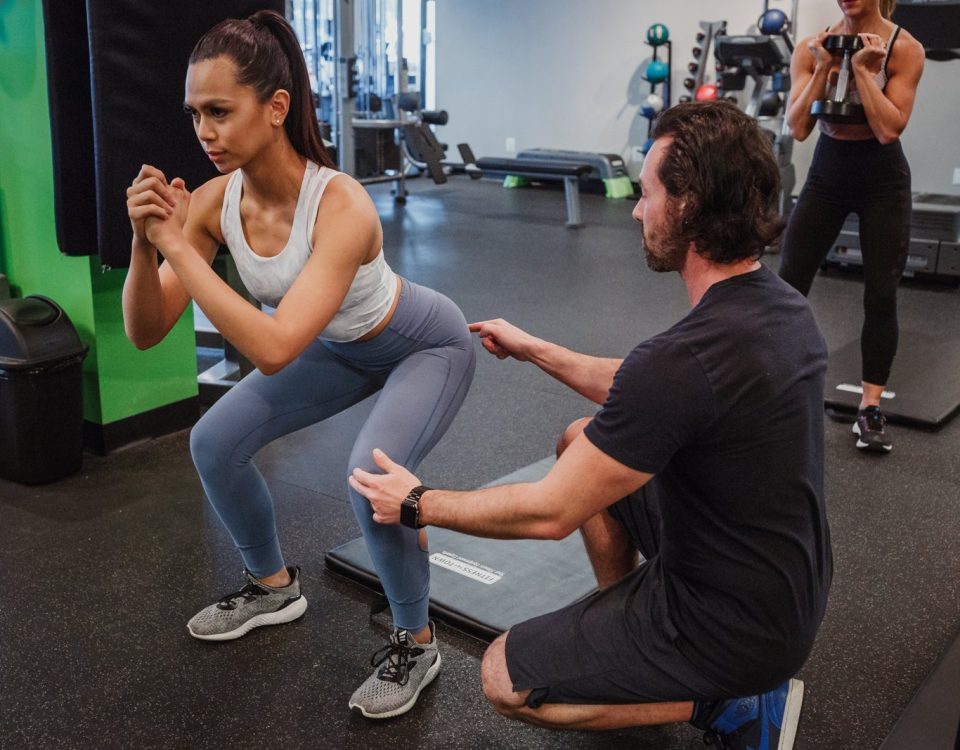
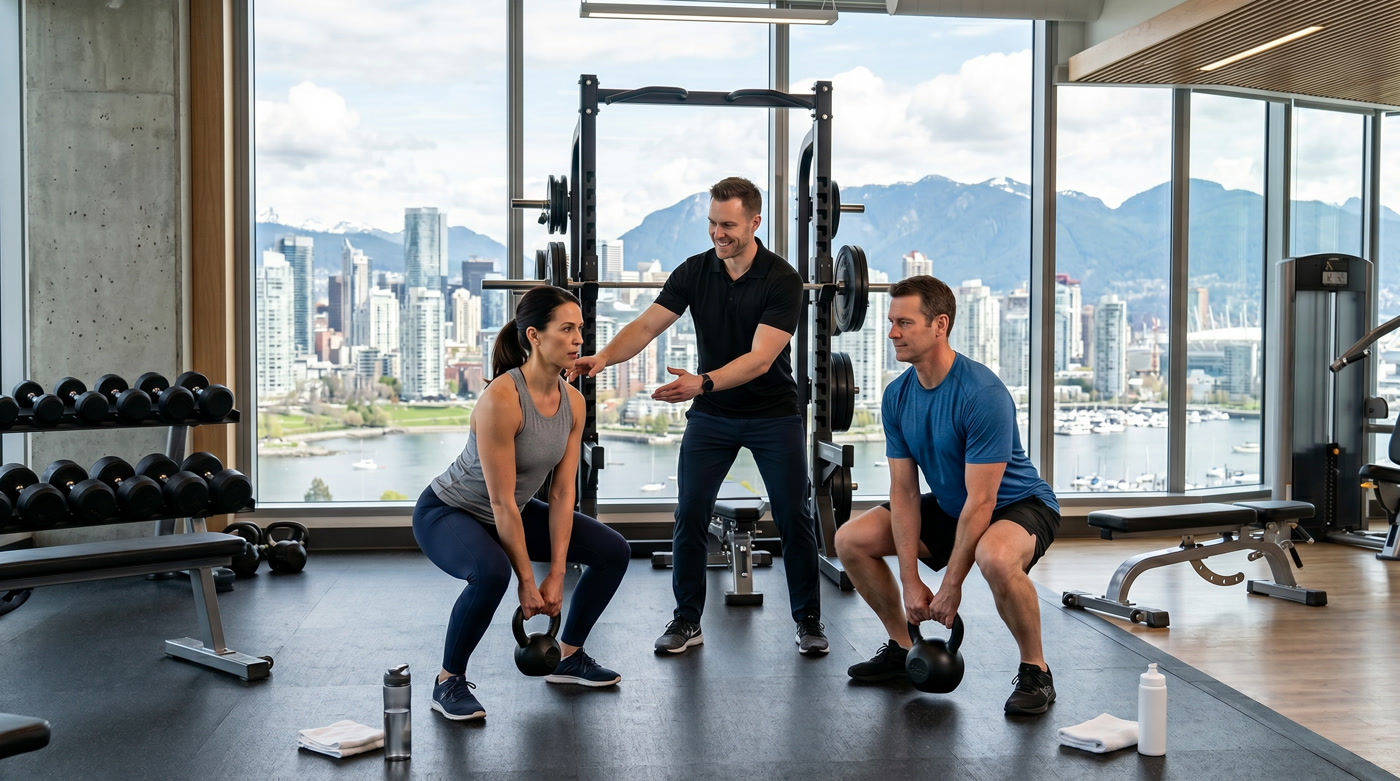
The signature delivery format is Monday, Wednesday, Friday — semi-private, 2-on-1 training. A BCRPA-certified TurnFit trainer comes directly to your office or facility. Two employees train together in each session, with fully individualised programming for each participant. This is not a group fitness class — every exercise is selected based on that employee’s fitness level, movement patterns, and goals. The trainer observes form, corrects technique, and adjusts load and intensity in real time.
The MWF structure is deliberate. Research on exercise habit formation consistently shows that three non-consecutive training days per week provides optimal stimulus for strength and fitness improvement while allowing recovery. Employees who train Monday, Wednesday, and Friday arrive at their desks on those days with measurably improved cognitive function. The University of Bristol (2008) study found that on exercise days, participants scored 21% higher on concentration, 22% higher on finishing work on time, and 41% higher on motivation — improvements that show up on the same day as the session.
A Sample Week for a Corporate Client
- Monday 7:30 AM: Trainer arrives. Pair 1 trains for 45 minutes — strength and mobility focus. Coffee is still on.
- Monday 8:20 AM: Pair 2 (or the same employees, if only 2 participants) trains. Equipment is compact — dumbbells, resistance bands, possibly a TRX anchor point. Your boardroom works.
- Wednesday lunchtime: Same trainer, different session format — conditioning and core. Employees who missed Monday catch up here.
- Friday afternoon: End-of-week session. Optional. Participation is high because it sets up the weekend.
- Monthly: HR manager receives a participation and engagement report.
- Quarterly: Full ROI review — attendance data, qualitative employee feedback, absenteeism comparison, programme adjustments.
Who Trains Your Employees
Every TurnFit trainer is BCRPA (BC Recreation and Parks Association) certified — the standard governing body for fitness professionals in British Columbia. TurnFit has earned 8 consecutive Top Choice Awards and holds over 240 Google reviews. You are not hiring a trainer who showed up last year. You are engaging a team that has been building a professional reputation in Vancouver for nearly a decade.
The Assessment and Onboarding Process
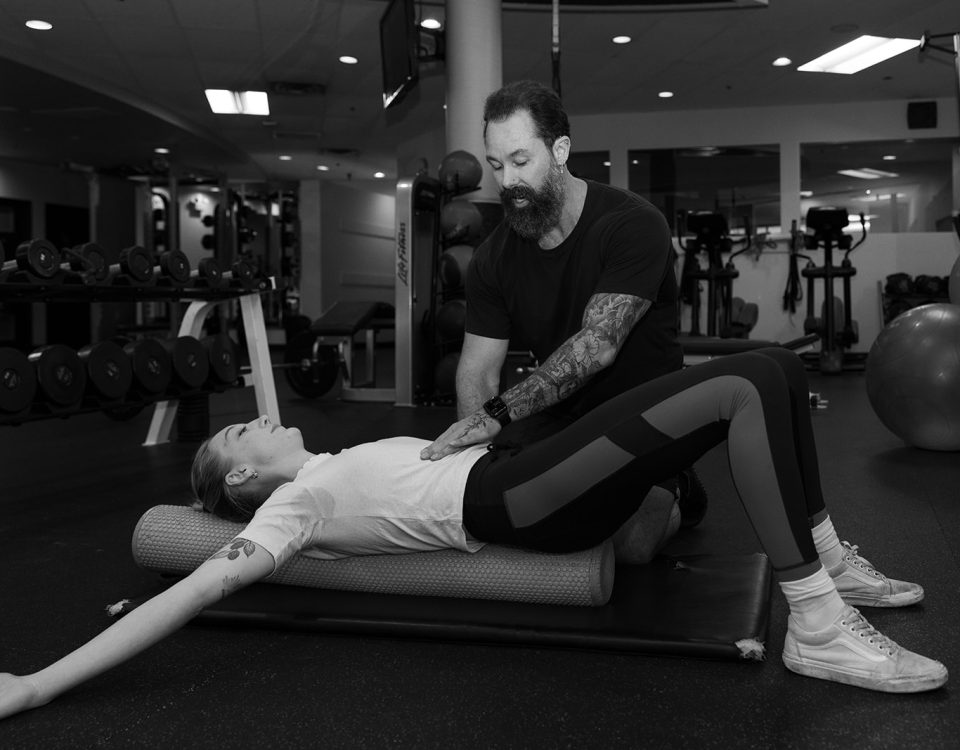
Before the first session begins, TurnFit conducts individual fitness assessments with every participating employee. This establishes baselines for strength, mobility, cardiovascular fitness, and any injury history. It serves two purposes: it protects the employee by ensuring programming is safe and appropriate, and it gives you a measurable starting point against which quarterly results can be reported.
The assessment also covers posture and movement quality — the primary predictors of musculoskeletal injury for desk workers. MSI (musculoskeletal injury) claims are the single most common workplace injury in BC, comprising over 88,000 time-loss claims in just five years (2020–2024), according to data from WorkSafeBC/AWCBC. Addressing the underlying physical weaknesses that cause MSIs is a legitimate business case that belongs in your safety budget, not just your HR wellness line.
Quarterly ROI Reporting
One of the most frequent reasons corporate wellness programmes get cut is that HR cannot demonstrate their value at budget time. TurnFit provides quarterly ROI reports to HR leadership — documenting participation rates, session completion, employee feedback, and programme adjustments. This gives you the data you need to justify renewal, not just the experience of having done it.
Online Training for Remote Employees
If your team is hybrid or fully distributed, the programme extends online. Remote employees receive individualised programming, coaching via video call, and access to TurnFit’s training protocols — the same methodology applied on-site, adapted for home or hotel environments. Your in-office team trains in person; your remote team trains online. One programme, one invoice, one point of contact.
3. The 10 Proven Benefits of On-Site Employee Personal Training
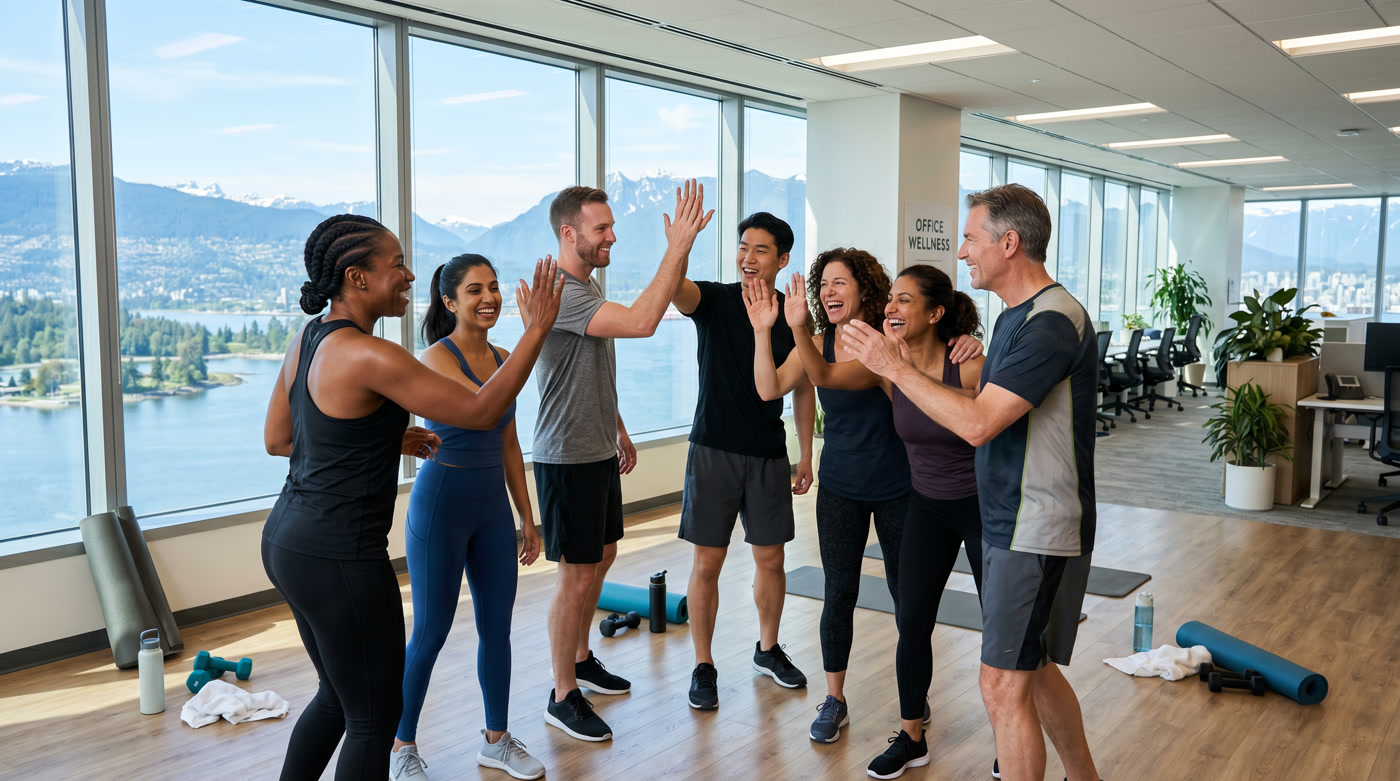
1. Productivity — +21% Concentration on Training Days
The University of Bristol (2008) study followed 200 employees across three organisations. On days when employees exercised, they scored 21% higher in concentration, 22% higher on completing work on time, 25% higher in avoiding unscheduled breaks, and 41% higher in motivation. These are not abstract quality-of-life improvements — they are same-day cognitive performance gains that show up directly in your team’s output.
2. Reduced Absenteeism — 56% Fewer Sick Days
Employees enrolled in structured wellness programmes take 56% fewer sick days, according to HolistiCare’s 2025 data synthesis. The Dutch prospective cohort study (PubMed) found employees meeting the recommendation for vigorous physical activity had more than 4 fewer sick days per year. The CDC confirms that employees achieving at least 75 minutes of vigorous physical activity per week miss an average of 4.1 fewer workdays annually.
3. Employee Retention — 53% Less Likely to Leave
Employees who believe their employer genuinely cares about their wellbeing are 53% less likely to seek new employment (HolistiCare 2025). Companies with strong wellness offerings report 9% voluntary turnover vs. 15% for those without meaningful programmes, per Towers Watson and Business Group on Health data. At $30,680 per replacement hire, this is the single largest financial lever in the entire corporate wellness ROI equation.
4. Team Cohesion — Social Accountability That Sticks
An Indiana University study on partner exercise found that participants who trained with a partner had a 6.3% dropout rate over 12 months, compared to a 43% dropout rate for those who trained alone. TurnFit’s 2-on-1 model is designed around this principle — employees who train together consistently develop accountability relationships that extend well beyond the training session. A meta-analysis in Frontiers in Psychology (2024) confirmed that team-based physical activity interventions show a significant moderate-to-large effect size on group cohesion.
5. Mental Health and Burnout Reduction
A study of 7,973 office workers, published in the Journal of Affective Disorders, found that employees achieving at least 25 minutes of moderate-to-vigorous exercise daily had a 62% lower risk of burnout, as reported by Women’s Health Magazine (2024). A 50-day workplace physical activity programme involving 2,903 Australian workers produced an 18.2% reduction in anxiety and a 13% reduction in reported stress (PMC, 2022). The Canadian Mental Health Association (CMHA) confirms that regular physical activity reduces depression, stress, and anxiety while building resilience — factors that directly affect your absenteeism and presenteeism numbers.
6. Executive Performance — 4–10% Higher Firm Value
Fit CEOs are not just healthier — they are measurably more valuable. Research by Limbach and Sonnenburg, studying 9,500 firm-year observations across S&P 1500 companies from 2001 to 2011, found that CEOs associated with higher physical fitness corresponded to a 4–10% increase in firm value (measured by Tobin’s Q). The effect was stronger for older CEOs and those facing high workloads — precisely the executives leading growing Vancouver companies.
7. WorkSafeBC Injury Reduction
MSI claims are BC’s most common workplace injury. Over a five-year period (2020–2024), WorkSafeBC recorded more than 88,000 time-loss MSI claims, according to AWCBC/WorkSafeBC. Professionally supervised strength and conditioning programming directly addresses the postural weakness, poor movement mechanics, and muscular imbalances that cause these injuries. Companies employing athletic trainers or wellness coaches report a decrease in workplace injury costs of more than 50%, according to the National Athletic Trainers’ Association.
8. Employer Brand and Talent Attraction
87% of employees consider health and wellness packages an important factor when choosing employers, according to HolistiCare 2025. In Vancouver’s competitive hiring market — where the tech sector alone grew 68.6% in total occupations between 2017 and 2022 — a visible, on-site fitness programme is not a nice-to-have. It is a differentiator that shows up on LinkedIn posts, Glassdoor reviews, and word-of-mouth referrals. Dialogue Health’s 2024 Canadian Workplace Wellness Report found that 62% of Canadians specifically want access to gyms or personal trainers as an employer-provided benefit.
9. Energy and Cognitive Performance
Exercise triggers the release of Brain-Derived Neurotrophic Factor (BDNF) — often called the brain’s “growth hormone” — which supports neuroplasticity, working memory, and executive function. A 2024 UCL study tracking 76 adults over eight days found that 30 extra minutes of exercise can boost memory performance for up to 24 hours. An umbrella review published in PubMed (2025) analysing 133 systematic reviews, 2,724 randomised controlled trials, and 258,279 participants confirmed that exercise improves general cognition, memory, and executive function across all studied populations.
10. Hybrid Workforce Coverage
Your remote employees are not second-class team members. TurnFit’s online training programme brings the same certified coaching methodology to employees who work from home, travel regularly, or are based outside Metro Vancouver. One corporate contract covers both your in-office and remote staff — ensuring no one is excluded from the programme and your benefit is genuinely inclusive.
4. The Honest Cons — and Why They Do Not Hold Up
Any credible analysis needs to address the objections. Here they are, and here is what the research actually says.
“It costs more than a gym membership.”
Yes — and 67% of gym memberships go completely unused, according to Gymdesk and multiple industry sources. The IHRSA (Health & Fitness Association) data shows 50% of new gym members quit within six months. The true cost of a gym subsidy is the full monthly fee divided by the number of employees who actually go — which in most organisations is approximately 20–30%. The cost-per-actual-workout of a subsidised gym membership is far higher than it looks. An on-site trainer with scheduled sessions achieves 70–80% participation consistency by eliminating every friction point between “I should exercise” and “I am exercising.”
“Not all employees will participate.”
You do not need 100% participation to see company-wide benefits. On-site wellness programmes achieve 50–60% employee participation, compared to 20–30% for digital-only or reimbursement-based programmes, according to Tim Borys’ corporate gym research. More importantly, the employees who do participate are the ones reducing your sick-day costs, staying longer, and performing better. The remaining employees often join organically once they see colleagues improving and enjoying the programme — social proof drives uptake over time.
“We do not have space for a gym.”
TurnFit trainers work with whatever space you have. A cleared boardroom (200–300 sq ft), a break room, a rooftop, a parking level, or a nearby park is sufficient. The semi-private 2-on-1 format requires minimal equipment — resistance bands, dumbbells, a TRX anchor. You are not building a facility. You are booking a time in your own space.
“Employees might be uncomfortable exercising in front of colleagues.”
The 2-on-1 format directly addresses this concern. Groups of two are intimate enough to feel private and supported, not exposed. Professional TurnFit trainers are trained to create psychologically safe, non-judgmental environments. This is not a group fitness class where a room of twenty people watches you struggle with a lunge. It is a focused session between two colleagues and a qualified trainer who has worked with all fitness levels.
“Results take time.”
Some results are immediate. The University of Bristol study found cognitive and motivation improvements on the same day as exercise. Mental health improvements (anxiety, stress) are measurable within 50 days of a structured programme, as published in PMC (2022). Many companies start with a short initial contract (for example one month) and extend from there, which fits the research timeline: early wins in the first months, with more measurable changes over time. TurnFit’s quarterly reporting process shows you the numbers before any budget conversation requires justification.
5. What the Accountant Needs to Know: CRA, Tax, and Structuring

The programme has been approved by HR. The CEO is interested. The question now sitting on your accountant’s desk: “How does this get treated for tax purposes?”
Here is the complete answer, sourced directly from CRA’s Recreational Facilities and Club Dues guidance.
The Three Conditions for Non-Taxable Treatment
When a corporate fitness programme is structured as follows, it qualifies as a non-taxable benefit to employees AND a deductible business expense for the employer:
- The invoice is issued directly to the company — not to individual employees and not as a reimbursement.
- The programme is available to all employees — not restricted to management, executives, or a select group.
- Training takes place at or near the workplace during or adjacent to work hours.
TurnFit’s standard corporate structure — a single monthly invoice to the company for on-site sessions available to all staff — satisfies all three conditions. Employees receive a genuine benefit. The company pays no additional payroll tax. The expense is deductible as a standard employee benefit and business expense.
If the programme is instead structured as a reimbursement (employees pay individually and submit receipts), it becomes a taxable benefit and must be reported on T4s. That structure creates administrative burden and reduces the perceived value of the benefit to employees. The direct invoice model avoids both problems.
WSA and HSA Structuring
If your company operates a Wellness Spending Account (WSA), personal training is an eligible expense — but it is a taxable benefit to the employee under the WSA model, even though the employer’s WSA contributions remain a deductible business expense. A Flex WSA with a moderate allocation ($500–$1,500/employee/year) can complement the TurnFit corporate programme as an additional benefit for employees who want to supplement with additional personal sessions.
Health Spending Accounts (HSAs) cover physiotherapy, massage, and medical expenses — not fitness. The optimal structure for your corporate fitness investment is a direct employer contract, not an HSA or WSA claim.
No GST on Personal Training Services in BC
Personal training services are exempt from GST/HST in Canada. Your TurnFit invoice will not include GST, which modestly improves the net cost calculation compared to other business expenditures.
EI Premium Reduction
Canadian employers who provide qualifying short-term disability plans can pay lower EI premium rates — potentially saving up to $261.68 per employee per year, according to Canada.ca’s EI Premium Reduction Programme. A wellness programme that demonstrably reduces disability claims strengthens this position.
How to Get Sign-Off From Your CFO in One Meeting
- Lead with the cost of the status quo. “We replaced [X] employees last year at an average of $30,680 each. That is $[Y]. The TurnFit programme for our team costs $[Z] annually.”
- Use the $6 return figure. “Harvard research shows $6 returned for every $1 invested in employee wellness.”
- Show the tax structure. “Structured as a direct company contract available to all staff, this is a deductible business expense with no taxable benefit to employees. The accountant has confirmed it.”
- Anchor to one retained employee. “If this programme keeps one person who would have otherwise left, it pays for itself. We need to keep two to be significantly ahead.”
- Propose a six-month pilot with quarterly reporting. “We baseline the data in month one, review at month three, and get a full report at month six. If we do not see measurable improvement in attendance and engagement, we do not renew.”
CFO Approval Checklist
- Direct corporate invoice (meets CRA non-taxable benefit condition)
- Programme available to all employees (not management-only)
- Training at or near the workplace (CRA condition three)
- Deductible as employee benefit / business expense on corporate return
- No GST on personal training services in BC
- Quarterly ROI report provided for budget justification and renewal review
- No taxable T4 benefit to employees under the direct employer contract model
- Programme costs less per employee per year than a full-time wellness coordinator ($60,000–$80,000 salary)
Source: CRA Recreational Facilities and Club Dues (Canada.ca)
6. TurnFit vs. a Gym Membership (or Doing Nothing)
The most common alternative a company considers is a gym membership subsidy. The second most common is doing nothing and hoping the problem resolves itself. Here is how those options compare against TurnFit’s on-site programme.
| Criterion | TurnFit On-Site | Gym Membership Subsidy | Corporate Group Fitness Class | Doing Nothing |
|---|---|---|---|---|
| Typical cost per employee/year | $500–$1,200 | $600–$960 | $300–$600 | $0 visible; $30,680+ per lost hire |
| Participation rate | 50–60% on-site | 20–30% (67% memberships unused) | 25–40% | N/A |
| Accountability | High — trainer present, scheduled | None | Low — class-based, impersonal | None |
| Personalisation | Individual programming per employee | Self-directed | Generic class format | N/A |
| Results timeline | Same-day cognitive benefits; 6 months measurable ROI | Uncertain — majority never start | Limited without continuity | Worsening over time |
| ROI data | $6 per $1 (Harvard/Health Affairs) | No structured ROI data | Limited | Negative (turnover, absenteeism) |
| CRA tax treatment | Non-taxable if structured correctly | Potentially taxable reimbursement | Varies | N/A |
| Remote employee coverage | Yes — online programme included | Only near the gym location | No | No |
The 67% unused gym membership figure bears repeating, because it is not a minor inefficiency. If you are paying $80 per month per employee for a gym benefit and 67% of those employees never use it, you are spending $80 per month to give two-thirds of your team nothing. The remaining one-third who do use it are likely already motivated exercisers who would have found a way to train regardless. You have not changed behaviour — you have subsidised the people who do not need the push.
An on-site trainer shows up. They are there. The barrier collapses from “get in the car, drive across town, find parking, change, work out, shower, commute back” to “take the elevator to the boardroom.” That logistical difference is the entire participation equation.
How TurnFit Compares to Other Vancouver Corporate Fitness Providers
| Provider | On-Site | Semi-Private 2-on-1 | Burnaby / Richmond | Contract Flexibility | ROI Reporting | Corporate Testimonials |
|---|---|---|---|---|---|---|
| TurnFit | ✅ | ✅ | ✅ | ✅ | ✅ | ✅ |
| Precision Athletics | ✅ | ❌ | ❌ | ❌ | ❌ | ❌ |
| Yard Athletics | ❌ | ❌ | ❌ | ❌ | ❌ | ✅ |
| Iron Lab | ❌ | ❌ | ❌ | ❌ | ❌ | ❌ |
| Innovative Fitness | ❌ | ❌ | ❌ | ❌ | ❌ | ❌ |
| Gym Membership | ❌ | ❌ | N/A | N/A | ❌ | N/A |
Competitor data sourced from April 2026 research audit of live websites for Precision Athletics, Yard Athletics, Iron Lab, and Innovative Fitness in Metro Vancouver.
7. Who We Have Worked With: Industries and Company Types in Vancouver
TurnFit’s corporate programme has served companies across Vancouver’s primary employment sectors. The programme adapts to the culture, schedule, and physical environment of each organisation.
Technology Companies
Vancouver’s tech sector is one of the most competitive hiring markets in Canada. Companies operating in the Amazon Vancouver, Microsoft Vancouver, SAP Labs, Hootsuite, Electronic Arts, and Activision Blizzard ecosystems are all competing for the same talent pool. A visible, on-site fitness programme operates as an employer brand signal that shows up before the first interview. TurnFit has worked with tech-sector companies across Downtown Vancouver, Burnaby’s technology corridor, and Richmond’s business parks.
Law and Professional Services Firms
High-stress, high-billing environments where burnout is a documented retention and productivity risk. The cognitive performance data — 21% concentration improvement on exercise days, 62% lower burnout risk with regular physical activity — maps directly to the value proposition for professional services. Associates and partners who train consistently arrive at their desks sharper and leave the firm less often.
Financial Services and Real Estate
Finance professionals in Vancouver understand ROI. The $6-per-$1 Harvard figure, the $30,680 replacement cost math, and the CRA tax efficiency angle resonate immediately. TurnFit has served financial services companies along the downtown core and in Richmond’s financial district.
Universities and Education Sector
UBC, SFU, BCIT, and affiliated research institutions all operate within TurnFit’s service area. The academic calendar creates natural programming cycles, and the proximity of campuses to Kitsilano and Burnaby makes on-site service straightforward.
Burnaby and Richmond Employers
Companies based at BCIT, SFU Burnaby, the Metrotown and Brentwood corridors, and Richmond’s YVR business parks — including employers like Air Canada, KPMG, and Electronic Arts — are within TurnFit’s active service zone. The corporate personal trainer serving Burnaby and Richmond is the same certified professional delivering the same programme as Vancouver Downtown.
A Richmond Biotech Lab — Richmond, BC
A biological laboratory company in Richmond has had TurnFit on-site for nine months, and the program is still running. Every Monday, Wednesday and Friday, a TurnFit coach trains the company’s 10 executives in its workplace gym, two at a time, in back-to-back 48-minute sessions across a four-hour day. The engagement started with a one-month contract, moved to a three-month contract, and has been extended repeatedly since because the team loves it. Read the full case study.
8. Areas We Serve for Corporate Training

TurnFit’s corporate personal training programme operates across Metro Vancouver and the surrounding region. The trainer comes to you — not the other way around.
Vancouver (Downtown, Kitsilano, West Side, East Van)
TurnFit’s two fixed locations are at 180 W Georgia Street (Downtown) and 3311 W Broadway (Kitsilano). Corporate clients in the downtown core, Yaletown, Gastown, False Creek, Fairview, and the Broadway tech corridor are all within the primary service zone. On-site corporate training Vancouver is TurnFit’s most-requested service category.
Burnaby — Metrotown, Brentwood, BCIT, SFU
Burnaby’s commercial corridors — from Metrotown to the Brentwood Town Centre redevelopment and the BCIT and SFU campuses — are served directly. Companies in Burnaby’s tech park and office tower clusters along Willingdon and Lougheed can access on-site corporate training without a Downtown premium.
Richmond — YVR Corridor and Business Parks
Richmond’s business parks along the YVR corridor, including the industrial and technology employers in east Richmond and the professional services firms in central Richmond, are within TurnFit’s active service area. Our ongoing on-site program at a Richmond biotech lab runs in this zone.
UBC and Point Grey
The University of British Columbia’s Point Grey campus, its affiliated research institutes, and the surrounding Point Grey and Dunbar areas are served for both on-site and consultation-based corporate programmes.
North Vancouver and West Vancouver
Corporate clients on the North Shore, including professional services firms in North Vancouver and the commercial districts along Marine Drive and Lonsdale, are within the service radius for on-site corporate training.
Remote Employees — Online Training Worldwide
Geography is not a constraint for remote team members. TurnFit’s online training programme extends the corporate benefit to employees anywhere in the world — same certified trainers, same individualised methodology, delivered through your chosen communication platform.
9. How to Get Started: A 3-Step Process
Step 1: Free Corporate Consultation (30 Minutes, No Obligation)
Book a 30-minute consultation call with David Turnbull directly. This is not a sales pitch — it is a structured conversation about your company’s current wellness profile, team size, schedule constraints, and goals. You will leave with a clear picture of what a corporate programme would look like for your organisation and an indicative cost range. There is no obligation to proceed.
Step 2: Employee Fitness Assessment (First Session)
If you decide to move forward, TurnFit conducts individual baseline fitness assessments with every participating employee in the first session. These establish movement quality, strength levels, cardiovascular capacity, and any injury history. The assessment creates the data baseline against which your quarterly ROI report is measured.
Step 3: Programme Launch — MWF Begins, Quarterly Check-Ins
Monday, Wednesday, Friday training begins. The HR manager or designated contact receives a participation report at the end of month one. At month three, a formal mid-contract review takes place with the full data package. At month six, the complete ROI report is delivered — showing attendance, qualitative employee feedback, and a comparison against the baseline established in step two.
10. Frequently Asked Questions
How much does corporate personal training cost in Vancouver?
TurnFit’s on-site corporate training is $350 per coach hour for commitments under one month, and $250 per coach hour for commitments of one month or more. Both rates include chat support with your coaches on days they’re not on-site, and programs designed around your team’s nutrition and workouts, so everyone knows exactly what to do and when. The semi-private 2-on-1 model means two employees share each session, so the cost per employee is lower than 1-on-1 training. Book a free consultation to map your schedule and hours. Call +1 (604) 757-3708 or email David@turnfit.ca.
Is corporate fitness training tax-deductible in Canada?
Yes — when structured correctly. A corporate personal training programme invoiced directly to the company and made available to all employees qualifies as a non-taxable employee benefit AND a deductible business expense for the employer. This structure satisfies all three conditions under CRA’s Recreational Facilities and Club Dues guidance. See the full breakdown in Section 5 above, or visit CRA Canada.ca directly. Personal training services are also GST-exempt in BC, which further improves the net cost calculation.
What if an employee gets injured during a session?
All TurnFit trainers are fully insured and BCRPA certified. Every participant completes a health screening and fitness assessment before their first training session. Sessions are designed for mixed fitness levels — no one is required to perform any movement they are not cleared for. It is worth noting that professionally supervised training is statistically safer than unsupervised exercise: a 2024 PubMed study found personal trainer groups showed more notable injury prevention than individual or partner training groups. WorkSafeBC-relevant MSI injuries are actually more common in sedentary, unconditioned workers — the group your programme is designed to help.
How many employees need to participate as a minimum?
The 2-on-1 model requires a minimum of 2 participating employees per session. Most corporate clients run 4–10 active participants across rotating pairs, which fills an MWF schedule efficiently. Companies with as few as 4–5 employees using the programme can run a full week of training. For executives who want individual 1-on-1 sessions, there is no minimum beyond one participant.
Do you provide equipment, or do we need a gym?
TurnFit trainers bring the equipment required for each session. You need approximately 200–300 square feet of cleared floor space — a boardroom, break room, or office area works well. No gym infrastructure required. Companies with existing on-site gym facilities can absolutely use them, but they are not a prerequisite.
How is this different from just giving gym memberships?
Accountability, structure, and results. Sixty-seven percent of gym memberships go completely unused. Employees who receive a membership benefit still have to motivate themselves, drive to the gym, navigate their own programming, and stay consistent — all without any support. A TurnFit trainer shows up at your office, knows your employees’ names, designs individual programmes, corrects form, and makes the session happen. On-site programmes achieve 50–60% participation rates compared to 20–30% for gym subsidies. You are buying outcomes, not access.
Can remote employees participate?
Yes. TurnFit’s online training programme is a fully integrated component of the corporate offering. Remote employees receive individually designed programmes, coaching via video call, and the same accountability structure as their in-office colleagues. One corporate contract, one invoice, both populations covered.
What contract lengths do you offer?
TurnFit’s no-lock-in policy means there are no mandatory long-term contracts. Month-to-month engagements are available. Many clients start with a one-month contract and extend once they see how the team responds; longer engagements give more time for meaningful changes to show. Most clients who start with a six-month programme renew because the quarterly report makes the ROI visible. The standard industry term for comparable programmes is 12 months — TurnFit’s six-month recommendation is a lower-friction entry point.
How quickly will we see results?
Immediate cognitive performance benefits (concentration, motivation) appear on the same day as exercise, per University of Bristol research. Mental health improvements are measurable within 50 days of a structured programme. Reduced absenteeism becomes visible in months three through six. Measurable retention impact appears in the six-to-twelve-month window. Full ROI materialises over one to three years for healthcare-cost reductions. TurnFit’s quarterly reporting process documents what is visible at each stage.
Can executives get private 1-on-1 sessions?
Yes. Executive 1-on-1 personal training is available as either a standalone service or an add-on to the corporate programme. Research by Limbach and Sonnenburg found that fit CEOs and senior leaders are associated with 4–10% higher firm value. A private training arrangement for your leadership team is a direct investment in the performance of your company’s most leveraged individuals.
What qualifications do your trainers have?
All TurnFit trainers hold BCRPA (BC Recreation and Parks Association) certification — the governing standard for fitness professionals in British Columbia. TurnFit has earned 8 consecutive Top Choice Awards and holds over 240 Google reviews. The company has been operating since 2016, and David Turnbull, the owner and founder, leads a team built around professional accountability and long-term client results — not session volume.
Do you serve Burnaby and Richmond?
Yes. TurnFit’s corporate programme serves Metro Vancouver including Downtown Vancouver, Kitsilano, Burnaby (Metrotown, Brentwood, BCIT, SFU), Richmond (YVR corridor, business parks), UBC/Point Grey, and North Vancouver. A Richmond biotech lab has had TurnFit on-site Monday, Wednesday and Friday for nine months and counting. If your company is outside the Downtown core, that is not a limitation.
Can we trial the programme before committing?
Yes. Contact David Turnbull directly to discuss a discovery session or short-form trial arrangement. The corporate consultation call is the best first step — it costs nothing and gives you a complete picture of what the programme looks like for your team before any commitment is discussed.
How do you handle scheduling changes?
TurnFit operates on a structured MWF schedule that builds routine — which is why participation rates are high. When scheduling conflicts arise, session substitution is available: if one participant cannot attend, another employee can take their spot. Rescheduling requests are handled directly through your designated TurnFit contact. The programme is designed to be logistics-simple for the HR manager or EA who oversees it — one contact, one invoice, one point of accountability.
What metrics do you track and report?
TurnFit’s quarterly ROI reports include: session attendance by employee, total sessions completed versus scheduled, programme adjustments made, qualitative employee feedback, and a comparison against the baseline fitness assessments conducted at programme launch. HR managers receive this report directly, formatted for internal presentation to leadership or finance. Monthly participation snapshots are available on request. These reports are designed so you can walk into any budget review and show the numbers without preparation.
We are a hybrid company — some employees are in the office three days a week and some are fully remote. Does this work?
Yes. The MWF structure maps directly onto common hybrid schedules. In-office employees train on their in-person days; remote employees receive online programming. You can even run different sessions on different days to accommodate varied hybrid schedules. TurnFit has structured programmes for companies with mixed attendance patterns — it is increasingly the norm, and the programme accounts for it from the outset.
Ready to Build a Stronger Team?
TurnFit Personal Trainers is accepting new corporate clients in Vancouver, Burnaby, and Richmond. Corporate programme spots are limited — we take on a finite number of corporate clients to maintain the quality of service and the depth of relationship that makes the programme work.
The free corporate consultation is 30 minutes. You will leave with a clear picture of what a programme costs, what it delivers, and what the ROI timeline looks like for your specific team size and budget. No obligation.
→ Book Your Free Corporate Consultation
Call: +1 (604) 757-3708
Email: David@turnfit.ca
Kitsilano: 3311 W Broadway, Vancouver, BC
Downtown: 180 W Georgia St, Vancouver, BC
turnfit.ca
Limited corporate spots available per month. Contact us to confirm availability for your preferred start date.
About the Author: David Turnbull is the founder and owner of TurnFit Personal Trainers LTD, Vancouver’s 8x Top Choice Award-winning personal training team. BCRPA certified, David has been building corporate and individual training programmes in Vancouver since 2016. He can be reached directly at David@turnfit.ca or +1 (604) 757-3708.
Sources and citations: Health Affairs ROI study (doi:10.1377/hlthaff.2009.0626); Harvard Business Review wellness ROI (HBR 2010); University of Bristol productivity study (bristol.ac.uk); WorkSafeBC MSI data (AWCBC/WorkSafeBC); CRA employee benefits guide (Canada.ca CRA); Indiana University partner exercise study; CMHA workplace mental health (cmha.ca); Express Employment Professionals Canada turnover cost (expresspros.ca); Wellhub 2024 Report (wellhub.com); HolistiCare 2025 (holisticare.io); TELUS Health Mental Health Index (telushealth.com); Dialogue Health Canada 2024 (dialogue.co); Limbach & Sonnenburg CEO fitness study (economic-sciences.com); AWCBC/WorkSafeBC MSI claims; Journal of Affective Disorders burnout study; UCL cognitive boost study (ucl.ac.uk); PubMed umbrella review (PMID 40049759); CDC Physical Activity Employer Guide (cdc.gov); Canada.ca EI Premium Reduction Programme (canada.ca); HR Reporter (hrreporter.com).
Ready to Get Started?
Whether you’re in Vancouver or anywhere across Canada, TurnFit builds programs around your life, your goals, and your body. Book your free assessment today — no commitment, just results.
In-person training in Kitsilano & Downtown Vancouver · Custom online training Canada-wide · Corporate wellness programs
Ready to Start Your Fitness Journey?
At TurnFit, we offer in-person personal training at our Kitsilano and Downtown Vancouver locations, online coaching programs with live Zoom calls, and online personal training across Canada. Check out our transparent pricing — no contracts, no hidden fees.
Book a Free 5-Minute Call →