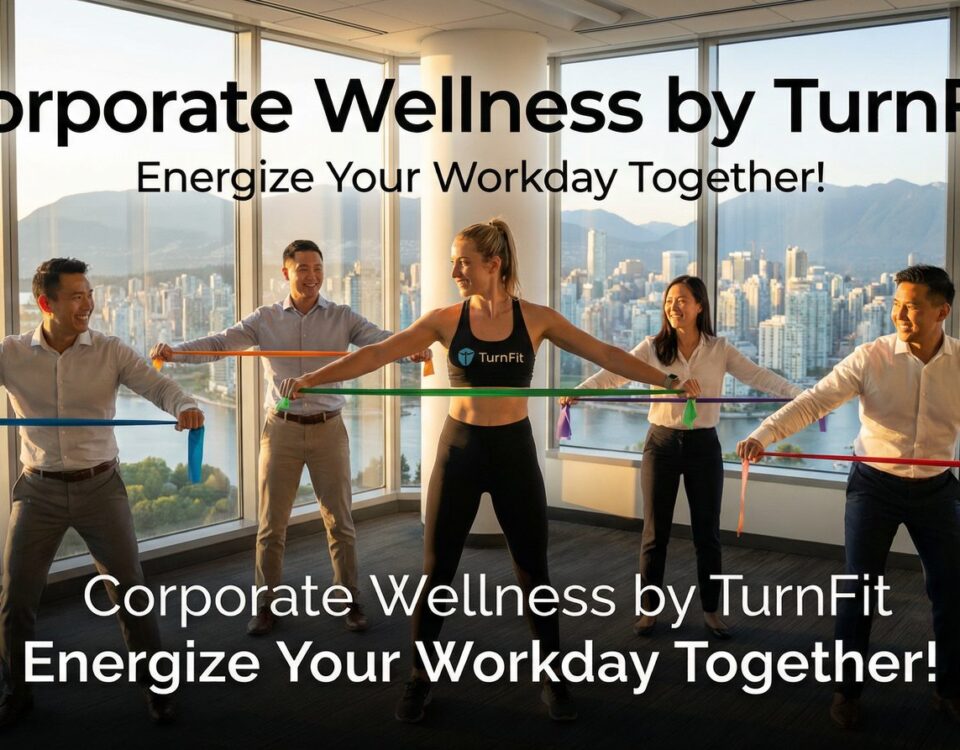
TurnFit is one of Vancouver’s most decorated personal training teams, with years of Top Choice Awards backed by real client results, corporate wellness partnerships, and powerful online coaching options for people who want serious change—not just another gym membership. Whether you are an individual, a busy executive, or an HR leader searching for “Vancouver personal trainer,” “corporate wellness Vancouver,” or “online personal trainer,” TurnFit is built to help you win back your team’s energy, confidence, and time.

Canadian workplace culture has always differed from its American counterpart—less obsessed with hustle, more focused on sustainable performance. Our approach to corporate wellness reflects this. After eight years of building workplace health programs for Vancouver companies, we’ve learned that effective corporate wellness isn’t about flashy gym memberships or token yoga classes. It’s about addressing the real problems your employees face every day.
Here’s what hundreds of corporate clients have taught us about what actually works.
What Our Vancouver Corporate Wellness Clients Have Taught Us
The most important lesson from our corporate wellness work is this: sustainable workplace health programs focus on solving specific problems for real people, not on creating impressive-sounding initiatives that look good in recruitment materials but don’t change anyone’s daily experience.
Your employees don’t need another generic wellness program. They need targeted help with the pain, fatigue, and stress they’re managing while trying to do their jobs well. They need trainers who communicate with their healthcare providers. They need programming that fits into their actual schedule rather than requiring them to carve out time they don’t have. They need a company that demonstrates through investment and follow-through that their wellbeing matters beyond PR statements.
This is what a Canadian approach to corporate wellness looks like—practical, integrated with healthcare, respectful of work-life boundaries, and focused on measurable improvements in the problems your team is actually facing.
When Corporate Wellness Doesn’t Work
We’ve also learned what causes corporate wellness programs to fail, regardless of budget or good intentions.
Programs fail when they’re positioned as a perk rather than a genuine investment in employee health. When participation is mandatory but the program isn’t tailored to actual needs. When there’s no mechanism for feedback or adjustment based on employee experience. When the program is designed around what leadership thinks employees need rather than what employees are actually dealing with. When HR treats it as a box-checking exercise rather than a meaningful component of workplace culture.
The programs that succeed are championed by leadership, designed around real employee feedback, flexible enough to adapt as needs change, and integrated with existing health and safety initiatives rather than operating in isolation.
The Healthcare Integration Model
One of the most effective elements of our corporate programs is the direct line of communication with healthcare providers. When employees know their trainer is coordinating with their physiotherapist or chiropractor, they trust the program more and engage more consistently.
This model also reduces the risk of training exacerbating existing injuries. Before we program loaded exercises for someone dealing with shoulder impingement, we confirm with their healthcare provider what movements are safe, what needs to be avoided, and what timeline we’re working within for progression.
This integration is distinctly Canadian. In the US fitness industry, trainers and healthcare providers often operate in silos or even view each other with suspicion. In Canada, collaboration is expected—and it produces better outcomes for the people we’re trying to help.
Common Canadian Workplace Issues

When organizations first reach out about corporate wellness programs, they usually mention productivity, morale, or absenteeism. But when we actually assess their teams, the issues are more specific and more solvable than generic “wellness.”
Desk workers are dealing with chronic neck and shoulder pain from poor workstation setup and hours of static posture. Mid-level managers are experiencing energy crashes by 2 PM because they’re running on stress hormones and inconsistent eating patterns. Remote workers have developed movement restrictions because they’ve spent two years sitting in suboptimal home office setups without the incidental movement that used to happen in an office environment.
These aren’t problems that get solved by offering a gym discount. They require targeted intervention—movement assessment, postural correction, education on recovery and stress management, and programming that fits into the reality of a working day.
What Makes Canadian Corporate Wellness Different
The Canadian model for workplace health has always been more integrated with healthcare than the American fitness-first approach. Our programs reflect this reality by working closely with the same healthcare providers your employees already see—physiotherapists, chiropractors, registered massage therapists, and occupational health specialists.
When someone in your organization is dealing with recurring back pain, we don’t just give them core exercises and hope for the best. We communicate with their physiotherapist to understand what’s been tried, what worked, what didn’t, and how our programming can complement their treatment rather than work against it. This integration is standard practice in Canadian fitness culture, not an exception.
We also operate within WorkSafeBC guidelines and Canadian occupational health standards, which means programs are designed around injury prevention and duty of care—not just performance optimization. Your HR team isn’t taking on additional liability risk when they bring us in.
The Sessions That Actually Change Things
Effective corporate wellness happens in the margins of the workday, not by asking employees to carve out another hour they don’t have.
The programs that produce measurable results focus on targeted interventions: personalized one-on-one or semi-private (two-on-one) training sessions of 40-50 minutes, scheduled 2-3 times per week. On non-training days, clients follow customized homework protocols designed for safe, independent execution—building confidence while maintaining accountability to their program. We complement this hands-on coaching with 20-minute mobility sessions that address common postural dysfunctions and lunch-and-learn workshops on managing energy and stress through movement and recovery strategies.

We’ve learned that participation rates matter less than whether the people who do participate actually experience relief from pain, improved energy, and better stress resilience. A program where 40% of employees show up and 90% of those people report tangible improvements beats a mandatory program with 90% attendance and minimal impact.
Mental Health Integration
Canadian workplace culture has become more sophisticated about mental health over the past five years, particularly post-pandemic. Effective corporate wellness programs now address the connection between physical stress, movement, and mental resilience—not as separate initiatives but as integrated components.
This doesn’t mean trainers trying to be therapists. It means teaching employees how movement, recovery, and nervous system regulation work together. How a 10-minute mobility session mid-afternoon can interrupt a stress response cycle. How strength training provides tangible feedback that reduces anxiety. How breathing patterns affect both physical tension and mental state.
The companies seeing the strongest results are those that position wellness programming as part of their broader mental health strategy, not as a separate “fitness” initiative that lives in a different category.
The Premium Price Question
Canadian companies often ask why effective corporate wellness costs more than generic gym memberships or online workout subscriptions. The answer is the same as in individual training: you’re not buying access to equipment or generic programming. You’re buying customized intervention that addresses your team’s specific problems.
A logistics company whose employees spend hours driving needs different programming than a tech startup where everyone sits at monitors. A restaurant group needs scheduling flexibility that a corporate law firm doesn’t. Construction companies need programs that account for physical labor. Healthcare organizations need trainers who understand shift work.
This customization, combined with healthcare provider integration and Canadian regulatory compliance, costs more than a template approach. But companies that measure outcomes rather than price per session consistently find the premium worthwhile.
Extended Health Benefits
Many Canadian companies don’t realize that corporate wellness programming can often be structured to qualify for reimbursement through extended health benefits or Health Spending Accounts. When employees can access personal training, mobility work, or movement assessments through their benefits rather than out-of-pocket, participation and engagement increase significantly.
We’ve worked with HR teams to structure programs that maximize this benefit, making premium programming accessible without requiring employees to choose between wellness and their budget. This is particularly effective in organizations where employees have coverage but aren’t using it because they don’t know what qualifies or how to access it.
Ready to Level Up?
If your organization is done with token wellness initiatives and ready to invest in programming that produces tangible improvements in employee health, energy, and resilience, we should talk. Book a consultation at TurnFit.ca or call +1 (604) 757-3708 to discuss how a customized corporate wellness program could work for your team’s specific needs and challenges.